
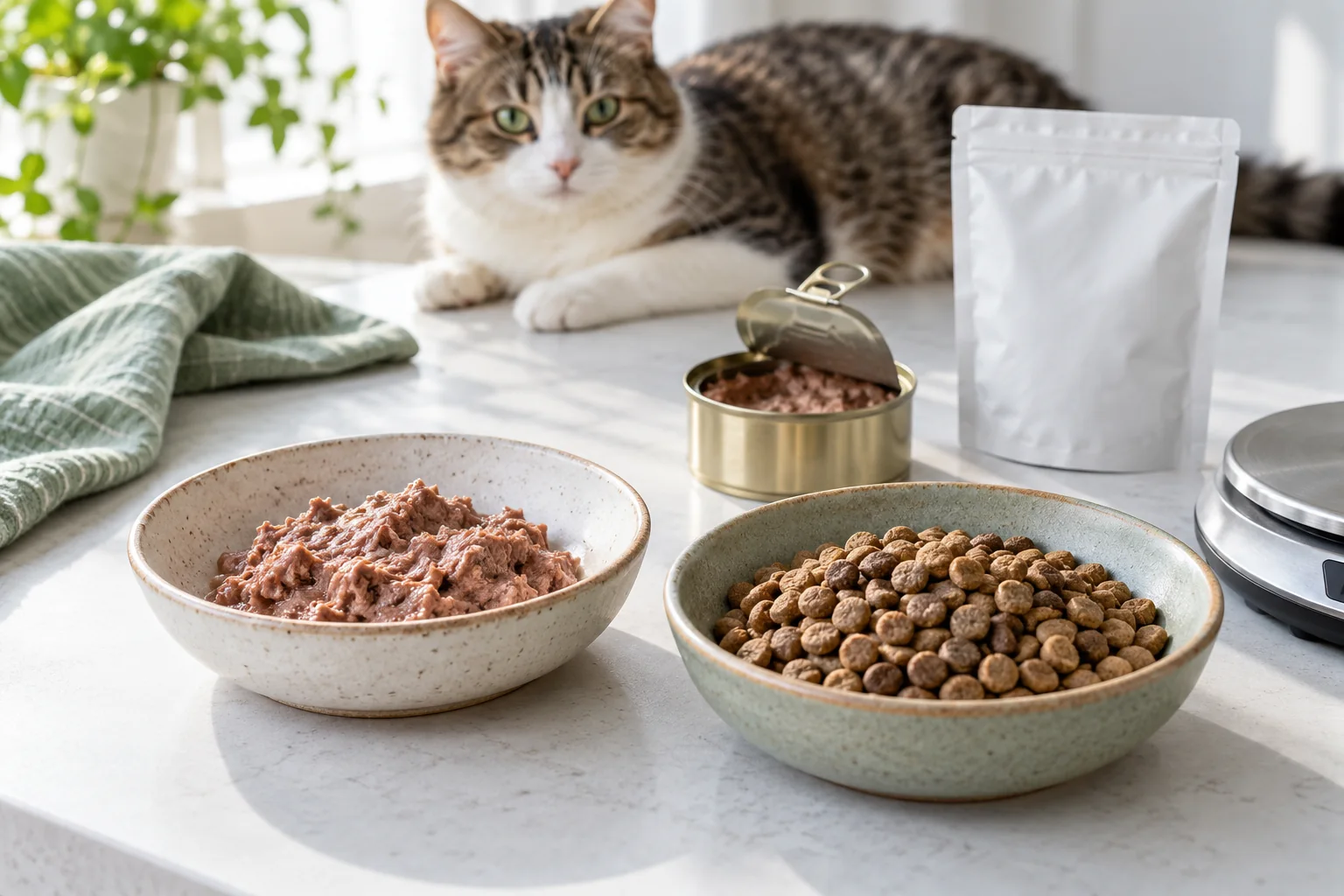
FROM LABEL TO BOWL
Build one day. Budget the rest.
Enter a daily calorie target you already use. Need a starting estimate? Open the cat calorie calculator in a new tab. This worksheet divides that target between foods; it does not set your cat’s calorie needs.
THE SAME CALORIE BUDGET
What changes when you change the mix?
Compare portions and food consumed over your budget period. Ratios are calorie shares, not nutrition rankings.
| Wet calorie share | Wet units / cat / day | Dry / cat / day | Food used cost | Try it |
|---|
These alternatives use the same food labels, treat allowance and calorie target. Incomplete labels or prices are shown as unavailable, never estimated from another brand.
“I FEED ONE CAN. HOW MUCH DRY FOOD?”
Subtract the wet calories first.
Suppose a cat’s existing target is 240 kcal/day, including 20 kcal of treats. That leaves 220 kcal for complete food. If one can supplies 100 kcal, the dry food must supply the remaining 120 kcal.
One can + 30 g dry
At 4,000 kcal/kg, dry food supplies 4 kcal per gram. Divide 120 by 4 to get 30 g of dry food, alongside the one can. Use “Start with daily cans / pouches” above to do this with your labels.
This is a worked arithmetic example, not a calorie recommendation. A different can or kibble changes the answer.
BEFORE YOU MEASURE A MEAL
Where are the calories on cat food labels?
Look for “Calorie Content,” “Metabolizable Energy” or “ME.” Copy the number and its unit together.
Wet food: check one container
“100 kcal per can” is the energy in one can. “100 kcal per 100 g” is an energy density. They only mean the same thing if that can contains exactly 100 g. Enter the net weight of a single can, pouch or tray so the calculator can also show grams.
Illustrative wet label
Enter 100, choose “One can / pouch / tray,” and enter 85 g. This is a fictional label example.
Dry food: kg is not a serving
“4,000 kcal/kg” means 4 kcal per gram. It does not mean a cat needs a kilogram. A food labeled 400 kcal/100 g has the same energy density. Use whichever unit your own packaging provides.
Illustrative dry label
If you only have kcal/cup, select cups. Grams per cup vary between foods; do not assume a universal cup weight.
Want to understand the rest of the label? Read how to read cat food labels, including calorie content and nutritional adequacy. For weighing small portions, see using a kitchen scale for cat food.
Return to wet-food fields ↑ / Return to dry-food fields ↑
FOOD COST ≠ TODAY’S RECEIPT
How much will mixed feeding cost per month?
The calculator shows both the value of food used and what you would pay to buy enough whole packs.
Food consumed during the period
Using the fictional labels above, a 50% wet / 50% dry calorie split uses 1.1 cans and 27.5 g of dry food each day. If a 12-pack costs $18 and a 2 kg dry bag costs $20, the food used costs about $1.93/day, or $57.75 over 30 days for one cat.
Amounts are calculated at full precision before money is rounded. Multiplying the displayed rounded daily price can therefore differ by a few cents.
Whole packs you need to buy
The same 30-day plan uses 33 cans and 825 g of kibble. Starting with no food in stock, you would buy three 12-packs and one 2 kg bag: $74 at checkout. Three cans and 1,175 g of dry food remain for later.
The model assumes usable leftovers carry forward. Food discarded, delivery charges, tax and treat purchases are not included. Choose your actual period; “30 days” is a budget window, not every calendar month.
OPEN CALCULATION METHOD
How does the mixed feeding calculator work?
All portions come from your calorie target and food labels. No average brand values, breed multipliers or price database are substituted.
Convert calories into food
Food budget = total target − treat calories
Wet kcal = food budget × wet percentage ÷ 100
Wet units = wet kcal ÷ kcal per unit
Dry kcal = food budget − wet kcal
Dry grams = dry kcal ÷ kcal per gram
For fixed wet units, wet calories equal units × kcal per unit. Dry food fills the remainder. If the chosen wet amount already exceeds the food budget, the calculator asks you to reduce it instead of producing a negative dry portion.
When using cups, dry cups = dry kcal ÷ kcal per cup. Grams and bag costs need that food’s grams per cup. The calculator will still give cup portions when that conversion is unknown.
Convert portions into purchases
Wet cost/day = daily units × pack price ÷ units per pack
Dry cost/day = daily grams × bag price ÷ bag grams
Food used cost = combined daily cost × days × cats
Packs to buy = round required food ÷ pack size UP to the next whole pack
The “cats” setting assumes each cat follows the exact same individual plan. It scales household shopping totals and package duration; displayed daily portions remain per cat. Use a separate worksheet when cats’ needs or foods differ.
Weight conversion: 1 oz = 28.349523125 g; 1 lb = 453.59237 g. Costs use full precision; displayed grams, units and money are rounded. Bag duration describes quantity used, not freshness or safe storage time.
What this worksheet can—and cannot—tell you
Use foods appropriate for your cat’s life stage and nutritional needs. In the US, the nutritional adequacy statement explains whether a food is “complete and balanced”; treats, toppers and complementary products may not provide a complete diet. [1] Matching calories alone does not verify nutrient balance or make a prescription diet interchangeable.
WSAVA advises treats supply no more than 10% of a cat’s daily calories. The tool flags a higher allowance, but 10% is a ceiling, not a treat target or a guarantee of nutritional suitability. [2] Use a veterinary plan for growth, pregnancy, weight loss or health conditions, and discuss changes to therapeutic diets with the treating team.
Inputs remain in the current page tab; the tool does not store a feeding profile. Site-wide analytics follow our privacy policy.
MAKE THE NUMBERS USEFUL
Build a mixed feeding routine that fits.
Use the guides alongside your calculations to understand feeding choices and check how the plan is working.
COMMON MIXED-FEEDING QUESTIONS
Wet, dry and the questions between.
How much wet and dry food should I feed my cat?
If I feed one can of wet food, how much dry food should I add?
Is a 50/50 wet and dry mix equal weights?
Can I mix different brands of wet and dry cat food?
Why can I see cups but not grams or dry-food cost?
Why is the shopping total higher than the food cost?
Can I use this for two or more cats?
Do wet and dry food have to be mixed in the same bowl?
Sources & food-label guidance
- FDA: “Complete and Balanced” Pet Food — nutritional adequacy statements and foods intended as a sole diet.
- WSAVA Nutrition Committee: Feeding treats to your cat — treat calorie limits and individual nutritional needs.
- Purina: How Much Wet Food Should You Feed a Cat? — adjusting dry food when adding wet food and following storage guidance.
The published calculation formulas are ordinary energy, mass and price arithmetic. These references support the nutrition context; they do not validate a specific calorie target or recommend a mixing ratio.
 EN
 DE
 ES
 PT