
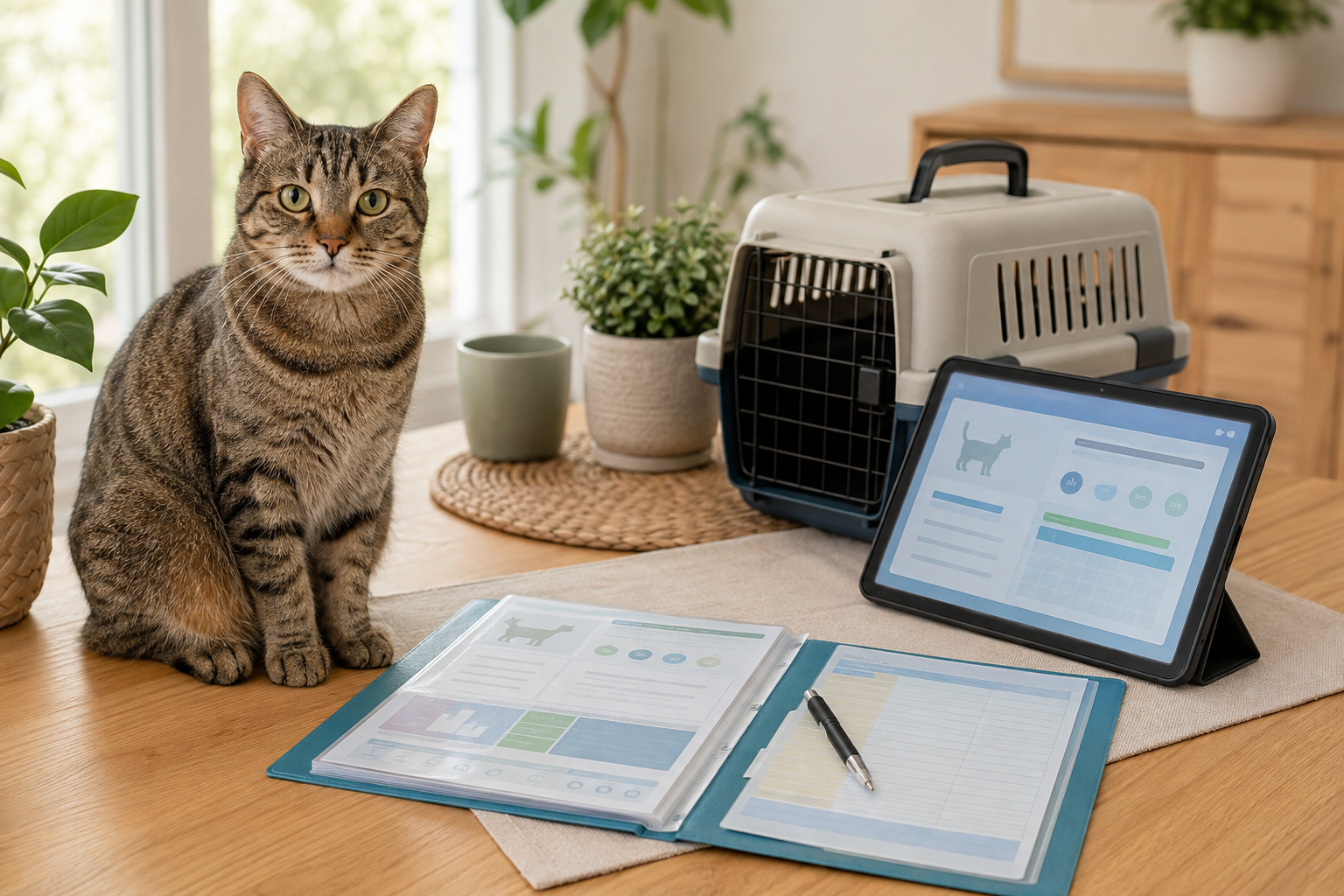
Share cat vaccine records with a new vet before the first appointment by sending the full record, not just a reminder card: vaccine names, dates given, next due dates, clinic names, rabies certificates, product details when available, and any reaction notes.
Changing clinics is already a lot. You may have a portal login from one hospital, a paper rabies certificate from another, adoption paperwork in a folder, and a calendar reminder that says "shots due" without proof of what was given. The new veterinary team needs the clearest version of that history so they can decide what is due, what can wait, and what must be verified.
If your records are scattered, start with SnuggleSouls' guide to organizing cat vaccine records, then use this handoff guide to share those records with the next clinic.
Table of Contents
- Why does a new vet need your cat's vaccine records?
- What should you send before the first appointment?
- How should you share records by portal, PDF, email, or fax?
- What should you ask the old clinic for?
- What if vaccine dates are missing or confusing?
- How should you handle reaction history?
- What should you bring to the appointment?
- Conclusion: Make the handoff clear before vaccine decisions are made
- Frequently Asked Questions
- References
Why does a new vet need your cat's vaccine records?
A new vet needs vaccine records because vaccine decisions depend on your cat's actual history, not a guess from memory. Feline vaccination guidelines emphasize individualized planning, risk assessment, lifestyle, exposure, and appropriate intervals 3. Without records, the new clinic may have to treat part of the history as unknown.
That does not mean your cat will automatically need every vaccine again. It means the veterinary team needs enough proof to decide safely. A complete vaccine handoff can reduce unnecessary duplication, avoid gaps before boarding or travel, and make reaction history visible before another injection is planned.
Records also help the clinic understand context. A kitten series from a rescue, a rabies certificate from a low-cost clinic, a FeLV vaccine given before adoption, or a vaccine reaction noted in an old chart may all change the conversation.
What should you send before the first appointment?
Send the new clinic a complete vaccine packet before the first appointment so the staff has time to attach it to your cat's chart. The most useful packet includes both proof documents and a short summary.

Include these items when you have them:
| Record item | Why it helps the new vet | Best format |
|---|---|---|
| Rabies certificate | Rabies rules can be legal as well as medical | PDF or clear scan |
| FVRCP record | Shows panleukopenia, calicivirus, and herpesvirus history | Visit summary or vaccine certificate |
| FeLV record | Helps risk-based adult planning and kitten history | Full vaccine record |
| Due-date reminder | Useful, but not enough by itself | Screenshot plus source document |
| Product, lot, route, and site | Helps with record quality and adverse-event follow-up | Full medical record |
| Reaction notes | May affect future vaccine planning | Clinic note plus your timeline |
| Shelter or rescue paperwork | Often contains early vaccines and tests | Original PDF or scan |
| Previous clinic contact | Lets the new clinic verify unclear details | Phone, email, hospital name |
UC Davis veterinary guidance says vaccine records should document the product, expiration date, lot number, route, and injection location for vaccines given 5. You may not have every detail at home, but the clinic record may include more than your receipt.
If the first visit may include vaccines, also review how to prepare a cat for vaccines so carrier setup, health notes, and aftercare questions are ready too.
How should you share records by portal, PDF, email, or fax?
Use whatever method the new clinic actually accepts, then make the files easy to identify. A portal upload is convenient, but an email, fax, or direct clinic-to-clinic transfer may be better if the portal is not set up yet.
For portal uploads, combine related pages into one PDF when possible. Name the file clearly, such as Milo-vaccine-records-2024-2026.pdf. If the portal has a message box, write one short note: "New patient vaccine records attached. Please confirm whether these are enough before the first appointment."
For email, ask whether the clinic wants records sent to a general inbox, medical-records inbox, or a specific new-client address. Put your cat's name, your last name, and appointment date in the subject line. Do not paste sensitive details into a public form if the clinic gives you a secure option.
For fax, ask for the correct number and whether the old clinic should fax directly. Fax is still common in medical-record transfers, and direct clinic-to-clinic sharing can avoid blurry phone photos.
After sending, call or message the new clinic to confirm receipt. "Sent" is not the same as "attached to the chart." Ask whether the record is readable and whether anything is missing before the appointment.
What should you ask the old clinic for?
Ask the old clinic for the complete vaccine record and any medical-record summary the new clinic needs for continuity of care. The AVMA's veterinary ethics principles say veterinarians should provide copies or summaries of medical records when a client requests them, while confidentiality and client permission still matter 1.
Keep your request simple and specific:
- Give your name, cat's name, and any previous account number.
- State that you are transferring care to a new veterinary clinic.
- Ask for the full vaccine history, rabies certificate, visit summaries, lab results tied to vaccine decisions, and reaction notes.
- Give the new clinic's name, email, portal instructions, or fax number.
- Ask whether you need to sign a release form.
Rules and timelines vary by location. For example, the California Veterinary Medical Board tells consumers that a written request is recommended when asking for a copy of pet medical records, and that there may be a duplication cost 2. Your state, province, or country may have different rules, so follow the old clinic's release process and ask your local veterinary board if a record request stalls.
If your cat is new to you, contact the shelter, rescue, breeder, mobile vaccine clinic, or adoption agency too. Our new cat first vet visit guide can help you gather adoption papers, current symptoms, and first-appointment questions in one place.
What if vaccine dates are missing or confusing?
If vaccine dates are missing, do not fill them in from memory or estimate them on a form. Label the record as incomplete, tell the new veterinarian what you know, and ask the previous provider for the full chart.

Missing records happen for ordinary reasons. A cat may have been adopted, rehomed, vaccinated at a community clinic, treated during an emergency visit, or moved between households. The safest response is transparency.
Use this triage table:
| What you have | What it does and does not prove | What to do next |
|---|---|---|
| Reminder card only | Suggests a due date, but may not prove what was given | Ask for the actual vaccine record |
| Receipt saying "annual shots" | Shows payment, not complete medical detail | Request itemized vaccine names |
| Rabies tag | May help identify a certificate, but is not the certificate | Ask the issuing clinic or local authority |
| Adoption paperwork with dates | Useful, but may need product or booster context | Send it and ask whether more is needed |
| Handwritten note | Better than nothing, but may be hard to verify | Share it as unconfirmed history |
WSAVA's 2024 guidance defines core vaccine principles and also stresses that vaccines should be used only as frequently as necessary for protection 4. That is why your veterinarian should decide what to do with missing dates. Depending on your cat's age, health, law, risk, and the quality of the record, the clinic may recommend verification, a booster, a restarted series, delayed vaccination, or another plan.
For background on which vaccines are usually core or risk-based, use the SnuggleSouls cat vaccine schedule guide before the appointment. Bring questions, not assumptions.
How should you handle reaction history?
Share reaction history even if the reaction seemed mild. A new vet needs to know whether your cat was sleepy for one evening, had soreness near an injection site, developed facial swelling, vomited repeatedly, collapsed, or needed urgent care.
Write the timeline in plain language:
- Vaccine date and clinic, if known
- Which vaccines were given, if known
- How soon signs started
- What signs you saw
- Whether your cat ate, drank, hid, vomited, or breathed normally
- Whether a lump, swelling, hives, pain, or fever was noted
- What the old clinic advised
- How long recovery took
UC Davis notes that previous vaccination reactions can affect future vaccine recommendations 5. That does not mean your cat can never be vaccinated again. It means the veterinary team may adjust timing, vaccine choices, observation, spacing, or risk-benefit discussion for your individual cat.
Call a veterinarian urgently if your cat has trouble breathing, facial swelling, collapse, repeated vomiting, severe weakness, seizures, pale gums, or rapid decline after any vaccine. For more detail, use SnuggleSouls' cat vaccine side effects guide and contact your clinic instead of trying to manage a serious reaction at home.
What should you bring to the appointment?
Bring the original papers if you have them, plus a printed one-page summary and a digital backup. Even if the clinic already has the portal upload, a paper copy helps if the file is attached to the wrong profile, unreadable, or missing from the chart.
Your one-page summary can list:
- Cat's current name and any previous name
- Microchip number, if known
- Previous clinic, shelter, rescue, or breeder
- Vaccine names and dates
- Next due dates listed on records
- Reaction history or "no known reaction"
- Current medications and health conditions
- Indoor, outdoor, boarding, travel, foster, or multi-cat exposure
- Questions you want answered before vaccines are given
Do not pressure the appointment into a same-day vaccine decision if the record is unclear or your cat is unwell. AAHA/AAFP guidance treats vaccine planning as individualized and tied to the cat's life stage, lifestyle, environment, travel, housing, and exposure risk 3. A careful new-patient visit may include reviewing records first and scheduling vaccines later.
If your cat is sick, not eating, breathing abnormally, repeatedly vomiting, having severe diarrhea, showing neurologic signs, or rapidly declining, call the clinic before the visit and ask whether the appointment should be changed from routine vaccines to medical evaluation.
Conclusion: Make the handoff clear before vaccine decisions are made
A strong vaccine-record handoff is simple: request the complete record, send it before the first appointment, confirm the new clinic received it, label any missing dates honestly, and bring a backup copy. The goal is not perfect paperwork. The goal is safer decisions for your cat.
Your new veterinarian should decide what is due next. Your job is to make the history as clear as possible: what was given, when, where, by whom, what is missing, and how your cat reacted. For more preventive-care support, keep browsing SnuggleSouls cat health guides.
Frequently Asked Questions
Can I just show my new vet a photo of my cat's vaccine record?
A clear photo can help, but a PDF or clinic-to-clinic record is usually easier to read and attach to the chart. If the photo is all you have, send it anyway and ask whether the clinic needs the original certificate or a full medical record.
Should I send vaccine records before or after booking the appointment?
Send them as soon as the appointment is booked, especially if the visit may include vaccines, boarding paperwork, travel forms, or a health certificate discussion. Early sharing gives the clinic time to spot missing pages.
What if my previous vet will not send records directly to me?
Ask whether they can send the record directly to the new clinic after you sign a release. Rules vary by location, and some clinics may provide a summary instead of original chart documents, so follow the clinic's process and contact your local veterinary board if a valid request is not answered.
Is a rabies tag enough for a new vet?
A rabies tag is useful, but it may not be enough. A rabies certificate or clinic record usually gives stronger proof because it can include the vaccine date, product duration, veterinarian or clinic, and next due date.
What if my adopted cat has no vaccine history?
Tell the new veterinarian that the vaccine history is unknown and share any shelter, rescue, or rehoming paperwork you do have. Your vet can build a plan based on age, health, risk, local rabies rules, and current feline vaccination guidance.
Can a new vet give vaccines if records are missing?
Sometimes, but the decision belongs to the veterinarian after reviewing your cat's health, age, risk, and available paperwork. Do not guess dates to make the chart look complete.
References
[1] AVMA. (2026). Principles of Veterinary Medical Ethics of the AVMA. URL
[2] California Veterinary Medical Board. (2026). Frequently Asked Questions. URL
[3] AAHA/AAFP. (2020). 2020 AAHA/AAFP Feline Vaccination Guidelines. URL
[4] WSAVA. (2024). 2024 Guidelines for the Vaccination of Dogs and Cats. URL
[5] UC Davis School of Veterinary Medicine. (2025). Vaccination Guidelines for Dogs and Cats. URL
 EN
EN DE
DE ES
ES PT
PT