
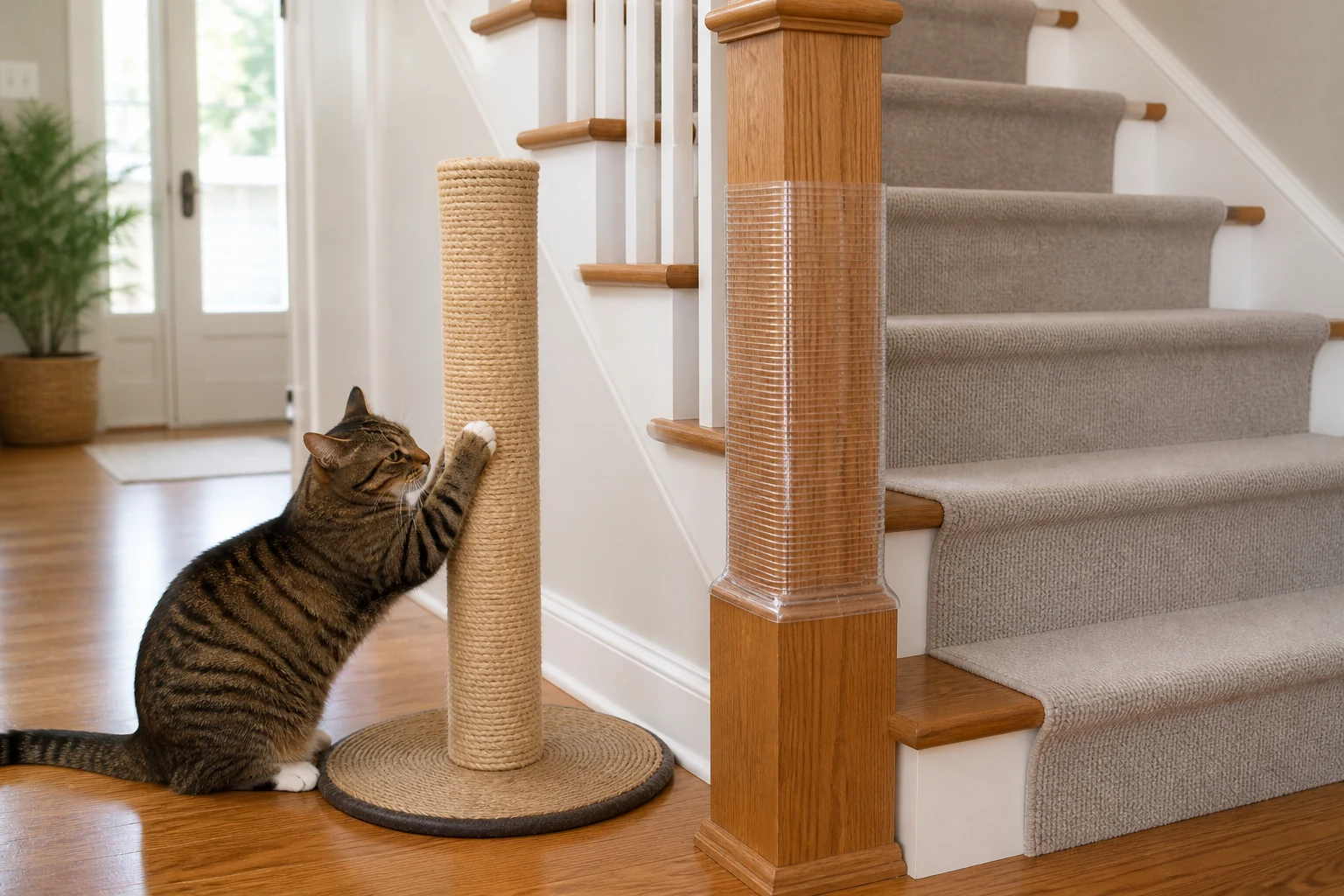
To protect stair banisters from cat scratching, cover the marked wood with a secure, route-safe barrier and place a better scratching target beside the same stair path. The goal is not to stop scratching altogether. It is to protect the banister while keeping your cat's normal climbing, stretching, and escape routes easy to use.
Banisters, newel posts, and stair rails can feel perfect to a cat: tall, solid, visible, and placed on a busy route through the home. A cat may rake the lower newel post after waking, hook claws into a painted spindle while turning a corner, or scratch the same handrail base when people come home. That does not mean the cat is being spiteful. Scratching helps cats maintain claws, stretch, and leave scent and visual marks 1.
This guide focuses on banister-specific fixes: choosing safe barriers, adding legal scratchers, protecting open walking paths, and knowing when sudden scratching deserves a deeper look.
Table of Contents
- Why do cats scratch stair banisters and newel posts?
- How can you tell whether the banister or the route is the real target?
- What banister protection is safe for cats and people?
- Where should you put scratchers so stair routes stay open?
- How do you train your cat away from the banister?
- What should you avoid on stair rails and posts?
- When is banister scratching a stress or health clue?
- Conclusion:
- Frequently Asked Questions
- References
Why do cats scratch stair banisters and newel posts?
Cats scratch stair banisters because they are stable vertical objects in socially important places. Newel posts and lower rails are often beside doors, hallways, landings, windows, and resting spots, which makes them valuable marking locations as well as convenient stretching surfaces.
FelineVMA describes scratching as a normal behavior that supports claw health, scent deposition, and visual communication 2. A banister can match those needs better than a weak post hidden in a corner. It does not move when the cat pulls down, it smells like the household, and it sits where the cat already travels.
Banister scratching often overlaps with stair scratching, but the fix is slightly different. If the cat is targeting carpeted treads, SnuggleSouls' guide to protect carpeted stairs from cat scratching is the better starting point. If the damage is on the rail, spindle, post, or trim, focus on vertical protection and scratcher placement beside the route.
| Scratched area | What it may mean | Best first fix |
|---|---|---|
| Lower newel post | High-value route marking near the landing | Put a tall, stable scratcher beside the post |
| Painted spindle | Narrow vertical grip or turning-point scratch | Protect the spindle and add a nearby vertical surface |
| Handrail base | Stretching or marking where people move | Add a tall post close by without blocking the handrail |
| Side trim near stairs | Carpet, wall, and wood textures all appeal | Cover the old texture and offer sisal or cardboard |
| Sudden heavy damage | Stress, conflict, boredom, or discomfort may be involved | Check household changes and watch for health signs |
How can you tell whether the banister or the route is the real target?
Look at the pattern before buying products. If the claw marks are mostly on one newel post, your cat may want a firm vertical marker. If the scratches run along lower stair edges, the carpet or tread texture may be the stronger draw. If the marks appear on several route corners, your cat may be communicating ownership of a pathway.
Start with a simple inspection:
- Which exact surface has the deepest marks: wood, paint, carpet, trim, or wall?
- Does the scratching happen after sleep, play, meals, door activity, or another cat passing through?
- Is the current scratching post tall, sturdy, and close to the stair route?
- Does one cat block another cat on the stairs or landing?
- Are there loose rugs, baby gates, storage bins, or furniture pieces narrowing the route?
The ASPCA recommends teaching cats where and what to scratch by providing attractive legal surfaces and making the wrong target less rewarding 3. That works best when the replacement target matches the original target. A cat scratching a tall newel post usually needs a tall post or wall-mounted board, not only a flat cardboard pad across the room.
If the cat also claws rugs or stair carpet, review how to stop cats scratching carpet so you can separate texture preference from banister marking. The more specific your diagnosis, the less likely you are to create a maze of barriers that frustrates both people and cats.
What banister protection is safe for cats and people?
Safe banister protection is smooth, secure, removable when needed, and limited to the damaged area. It should protect the surface without creating sharp edges, sticky paw traps, visual confusion on stairs, or anything that interferes with handrail use.
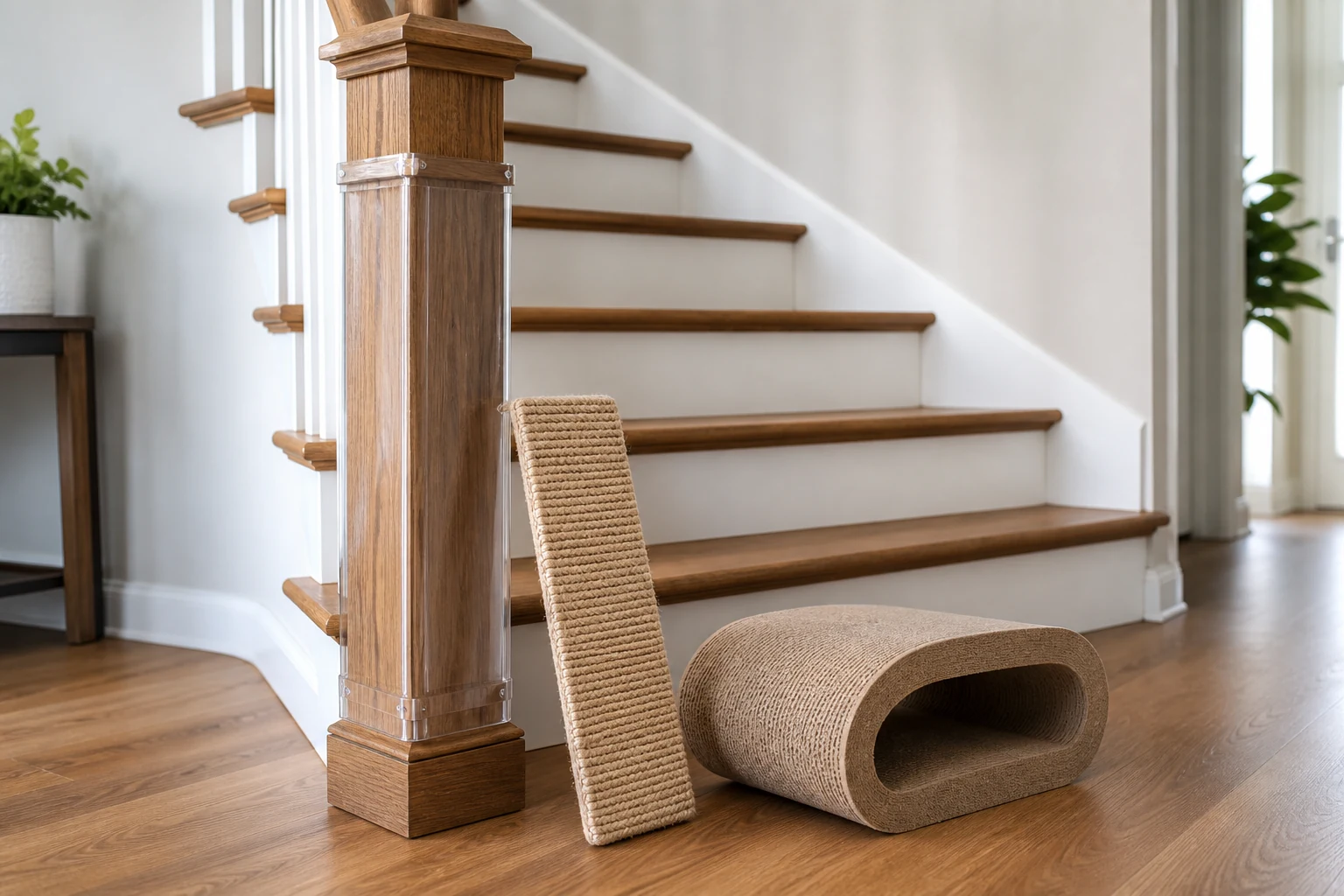
Banister protection works best when the barrier is secure, removable, and paired with a more satisfying legal scratching surface nearby.
Good options often include:
- Clear removable furniture or post protectors that wrap only the lower marked section.
- Smooth temporary panels attached firmly to a newel post, following the product directions.
- Sisal or jute wrap only if it is deliberately offered as a legal scratching surface and does not loosen.
- A freestanding scratcher placed beside the post instead of covering the post itself.
- A professional finish repair after the new scratching habit is stable.
Avoid anything that curls, slides, sheds fibers, or blocks a person's grip on the handrail. Do not wrap a full handrail with slippery material. Do not place adhesive tape on walking surfaces. If you rent, test removable products cautiously and check lease rules before using adhesive-backed barriers on finished wood.
Think of this as part of cat-proofing your home, not just furniture protection. Stairways are shared safety zones. A fix that saves the wood but creates a trip hazard is not a good fix.
| Protection choice | Useful when | Watch-outs |
|---|---|---|
| Clear post guard | The lower newel post is the main target | Must sit flat and avoid sharp corners |
| Temporary smooth panel | Painted trim or one side of a post is damaged | Check finish compatibility before applying |
| Sisal wrap on a separate board | Cat wants a vertical scratching texture | Secure it to a safe spot beside the route, not on the handrail |
| Freestanding tall post | Cat wants a full-body stretch | Needs a heavy base and enough landing space |
| Cardboard scratcher on landing | Cat also scratches flat carpet nearby | Keep it outside the walking path |
Where should you put scratchers so stair routes stay open?
Put the first legal scratching target beside the scratched banister, not on the stairs. It should be close enough to compete with the old target and far enough from the stair tread, handrail, and landing turn that people and cats can pass safely.
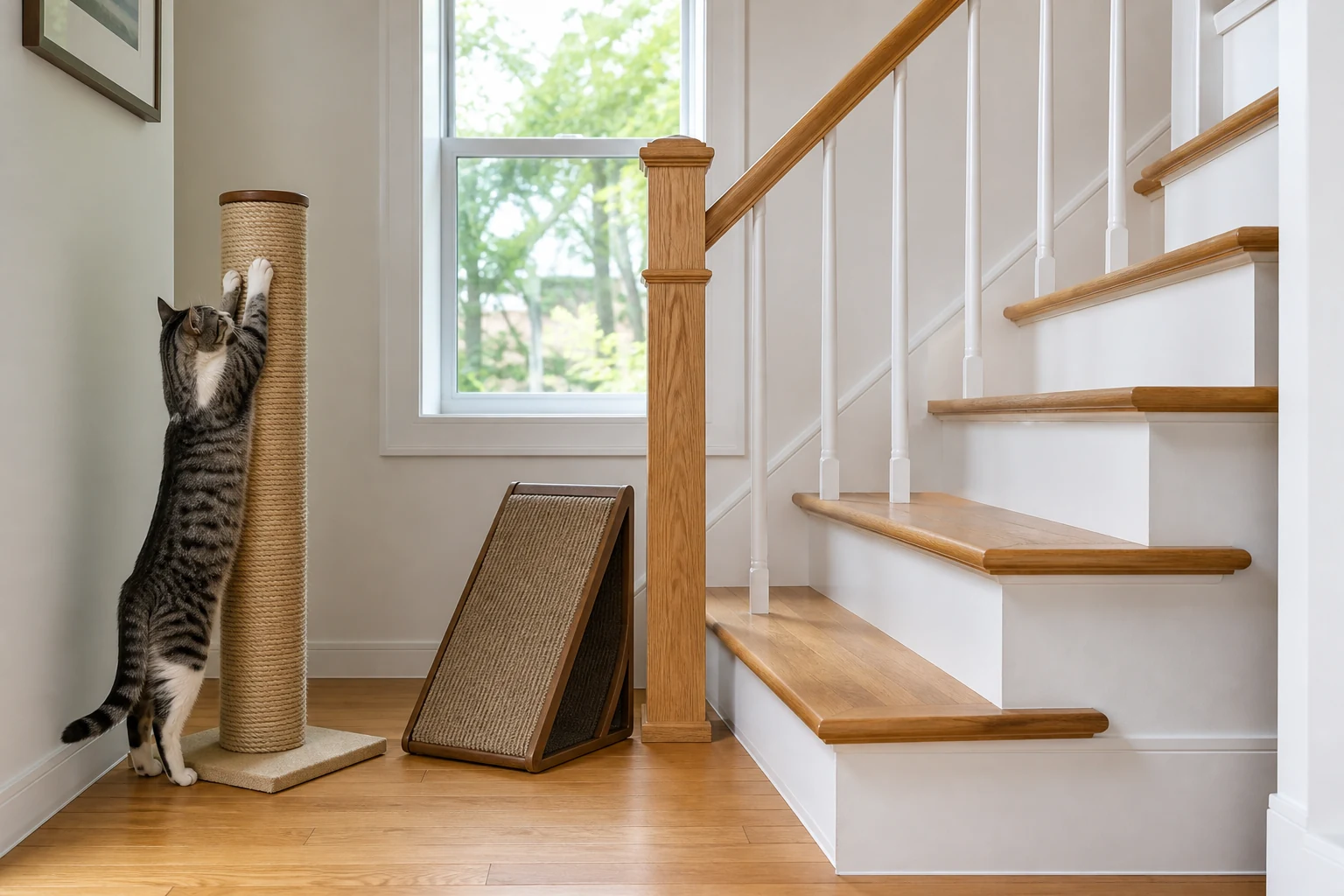
Keep scratchers close to the marked banister, but leave the stair treads, handrail access, and landing route open.
For most homes, start with one of these placements:
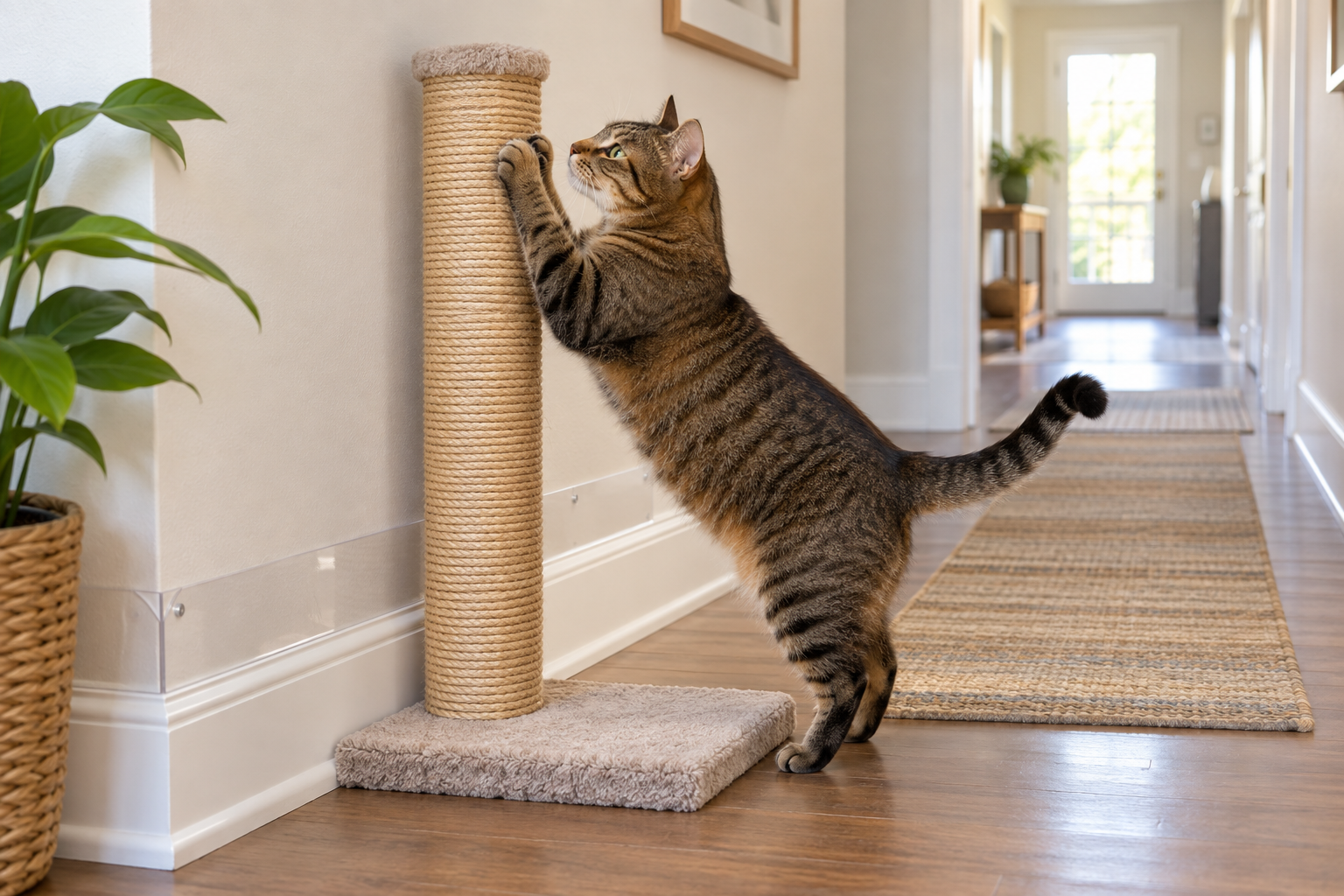
- A tall sisal post on the bottom landing, parallel to the wall.
- A wall-mounted scratch board beside the newel post, if it can be installed securely.
- An angled scratcher tucked beside the stair opening, not across it.
- A horizontal scratcher on a wide landing if your cat prefers flat surfaces.
- A second scratcher near the top landing if the upstairs route is also marked.
International Cat Care notes that scratching posts should be placed near areas where the cat already spends time or scratches, and multi-cat homes often need multiple scratching sites 4. That is especially true around stairways because routes can carry social tension. A confident cat may scratch the visible post as a normal mark; a worried cat may scratch because the route feels contested or too narrow.
If you need help choosing height, base weight, and material, use SnuggleSouls' guide to the best scratching posts for cats. Around stairs, stability is non-negotiable. If a post tips toward the steps when the cat pulls on it, move it or replace it.
How do you train your cat away from the banister?
Training should make the legal scratcher obvious and rewarding while the protected banister becomes boring. Do not punish your cat for choosing the banister. Punishment can increase fear and may teach the cat to scratch when you are not present instead of teaching a new behavior.
Use this sequence for two to four weeks:
- Place the new scratcher beside the marked banister before covering the old damage.
- Add a secure barrier to the scratched wood or painted surface.
- Use a wand toy so your cat lands paws near the legal scratcher.
- Reward sniffing, stretching, or scratching with praise, play, or a small treat.
- Keep the setup consistent until the cat uses the scratcher without prompting.
- Move the scratcher only a few inches at a time if you need a tidier final location.
The Oregon Veterinary Medical Association advises giving cats permitted scratching items and encouraging their use with rewards, catnip, and play near the surface 5. That is exactly what you want at a stair route: make the right choice easier than the old one.
Nail care can reduce damage while the habit changes, but it does not replace scratching. If claws snag in wood grooves or carpet loops, learn how to trim your cat's nails safely or ask your veterinary team or groomer for help. Keep sessions short and stop before struggling begins.
If your cat scratches after running games or evening zoomies, end a daily play routine beside the new post. Many cats naturally scratch after excitement, stretching, or waking, so the end of play is a useful moment to reward the legal surface.
What should you avoid on stair rails and posts?
Avoid any fix that makes the stairway harder to use. Banisters are not ordinary furniture. People need reliable hand contact, cats need clear routes, and everyone needs predictable footing.
Skip these common mistakes:
- Loose carpet scraps or mats on stair treads.
- Tape, foil, or plastic placed where people step.
- Slippery wrap on the handrail people hold.
- Hanging toys from spindles where they can tangle or startle a cat.
- Citrus oils or strong scents applied where a cat must pass.
- Wobbly posts that can fall toward the stairs.
- Blocking the stair route so one cat can trap another.
Strong smells and stressful surprises can make some cats more anxious, not calmer. FelineVMA emphasizes that cats need familiar, safe environments with resources such as scratching surfaces, resting spaces, hiding areas, and play opportunities placed in appropriate locations 2. A stairway fix should support that sense of control.
This matters even more for kittens, seniors, newly adopted cats, and cats with mobility concerns. If the stair route itself is new or intimidating, read how to help a new cat explore stairs safely before adding scratchers, barriers, or gates.
When is banister scratching a stress or health clue?
Most banister scratching is normal behavior in the wrong place. Still, a sudden change deserves attention, especially if it appears with other behavior or health signs.
Look deeper if you notice:
- A cat who never used the banister starts scratching it intensely.
- Scratching increases after moving, renovations, visitors, or a new pet.
- One cat waits on the stairs and blocks another cat's route.
- Your cat scratches while hiding more, eating less, or avoiding normal rooms.
- Your cat hesitates on stairs, limps, misses jumps, or seems painful.
- Claws are broken, overgrown, bleeding, or curling toward the paw pad.
- Scratching appears with litter box changes, aggression, or vocal distress.
Contact your veterinarian if scratching comes with pain signs, mobility changes, damaged claws, appetite change, or a rapid behavior shift. For urgent symptoms such as breathing trouble, collapse, seizures, suspected poisoning, blocked urination, severe trauma, repeated vomiting, or rapid decline, seek emergency veterinary care.
A scratcher can protect a banister, but it cannot solve pain, illness, serious fear, or resource conflict by itself. If the behavior keeps escalating despite good barriers and better scratchers, ask your veterinarian or a qualified feline behavior professional for help.
Conclusion:
The best way to protect stair banisters from cat scratching is to redirect the behavior at the exact route where it happens. Cover the damaged post or rail safely, put a stable legal scratcher beside the landing, reward the new choice, and keep the stairs easy for people and cats to use.
Once the banister is no longer the best target, keep the setup in place long enough for the new habit to feel normal. Scratching, play, nail care, safe routes, and household stress all connect, and SnuggleSouls' Daily Care guides can help you keep improving the whole home without making the stairway harder to navigate.
Frequently Asked Questions
Can I wrap sisal rope around my stair banister for my cat?
Only do this if the wrapped area is not a handrail people need to grip and the rope is secured so it cannot loosen. In many homes, a separate sisal board or tall scratcher beside the newel post is safer than turning the actual banister into a scratching surface.
Is double-sided tape safe on a stair banister?
It may be useful on a vertical section if the product is pet-safe and compatible with the finish, but do not put sticky tape on stair treads or places where paws may become stuck. Test a small hidden area first and pair any deterrent with a nearby legal scratcher.
Why does my cat scratch the newel post instead of the scratching post?
The newel post may be taller, sturdier, closer to a route, or more socially important than the scratching post. Move a taller, heavier scratcher beside the post and reward your cat for using it before trying to move it elsewhere.
Should I block my cat from using the stairs to protect the banister?
Use temporary access control only if you must repair damage or prevent immediate safety problems. Blocking a normal route can create stress, especially in multi-cat homes, so the longer-term fix should be protection plus redirection, not permanent route removal.
Can nail caps protect stair banisters?
Nail caps can reduce surface damage for some cats, but they need correct sizing, regular replacement, and a cat who tolerates paw handling. They do not remove the need for good scratching surfaces, and they are not right for every cat.
When should I call a vet about banister scratching?
Call your vet if the scratching is sudden, intense, paired with limping or stair hesitation, or connected to damaged claws, appetite change, hiding, litter box issues, or rapid behavior change. The scratching may be a visible clue that your cat is uncomfortable or stressed.
References
[1] University of California, Davis School of Veterinary Medicine. (2019). Inappropriate Scratching in Cats. URL
[2] FelineVMA. (2026). Setting Up the Environment for Success. URL
[3] ASPCA. (n.d.). Destructive Scratching. URL
[4] International Cat Care. (2025). Scratching on furniture and carpets. URL
[5] Oregon Veterinary Medical Association. (2023). Cat Behavior: Scratching. URL







 EN
EN DE
DE ES
ES PT
PT