
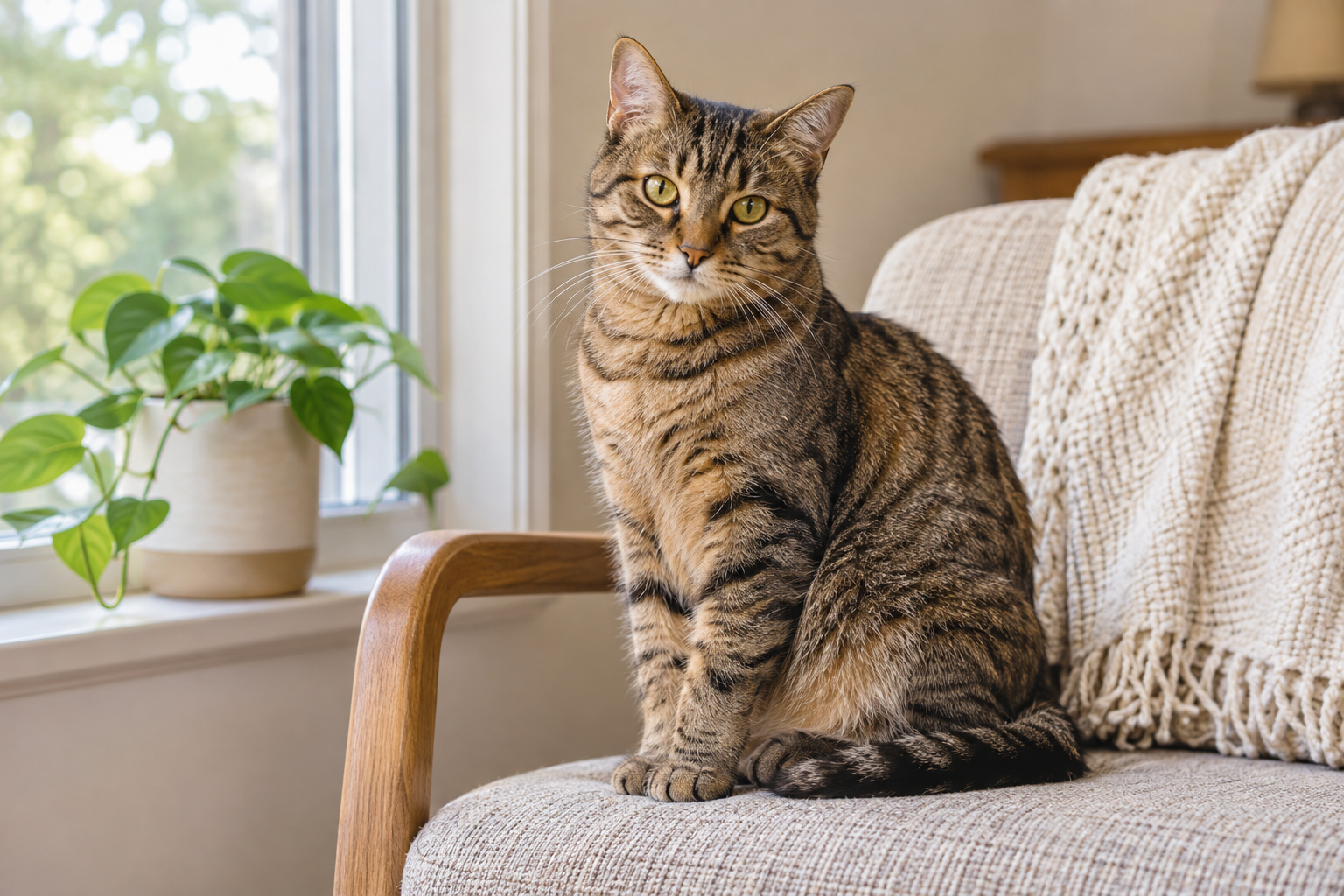
A domestic short-haired cat (also called “domestic shorthair” or DSH) is a short-coated cat with mixed, unknown, or undocumented ancestry—not one standardized pedigree breed. A photo can describe visible coat colors and patterns, but it cannot verify registered lineage. Use “Domestic Shorthair” as a practical coat-and-ancestry description, not a pedigree claim. 1 2
That distinction matters because breed names, coat length, and markings answer separate questions. A brown mackerel tabby can be a Domestic Shorthair; “tabby” describes the striped pattern, while “Domestic Shorthair” describes the short coat and unverified background.
Table of Contents
- What does “domestic short-haired cat” mean?
- Are Domestic Shorthairs a breed?
- How are breed, coat length, color, and pattern different?
- How can you identify a cat without guessing its breed?
- What breed is this cat if you only have a photo?
- Is a Domestic Shorthair the same as an American Shorthair?
- Can a photo or DNA test confirm a cat’s breed?
- What does Domestic Shorthair mean on shelter paperwork?
- What can you expect when caring for a domestic short-haired cat?
- Conclusion
- Frequently Asked Questions
- References
What does “domestic short-haired cat” mean?
“Domestic Shorthair” is a practical label for a cat with a short coat and no confirmed pedigree for a recognized breed. Cat organizations and shelters may use slightly different wording, but the phrase tells you about coat length and available ancestry records—not a uniform look, personality, or family tree. The Cat Fanciers’ Association separates color, pattern, and breed, and notes that cats found outdoors or in shelters are commonly described as domestic shorthairs or domestic longhairs. 1
Cornell’s Feline Health Center similarly describes mixed-breed cats as generally categorized by coat length, such as domestic shorthair or domestic longhair. A mixed-breed cat can be a wonderful companion; the label simply does not promise the predictable appearance associated with a documented pedigree. 2
Spelling varies across veterinary forms and adoption listings. “Domestic short-haired cat,” “domestic shorthair,” and “domestic short hair cat” all refer to the same general descriptive type, whereas American Shorthair is a pedigreed breed with a formal registry standard.
Are Domestic Shorthairs a breed?
No, a Domestic Shorthair is not one standardized pedigree breed with a single body shape, coat color, temperament, or breed standard. Instead, “Domestic Shorthair” is a descriptive category for a short-coated cat whose ancestry is mixed, unknown, or not documented under a recognized cat registry. 1 2
“Unknown ancestry” does not prove that a cat has no purebred ancestor. It means the records available to the current caregiver do not establish that ancestry. A short-haired shelter cat may resemble a pedigreed breed, but visual resemblance alone cannot supply a verified family tree.
How are breed, coat length, color, and pattern different?
Breed, coat length, color, and pattern each describe a separate trait. Separating these four terms keeps shelter records, veterinary forms, and adoption descriptions accurate without turning a visual guess into a pedigree claim.
| Label | What it describes | Example |
|---|---|---|
| Breed or pedigree | Documented lineage recognized under a registry’s rules | American Shorthair with registration records |
| Coat length | How long the cat’s fur is | Short-haired, medium-haired, or long-haired |
| Color | The cat’s main fur color or colors | Black, white, orange, gray, or brown |
| Pattern | How colors are arranged in the coat | Tabby, tortoiseshell, calico, or tuxedo |
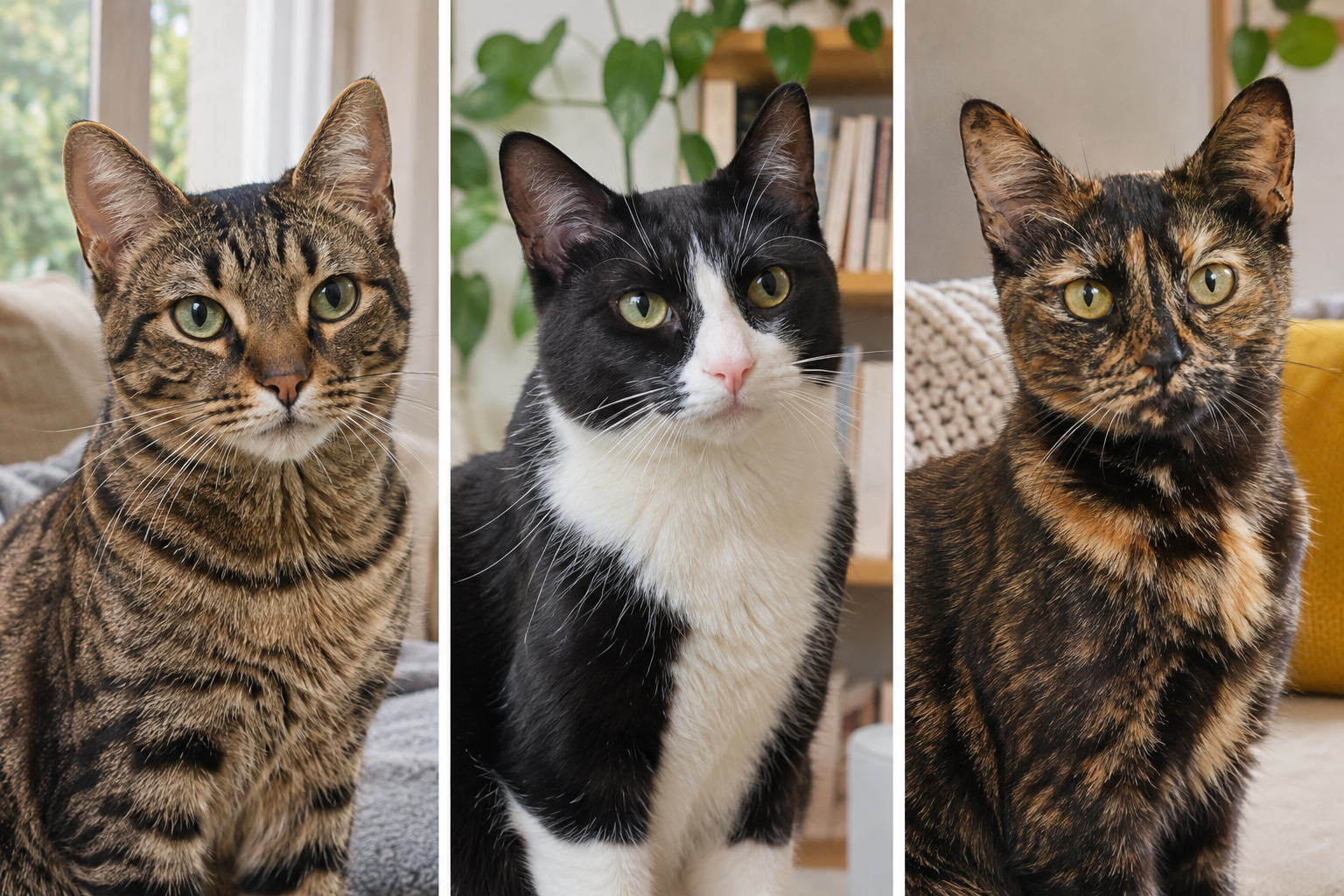
A tabby cat pattern is not a breed, and “tuxedo” describes a black-and-white bicolor pattern rather than a pedigree. CFA’s identification guidance specifically distinguishes coat pattern from breed. If a cat’s records do not establish a pedigree, you can still identify the visible coat accurately—for example, “Domestic Shorthair, brown mackerel tabby.” 1 6
How can you identify a cat without guessing its breed?
Start with documented paperwork, then record the cat’s visible coat traits in a consistent order. This four-step method gives you an accurate identification even when a cat’s family history is unavailable.
- Check what is documented. Look for registration papers, a breeder contract, a shelter intake record, or reliable information about the parents. Ask which registry issued any pedigree and whether the document belongs to that specific cat.
- Describe coat length. Record short, medium, or long hair. Coat length is often the clearest practical classification for an adult cat whose ancestry is unknown. 6
- Name color and pattern separately. Examples include “black,” “orange tabby,” “brown mackerel tabby,” “black-and-white tuxedo,” and “tortoiseshell.” CFA’s guidance treats pattern and breed as separate identification details. 1
- List distinctive features as observations. Note traits like blue eyes, a naturally short tail, or a broad face as visual observations rather than breed proof.
When filling out a veterinary intake form or pet profile, use this standardized format:
Domestic Shorthair — [coat color and pattern]; pedigree or ancestry [documented / unknown].
For example: Domestic Shorthair — black-and-white tuxedo; pedigree unknown. This phrasing is far more accurate than guessing “American Shorthair” from a round face or “Bombay” from a solid black coat.
What breed is this cat if you only have a photo?
A photo can help you describe a cat’s coat length, color, pattern, and body shape, but it cannot confirm a registered breed. If a short-coated cat has no documented pedigree, “Domestic Shorthair” is the most accurate practical classification.
Be cautious with smartphone breed-scanner apps. A percentage match means the photo resembles visual features in that app’s reference images; it does not prove genetic ancestry or replace registry records. Lighting, camera angle, age, and body condition can all alter how a cat’s features look on screen.
Is a Domestic Shorthair the same as an American Shorthair?
No, a Domestic Shorthair is a broad descriptive type for short-haired mixed-breed cats, while an American Shorthair is a standardized pedigreed breed with a formal registry standard. Both can have short coats and classic tabby markings, so a photograph alone cannot reliably separate them; CFA and TICA registration records are what substantiate an American Shorthair pedigree. 4 5
| Comparison Point | Domestic Shorthair | American Shorthair |
|---|---|---|
| Standardized pedigree breed? | No; descriptive coat-and-ancestry type | Yes; recognized pedigreed breed |
| Coat length | Short coat | Short, dense coat |
| Can appearance alone confirm it? | No | No; registry papers establish lineage |
| Appearance and temperament range | Wide variation across individuals | More consistent breed type, though individuals still vary |
For the pedigreed breed’s documented traits, see our American Shorthair breed guide. You can also compare short-coated pedigreed breeds in our shorthair cat breeds guide.
Can a photo or DNA test confirm a cat’s breed?
Neither a photo nor a consumer DNA test issues a formal breed pedigree. A consumer feline DNA kit may provide an ancestry similarity breakdown or screen for specific health variants, which is different from registry parentage documentation.
Before ordering a test, check which reference populations the laboratory uses and whether the report covers ancestry estimates, coat-trait markers, or inherited health variants. UC Davis notes that companion-animal genetic testing lacks uniform industry regulation and that health-related findings require veterinary interpretation rather than self-diagnosis. 3
What does Domestic Shorthair mean on shelter paperwork?
On shelter paperwork, “Domestic Shorthair” is an intake shorthand for a short-coated cat without verified pedigree papers. It is an administrative description, not a genetic test result or a prediction of adult temperament.
When adopting from a shelter or foster home, ask caregivers about the individual cat’s observed behavior, medical history, age estimate, and compatibility with children or other pets. Our complete cat adoption guide provides a practical checklist of questions to ask before bringing a cat home.
What can you expect when caring for a domestic short-haired cat?
Because Domestic Shorthairs come from diverse genetic backgrounds, daily care depends on the individual cat’s age, body condition, and temperament rather than a single breed rule. A short coat usually takes less brushing than a long coat, while feeding portions and enrichment should match the cat’s activity level and life stage. 2
| Care & Household Factor | What to Expect for a Domestic Shorthair | Practical Planning Tip |
|---|---|---|
| Typical adult weight | Commonly 8–12 lbs (3.6–5.4 kg), though frame size varies | Check ideal body condition and daily kcal with our Cat Calorie Calculator |
| Typical lifespan | Often 13–17+ years with indoor care and preventive vet visits | Estimate life stage with our Cat Age Calculator |
| Weekly grooming time | 5–10 minutes once a week (more during spring/fall shedding) | Follow our cat grooming guide for brushing and nail trims |
| Energy & vocalization | Varies widely from quiet couch companions to active climbers | Meet an adult cat when possible to observe established energy |
| Kid & multi-pet fit | Depends on early socialization and gradual introductions | Provide vertical perches and separate litter/food resources |
Track body condition regularly using our Cat Body Condition Score & Weight Tracker so portion sizes stay aligned with your cat’s lean muscle mass as it ages.
Conclusion
“Domestic Shorthair” is the clearest, most accurate label for a short-coated cat whose pedigree is mixed, unknown, or undocumented. Separate visible appearance—coat length, color, and pattern—from documented breed ancestry. When adopting or caring for a Domestic Shorthair, let the individual cat’s observed personality, body condition, and veterinary guidance shape your daily routine.
Frequently Asked Questions
Is a domestic short-haired cat a breed?
No, “domestic short-haired” describes a short-coated cat with mixed, unknown, or undocumented ancestry rather than a standardized pedigree breed. Organizations like CFA and Cornell use the term as a practical coat-and-ancestry category for non-pedigreed house cats. 1 2
What breed is this cat if it has no papers?
If a cat has a short coat and no verifiable pedigree documentation, “Domestic Shorthair” is the most accurate practical description. You can pair it with the cat’s visible color and pattern—such as brown mackerel tabby or black-and-white tuxedo—without treating those markings as a pedigree breed.
Is a domestic short hair cat different from a Domestic Shorthair?
No, “domestic short hair cat,” “domestic short-haired cat,” and “Domestic Shorthair” are spelling variations for the exact same descriptive category. None of these terms refers to a registered pedigree breed.
Can I tell whether my cat is an American Shorthair from a photo?
A photo may show a round face or classic silver tabby markings that resemble the American Shorthair standard, but visual appearance alone cannot prove pedigree. Only official registration papers issued by a recognized association like CFA or TICA confirm American Shorthair lineage. 4 5
References
[1] The Cat Fanciers’ Association. (n.d.). The Pet Owners Corner: What Is My Cat? CFA guidance on coat pattern, color, and breed
[2] Cornell University College of Veterinary Medicine. (n.d.). Choosing and Caring for Your New Cat. Cornell Feline Health Center
[3] University of California, Davis, School of Veterinary Medicine. (2023). What Genetic Testing Can and Can’t Tell You About Your Pet. UC Davis Veterinary Medicine
[4] The International Cat Association. (n.d.). American Shorthair Breed Standard. TICA breed standard
[5] The Cat Fanciers’ Association. (n.d.). American Shorthair. CFA breed profile
[6] Texas Department of State Health Services. (2014). Animal Identification (Basic): Identification of Felines. Texas DSHS guide (PDF)