
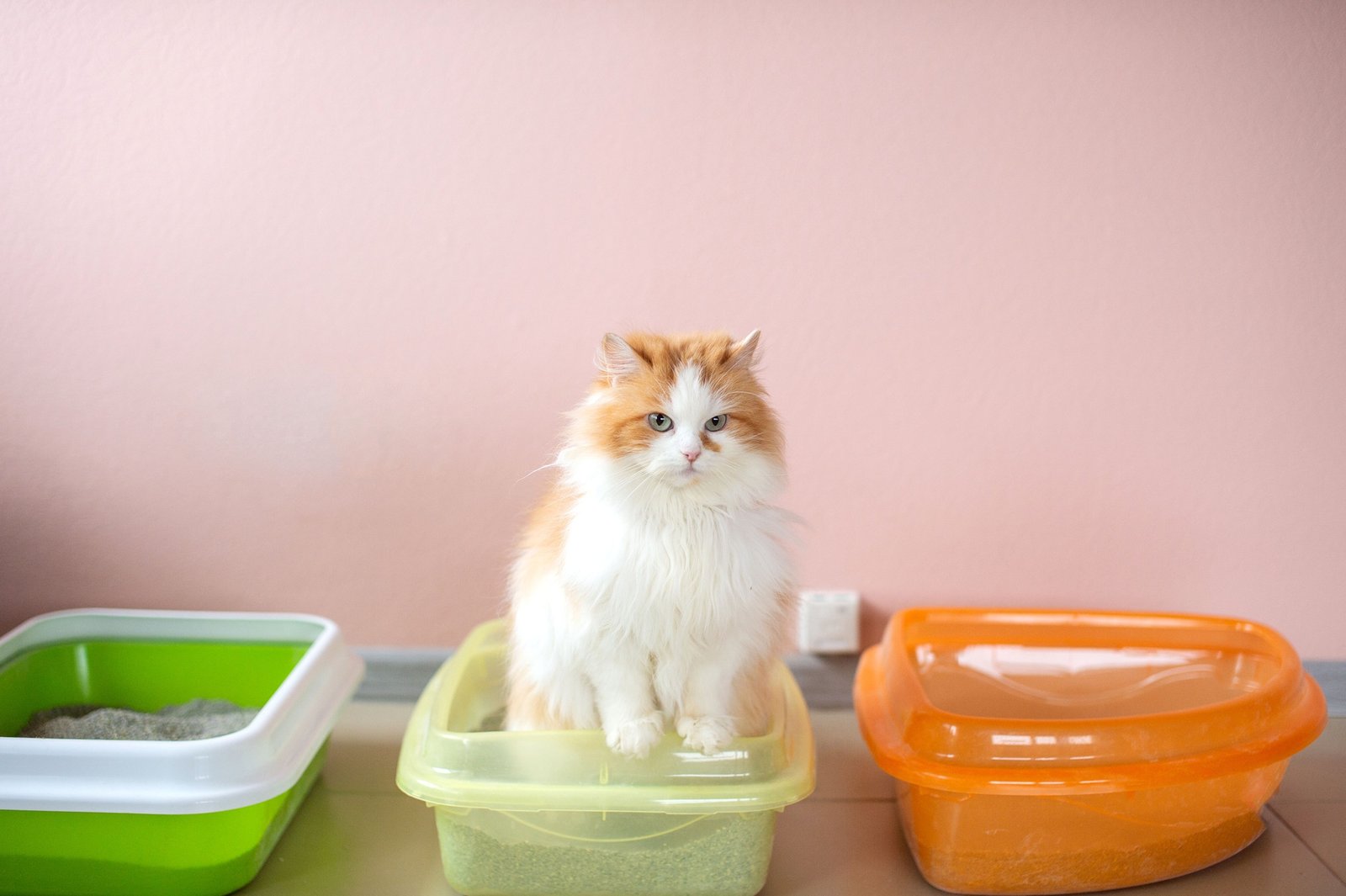
How big should a cat litter box be?
A tray is large enough when the cat can stand in it, turn around, and squat without touching the sides. International Cat Care puts a number on that: the ideal tray length is one and a half times the cat's body length, measured from the nose to the base of the tail. The RSPCA gives the same rule with a worked example — an average cat measuring about 50 cm nose to tail needs a tray at least 75 cm long.
That measurement is why many standard trays fail. A tray sold as "large" is often 55–60 cm long, which suits a small cat and is too short for an average one. Measure the cat first, then compare the tray's internal length — not the outer rim, and not the packaging claim.
| Body length, nose to tail base | Minimum tray length | Typical cat |
|---|---|---|
| 40 cm | 60 cm | Small adult, some females |
| 46 cm | 69 cm | Average adult |
| 50 cm | 75 cm | RSPCA's worked example |
| 55 cm | 83 cm | Large adult |
| 60 cm | 90 cm | Large breeds |
| 65 cm | 98 cm | Maine Coon and similar |
How many litter boxes do you need?
The working rule is one tray per cat, plus one extra. Two cats means three trays. The extra tray is not a spare: it matters when one cat guards a tray, when a tray is being cleaned, and when an older cat cannot travel to a tray on another floor.
Placement carries as much weight as the count. Trays pushed together in one corner behave like a single resource, because a cat can block access to all of them at once. Spread them across floors and rooms, keep them away from food and water, and avoid spots next to noisy appliances or full-length windows.
How deep should cat litter be?
International Cat Care reports that cats prefer a depth of approximately 3 cm. That figure sits inside the 1–2 inch range described by Cornell, the ASPCA, and Ohio State, so the practical target is a shallow, even layer of about 2.5–4 cm rather than a deep fill.
Deeper is not kinder. A thick layer feels unstable underfoot, hides soiled litter underneath, and wastes litter. Too shallow is worse in a different way: urine reaches the tray floor, clumps stick, and odour builds. Start near 3 cm, then adjust for how your cat digs — add a little if clumps stick hard to the bottom, reduce if the cat sinks or kicks litter over the sides.
To work out how much litter a tray holds, multiply internal length × width × 3 cm and divide by 1,000 for litres. A 60 × 40 cm tray at 3 cm takes about 7.2 L.
Kittens, senior cats, and large cats
Kittens need a tray they can climb into and out of, so a lower side matters more than a generous length. Use a smaller tray while they grow, then re-measure — a tray that fits a three-month-old kitten is too small by six months.
Senior cats and cats with arthritis benefit from low entry sides and a tray on every floor they use. A high-sided tray that worked for years can become the reason a cat stops using it. Keep the route clear and lit at night.
Large cats are where covered trays fail most often. A hood reduces the usable internal length, and a large cat cannot position itself to dig. If the calculated minimum exceeds the internal length of a covered tray you are considering, choose an open one.
Frequently asked questions
What size litter box does a large cat need?
Measure the cat from nose to the base of the tail, then multiply by 1.5. A cat measuring 55 cm needs at least 83 cm of internal tray length. Most covered trays are shorter than that once the hood is fitted, so an open tray is usually the practical answer.
How many litter boxes for two cats?
Three. The rule is one per cat plus one extra. Two trays for two cats works only if both cats get along and both trays stay clean, and it leaves nothing in reserve when one tray is being washed.
Is 2 inches of litter enough?
Two inches is about 5 cm, slightly above the 3 cm cats prefer. It is enough if the tray is scooped daily and clumps are not sticking to the bottom. If urine regularly reaches the tray floor, add a little more rather than filling deeply.
Should the litter box be covered or open?
Open trays are easier to keep clean and give the cat room to turn. Covered trays contain odour for people but concentrate it for the cat, and the hood reduces usable space. If you use a covered tray, remove the flap and check that the internal length still meets the minimum.
How often should the litter be fully replaced?
Scoop at least twice a day. Replace clumping litter completely every two to four weeks, and non-clumping litter weekly. Top up between changes only when the remaining litter is dry and clean.
Does tray height matter?
Yes, for two different reasons. High sides keep litter in for a vigorous digger. Low sides let a kitten, senior, or arthritic cat walk in without a jump. Choose the lowest side the cat can manage comfortably, then use a mat to catch tracking.
Where these figures come from
- International Cat Care — Choosing a litter tray for your cat: the 1.5× body length rule, the ~3 cm depth, and one tray per cat plus one extra.
- RSPCA Knowledgebase — Why is my cat urinating inappropriately?: the same 1.5× rule with a 50 cm to 75 cm worked example.
 EN
 DE
 ES
 PT