
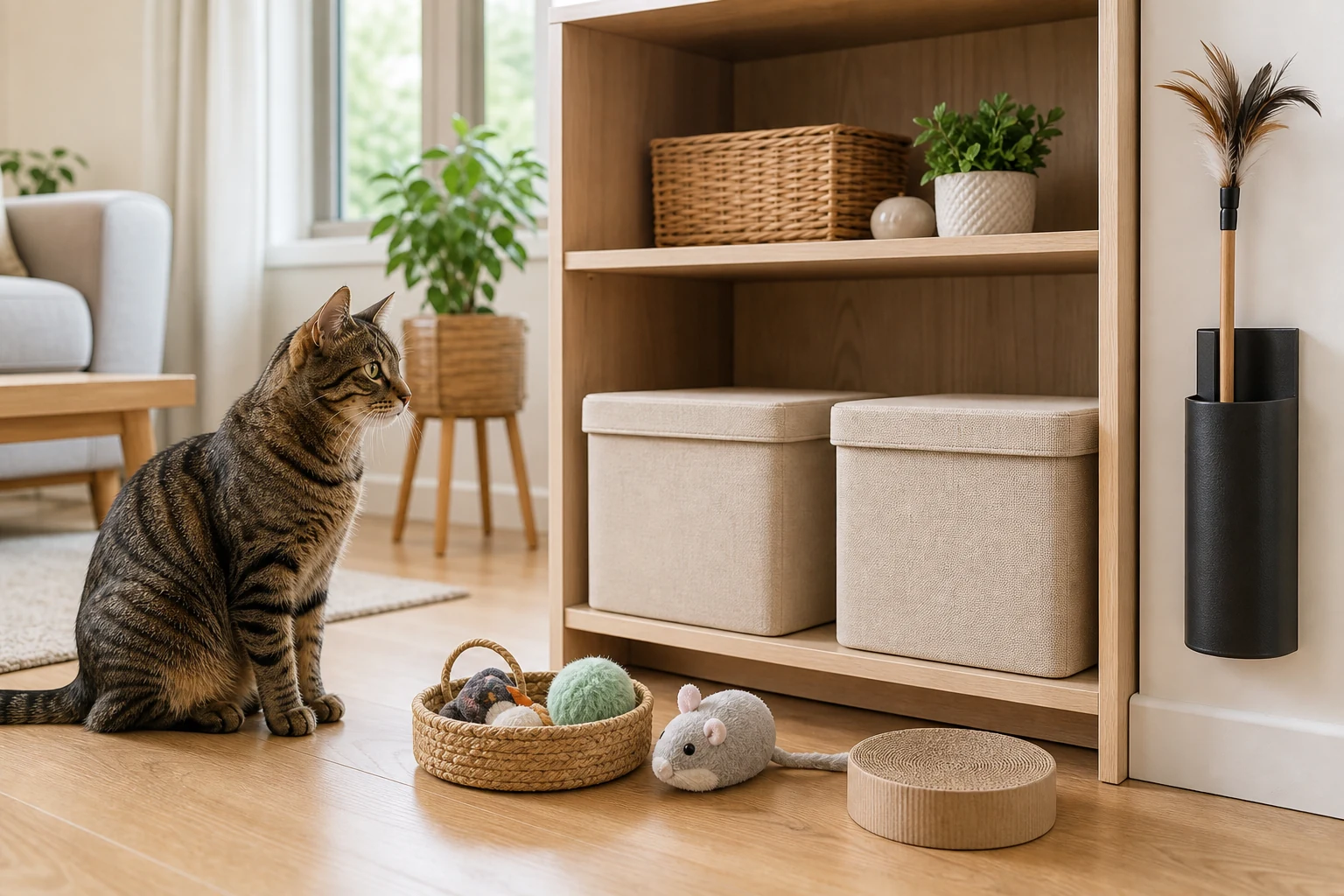
Store cat toys by keeping a small inspected play set out, locking away wand and string toys, cleaning food-contact toys, and retiring damaged pieces.
Cat toy storage sounds like a clutter problem, but it is really a safety and routine problem. Cornell Feline Health Center notes that toys can support exercise, cognitive enrichment, and natural stalking or pouncing, while also warning cat parents to avoid small pieces and strand-like parts that can separate and be swallowed 1.
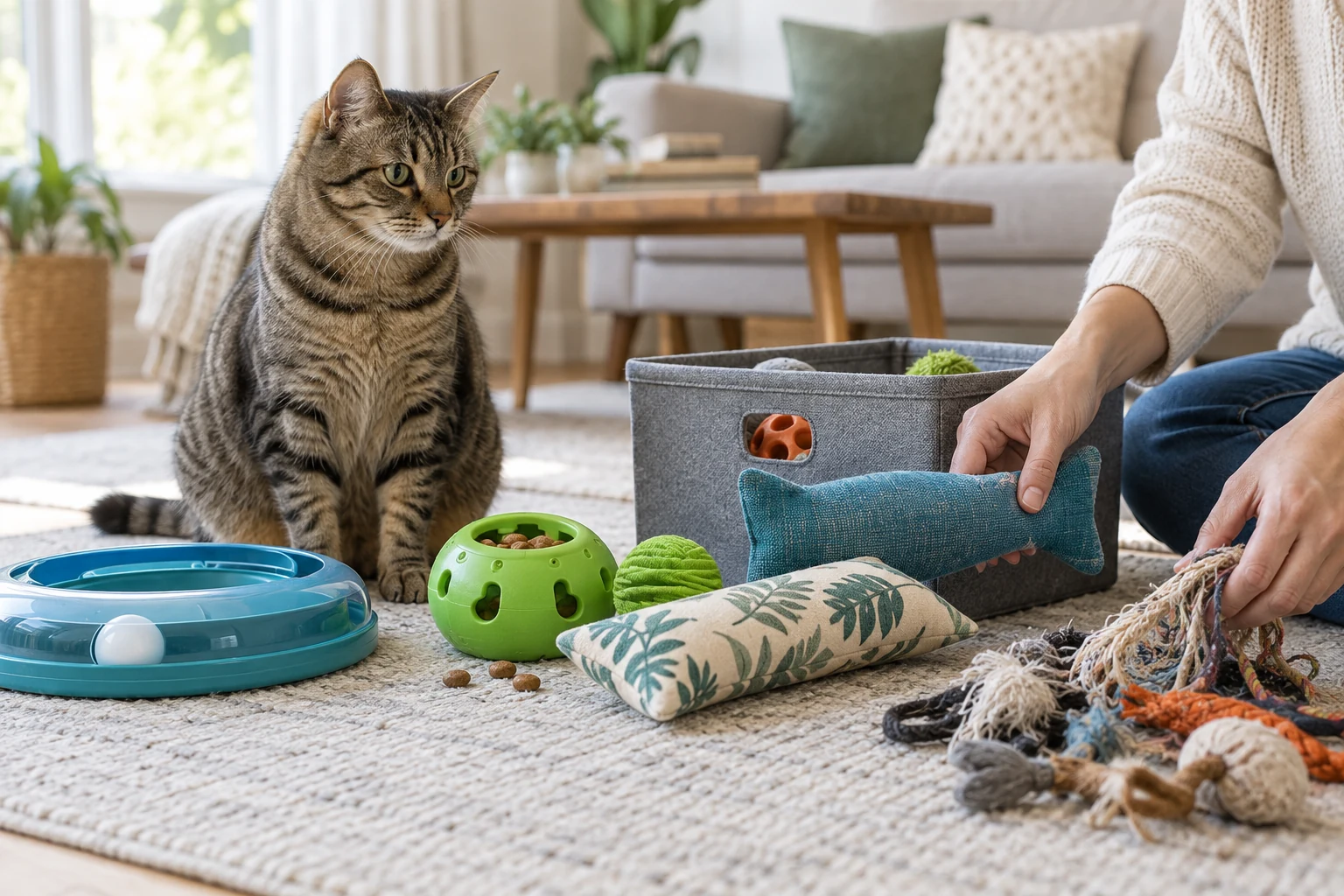
A good system does not need fancy bins. It needs clear zones: safe solo toys, supervised toys, washable toys, toys waiting to dry, and damaged toys that never return to your cat.
Table of Contents
- How should you set up a safe cat toy storage system?
- Which cat toys can stay out, and which should be put away?
- What is the best way to store wand toys and string toys?
- How do you organize bins for toy rotation?
- How often should you clean cat toys between rotations?
- Which toys need extra cleaning because food touches them?
- What safety checks should you do before toys come back out?
- How can multi-cat homes prevent toy guarding and clutter?
- What should you do if a toy is missing, chewed, or swallowed?
- Conclusion: A small, clean toy system is safer
- Frequently Asked Questions
- References
How should you set up a safe cat toy storage system?
Set up cat toy storage as a few simple zones, not one overflowing basket. The goal is to make the safe choice automatic: your cat can reach sturdy solo toys, while higher-risk toys stay behind a lid, door, latch, or cabinet.
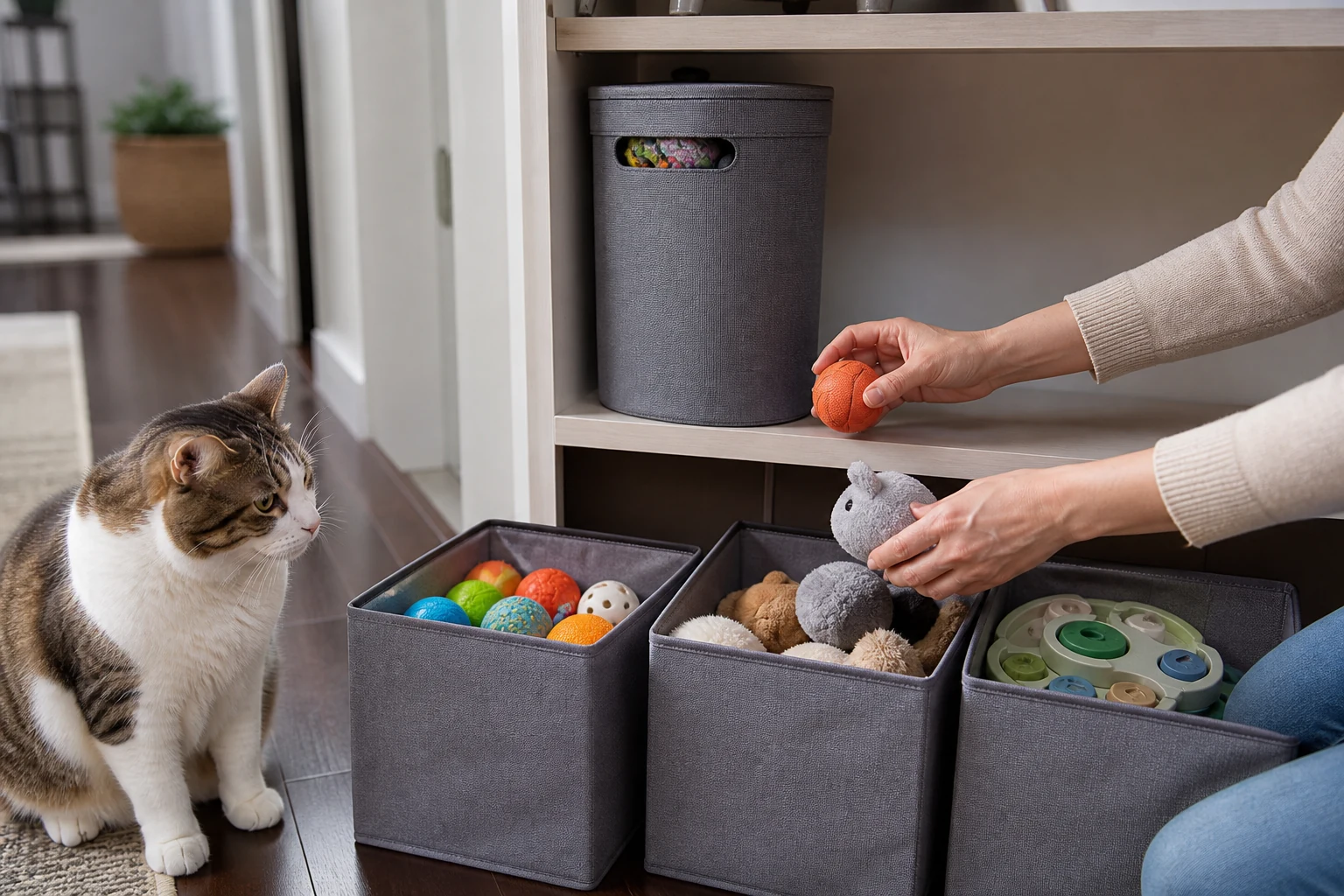
Start with four containers:
- An active-play bin for the few toys your cat can use this week.
- A supervised-only bin for wand toys, feather toys, ribbons, long cords, and anything with small detachable pieces.
- A cleaning bin for toys that touched food, drool, litter dust, vomit, or dirty floors.
- A retire bin for damaged toys you need to inspect once more before throwing away.
This system also protects novelty. The FelineVMA Cat Friendly guidance says cats benefit from toys that mimic prey and from rotating toys so they stay interesting 2. Rotation works best when storage is tidy enough that you can actually find, inspect, and reintroduce toys with intention.
Keep the containers away from food prep counters and away from litter-box dust. If your cat opens drawers or noses into baskets, choose lidded bins, child-safe cabinet latches, or a high closet shelf.
Which cat toys can stay out, and which should be put away?
Leave out sturdy solo toys only. Put away anything your cat could shred, unwrap, swallow, or drag into unsafe places when you are not watching.
| Toy type | Can it stay out? | Safer storage rule |
|---|---|---|
| Solid balls, tracks, tunnels, and sturdy kickers | Usually, if intact | Keep a few available and inspect for cracks, torn seams, or loose fillings. |
| Plush mice or soft toys | Sometimes | Leave out only if your cat does not chew pieces off; rotate and wash when dirty. |
| Wand toys, teaser poles, feathers, ribbon, yarn, tinsel, elastic, and long cords | No | Use only during supervised play, then store behind a closed door, lid, or high cabinet. |
| Food puzzles, treat balls, lick mats, and treat-dispensing toys | Only after cleaning | Empty leftovers, wash, dry fully, and store separate from dry toys. |
| Battery or electronic toys | Depends on the toy | Follow the maker's instructions, check battery compartments, and remove damaged toys immediately. |
| DIY toys such as boxes and paper rolls | Usually, if plain and clean | Remove staples, handles, plastic film, tape, and chewed pieces. |
If you are still building your toy set, this article pairs well with SnuggleSouls' guide to the best interactive cat toys for indoor cats. Choose toys your cat actually uses, then make storage rules around the risk level of each toy.
One important distinction: "cute" is not the same as "safe." A tiny bell, plastic eye, feather bundle, elastic loop, or dangling thread can turn an otherwise useful toy into a supervised-only item.
What is the best way to store wand toys and string toys?
Store wand toys upright, coiled, clipped, or closed away so your cat cannot chew the string between play sessions. The wand itself is not usually the main risk; the loose line, feather attachment, ribbon, elastic, or connector is.
Cat Friendly play guidance specifically warns that string-type products and toys with loose pieces should be put away after playtime because cats can swallow them 2. Merck Veterinary Manual also notes that cats commonly develop intestinal obstruction from linear foreign bodies such as string, yarn, or dental floss while playing with them 4.
Good wand storage options include:
- A tall closed umbrella stand inside a closet.
- A wall hook or broom clip mounted high enough that the lure does not dangle within reach.
- A lidded plastic box with the string gently coiled, not knotted.
- A zip pouch or hard case for feather refills and attachments.
- A "play only with a person" shelf that children and guests also understand.
After a session, take ten seconds to check the line, swivel, feathers, and knots. If the string is frayed, the bell is loose, or the lure is coming apart, move it to the retire bin. Then offer a safer solo toy or food puzzle so your cat does not learn to search for the hidden wand.
For the play side of the routine, use SnuggleSouls' daily guide on how to play with your cat. Safe storage and good technique work together: supervise the exciting prey-like toys, then remove them before boredom turns into chewing.
How do you organize bins for toy rotation?
Organize bins by use, not by how the toys look. A rotation system should help you answer three questions quickly: what can my cat play with alone, what needs a person present, and what needs cleaning before it comes back?
The 2013 AAFP/ISFM Environmental Needs Guidelines describe play areas as one of a cat's key environmental resources and recommend opportunities for predatory play and feeding behaviors 3. Storage should support that need instead of hiding all enrichment in a closet.
Try this weekly rhythm:
- Keep three to five safe solo toys available.
- Keep one or two supervised wand or chase toys ready for human-led sessions.
- Put the rest away so they can feel interesting later.
- At the end of the week, inspect, clean, and swap a few toys.
- Leave a beloved comfort toy out if it helps your cat relax.
If your cat gets bored quickly, use the cat toy rotation schedule as the broader plan and let this storage setup become the practical station that makes rotation easier. If your cat has high energy, pair toy storage with a realistic estimate of how much playtime a cat needs so you are not relying on toys alone to solve restlessness.
The storage rule is simple: rotate for interest, inspect for safety, and clean before reintroducing anything that has been mouthed, dragged, or used with food.
How often should you clean cat toys between rotations?
Clean cat toys about monthly as a baseline, sooner if they smell bad, look dirty, touched food, were mouthed heavily, or were used by a sick cat. CDC guidance says pet toys are among the items that can carry germs and gives monthly toy cleaning as an example schedule, with more frequent cleaning when items are dirty or household risk is higher 5.
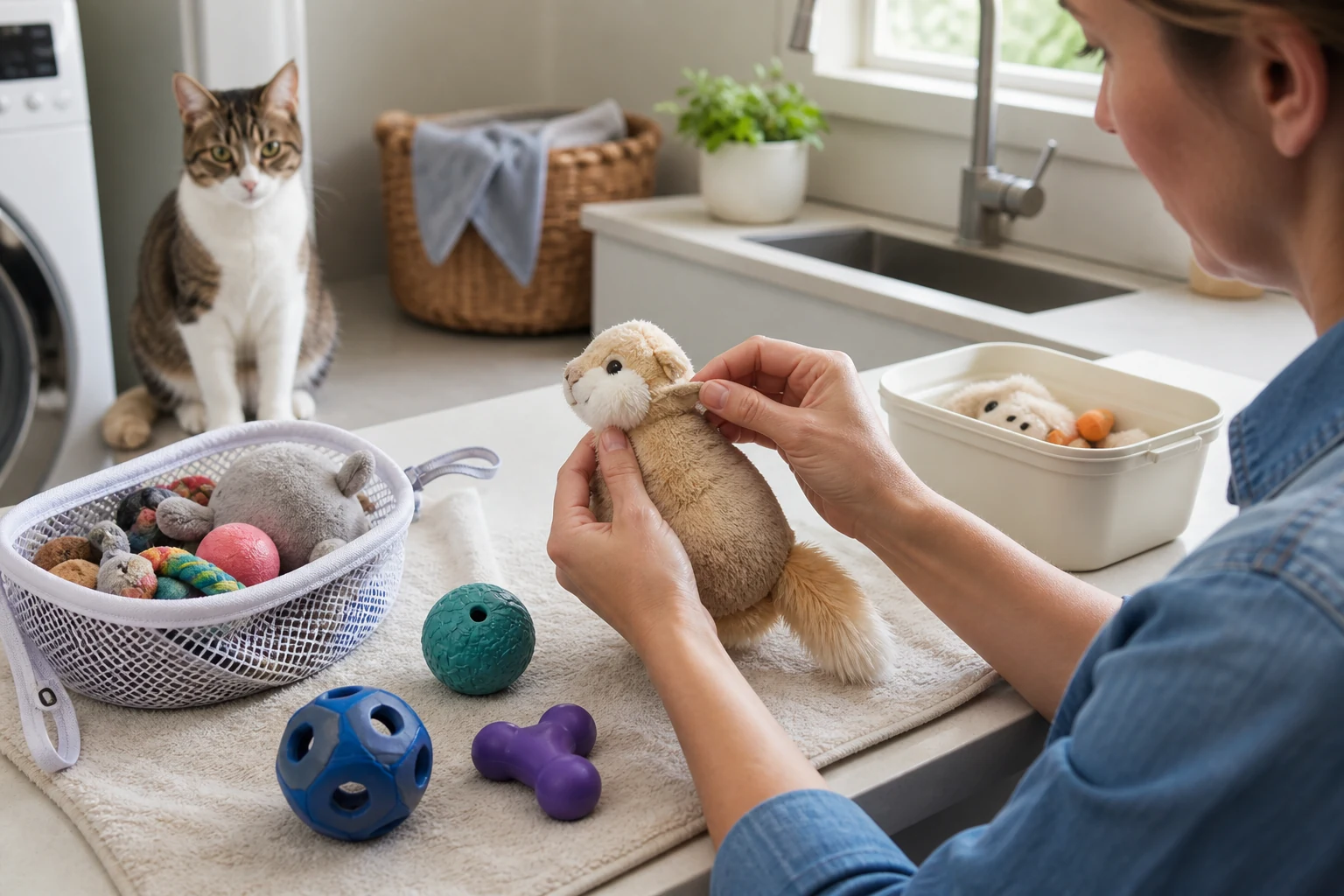
Use the toy's own care label first. If there are no instructions, separate toys by material:
- Hard rubber or plastic toys: wash with warm soapy water, scrub grooves, rinse well, and air dry completely.
- Dishwasher-safe hard toys: use the dishwasher if the maker says it is safe.
- Plush toys: machine wash if the toy allows it, then dry fully before storage.
- Rope toys: wash according to the label and retire them if fibers fray or your cat chews strands loose.
- Catnip toys that cannot be washed: throw them away when dirty, damp, torn, or stale-smelling.
Do not spray a toy with a strong-smelling cleaner and hand it back damp. Cats explore with their mouth and nose. If you disinfect, follow the product label, rinse when appropriate, and let the toy dry fully before your cat can reach it 5.
Which toys need extra cleaning because food touches them?
Food-contact toys need stricter handling than dry plush toys. Treat balls, puzzle feeders, lick mats, food-dispensing mice, and any toy stuffed with wet food should be emptied, washed, dried, and stored away from fuzzy toys.
Food residue changes the risk profile. It can attract insects, grow odors, and encourage a cat to chew harder at seams or plastic edges. If your cat uses food toys because of begging, boredom, or fast eating, pair the routine with SnuggleSouls' guide to cat begging for food after eating so enrichment does not quietly become overfeeding.
Use a separate washable container for food puzzles and treat toys. Keep a tiny measuring scoop nearby, but do not leave loose treats sitting in the toy between sessions. If you are using food toys daily, count those calories in the day's total; the cat calorie calculator can help you estimate a starting point before you adjust with your veterinarian.
Clean these toys after wet food every time. For dry treats or kibble, clean frequently and immediately if crumbs build up in grooves. Let each toy dry open, not sealed in a bin while damp.
What safety checks should you do before toys come back out?
Before a toy returns to your cat, check it with your fingers and eyes. If you would not trust it during five minutes of chewing, do not put it in the active bin.
Use this quick inspection:
- Pull gently on seams, feathers, tails, bells, eyes, and glued pieces.
- Look for cracks in hard plastic or rubber.
- Check wand strings for fraying, knots, sharp connectors, or loose swivels.
- Squeeze plush toys to feel for exposed stuffing or crinkle film.
- Smell the toy; sour, musty, or food-like odors mean it needs cleaning or retirement.
- Look for missing parts compared with how the toy looked last time.
- Check electronic toys for secure battery covers and corrosion.
Retire toys generously. Keeping a damaged toy for "one more week" is not worth the risk. Cornell's safety guidance flags small pieces, strand-like parts, and play spaces where a distracted cat could be hurt 1. Storage is where you catch those risks before play starts.
If you live with kittens, senior cats, heavy chewers, or a cat with a history of eating non-food items, be stricter. A toy that is fine for one cat may be a poor match for another.
How can multi-cat homes prevent toy guarding and clutter?
Multi-cat homes need several play zones, not just one toy basket in the busiest room. Multiple, separated resources help cats feel control and reduce competition, which is one reason the AAFP/ISFM environmental-needs framework emphasizes separated key resources 3.
If one cat guards toys, stash active toys in two or three locations:
- A quiet solo-play bin for the shy cat.
- A supervised wand station for human-led sessions.
- A puzzle-feeder shelf where food toys can be cleaned and refilled separately.
- A senior-friendly basket near a low resting area.
Do not assume every cat wants the same toy. One cat may love a crinkle ball; another may prefer a slow wand sweep across a rug. Separate storage lets you match toys to each cat without turning the floor into a pile that no one uses.
Children and visitors need the system too. If a child knows that feather wands go into the closed bin after play, you reduce the chance that a string toy gets left on a sofa overnight.
What should you do if a toy is missing, chewed, or swallowed?
If part of a toy is missing or you think your cat swallowed string, ribbon, yarn, elastic, plastic, foam, or a small hard piece, call your veterinarian or an emergency clinic for advice. Do not wait for obvious illness if the missing piece could cause obstruction.
Treat these as urgent warning signs:
- Repeated vomiting, retching, or drooling.
- Not eating or sudden loss of interest in food.
- Lethargy, hiding, collapse, or rapid decline.
- Pain when picked up or a tense, uncomfortable belly.
- Straining to poop or producing very little stool.
- A string visible under the tongue, from the mouth, or from the anus.
Merck lists vomiting, anorexia, diarrhea, lethargy, shock, abdominal pain, and visible oral linear material among possible findings with gastrointestinal obstruction, and warns that a linear foreign body in the mouth should never be pulled because pulling can lead to perforation 4. If you see string, cut off access to the toy, keep your cat calm, and contact a veterinarian immediately.
If the toy was only chewed but every piece is accounted for, retire it anyway. Photograph the damaged toy if you need to compare missing parts, then replace it with a safer option.
Conclusion: A small, clean toy system is safer
Safe cat toy storage is not about having a perfect shelf. It is about knowing which toys your cat can reach alone, which toys need a person present, which toys need washing, and which toys should never return to play.
Keep sturdy solo toys accessible, store wand and string toys behind a barrier, clean food-contact toys promptly, and inspect everything before it rotates back. For more practical routines like this, browse SnuggleSouls' daily care guides.
Frequently Asked Questions
Can I leave cat toys out all day?
You can leave sturdy solo toys out all day if they are intact and your cat does not chew pieces off them. Wand toys, ribbons, yarn, feather teasers, small detachable parts, and food toys with residue should be put away after use.
Are wand toys safe if the string is thick?
A thick string is still a string, so treat wand toys as supervised-only. Store them where your cat cannot chew or swallow the line between play sessions.
How often should I throw away cat toys?
Throw away a toy as soon as it has loose parts, torn seams, exposed stuffing, cracked plastic, frayed rope, a damaged battery cover, or a smell that cleaning does not fix. It is better to retire a cheap toy early than risk a swallowed piece.
Can I wash catnip toys?
Some catnip toys are washable, but many are not. Follow the tag; if there are no instructions and the toy cannot be cleaned well, throw it away when it becomes dirty, damp, torn, or stale-smelling.
What is the best cat toy storage for a small apartment?
Use one lidded bin for the backup rotation, one high or closed container for wand toys, and a small open basket for two to five safe active toys. Vertical storage matters more than having a large toy area.
References
[1] Cornell Feline Health Center. (2026). Safe toys and gifts. https://www.vet.cornell.edu/departments-centers-and-institutes/cornell-feline-health-center/health-information/feline-health-topics/safe-toys-and-gifts
[2] Feline Veterinary Medical Association. (2026). Playing With Your Cat. https://catfriendly.com/be-a-cat-friendly-caregiver/playing-with-your-cat/
[3] Ellis, S. L. H., Rodan, I., Carney, H. C., Heath, S., Rochlitz, I., Shearburn, L. D., Sundahl, E., & Westropp, J. L. (2013). AAFP and ISFM Feline Environmental Needs Guidelines. https://pmc.ncbi.nlm.nih.gov/articles/PMC11383066/
[4] Merck Veterinary Manual. (2026). Gastrointestinal Obstruction in Small Animals. https://www.merckvetmanual.com/digestive-system/surgical-problems-of-the-gastrointestinal-tract-in-small-animals/gastrointestinal-obstruction-in-small-animals
[5] Centers for Disease Control and Prevention. (2026). About Cleaning and Disinfecting Pet Supplies. https://www.cdc.gov/healthy-pets/about/cleaning-and-disinfecting-pet-supplies.html
 Why Does My Cat Flinch When Touched While Sleeping? Startle, Trust, and Pain Clues">
 Cat Scratching Baseboards: Trim Guards and Route Fixes">
 EN
EN DE
DE ES
ES PT
PT