
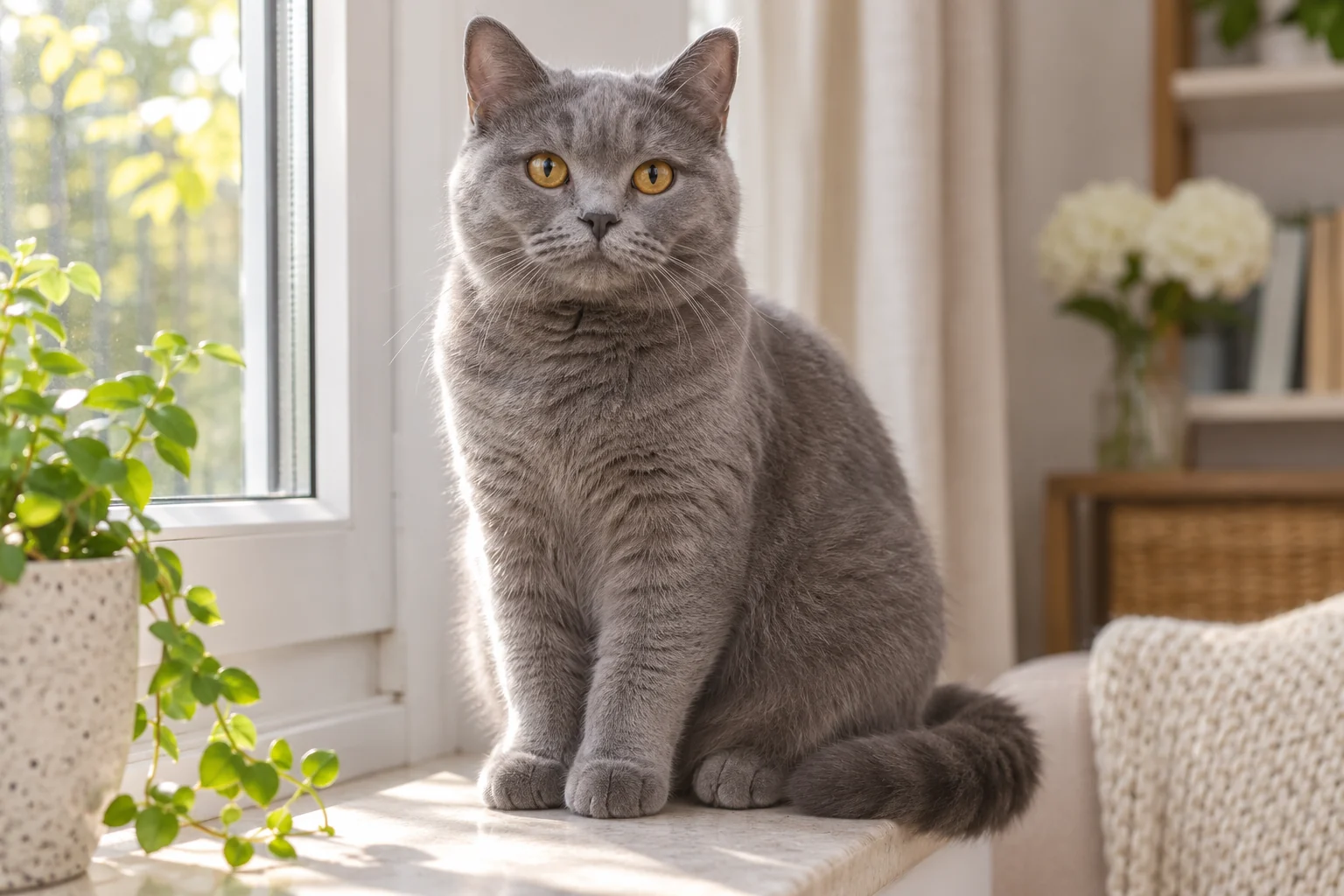
A Scottish Straight cat is a Scottish-type cat with upright ears whose exact breed or variety label varies by cat registry. 1 2 Before adopting, verify registration papers and genetic records because upright ears alone do not prove pedigree or rule out the Scottish Fold–associated TRPV4 variant. 6
Table of Contents
- What Is a Scottish Straight Cat?
- Are Scottish Straights a Separate Breed?
- How Is a Scottish Straight Different From a Fold or British Shorthair?
- What Does a Scottish Straight Look Like?
- What Temperament Can You Expect?
- How Do You Care for a Scottish Straight Cat?
- Can a Scottish Straight Carry the Scottish Fold Mutation?
- Common Myths vs. Facts About Scottish Straight Cats
- What Should You Ask Before Choosing a Scottish Straight?
- Is a Scottish Straight a Good Fit for Your Home?
- Conclusion
- Frequently Asked Questions
- References
What Is a Scottish Straight Cat?
“Scottish Straight” refers to a Scottish-type cat whose ears remain upright rather than folding forward. 1 The International Cat Association (TICA) groups Scottish Folds and Scottish Straights within the same Scottish breed group because both ear types can occur in the same litter; their defining visible difference is ear shape. 1
Because breeders, registries, and countries use the label differently, a listing may use “Scottish Straight” as a breed name, a coat-length variety, or a description of a straight-eared cat from Scottish Fold lines. Ask which registry issued the pedigree and check the exact breed or variety printed on the certificate.
Are Scottish Straights a Separate Breed?
There is no single worldwide naming rule across cat associations. 1 2 3 TICA registers Scottish Straight Shorthair and Scottish Straight Longhair within its Scottish breed group, whereas the Cat Fanciers’ Association (CFA) covers straight-eared cats within its Scottish Fold breed framework and show divisions, and the Canadian Cat Association (CCA-AFC) judges Scottish Fold and Scottish Straight as separate breeds. 1 2 3
A cat’s round face or upright ears can suggest a type, but appearance alone cannot prove registry status. For a pedigreed cat, request the registration certificate and confirm terminology with the issuing registry; for a rescue cat, treat “Scottish Straight” as a reported type description unless documented records verify lineage.
How Is a Scottish Straight Different From a Fold or British Shorthair?
Scottish Straight and Scottish Fold cats share a rounded face and sturdy medium build, differing visually in upright versus forward-folding ears, whereas a British Shorthair is a separate breed with its own pedigree standard. 1 2 Do not rely on a photograph or round cheeks alone to distinguish these cats.
| Comparison Factor | Scottish Straight | Scottish Fold | British Shorthair |
|---|---|---|---|
| Typical Ear Appearance | Upright 1 | Folded forward in cats expressing the Fold phenotype 2 | Upright |
| Registry Classification | Separate breed or variety depending on association 1 3 | Fold breed; some registries show straight-eared cats in its group 2 | Separate pedigree breed |
| What Confirms Lineage | Registry paperwork and recorded pedigree | Registry paperwork and recorded pedigree | Registry paperwork and recorded pedigree |
| Primary Health Question | Request individual TRPV4 c.1024G>T result if Fold ancestry exists 4 6 | Fold-associated TRPV4 variant is linked to cartilage and bone disease 5 | Review parental cardiac (HCM) and line health records |
Compare folded-ear health considerations in our Scottish Fold guide, or explore upright-eared British cousins in our British Shorthair breed guide.
What Does a Scottish Straight Look Like?
Scottish Straights are medium-sized, rounded cats with medium-to-small upright ears, large round eyes, and a dense plush coat. 1 3 Both shorthaired and longhaired varieties exist across a wide spectrum of solid, tabby, bicolor, and shaded coat patterns depending on lineage. 1
Do not confuse a naturally round facial outline with a healthy body-weight target. Evaluate rib coverage and waist tuck with your veterinarian—or check portions with our Body Condition Score Calculator and Cat Calorie Calculator.
What Temperament Can You Expect?
TICA notes that Scottish Straights and Scottish Folds share general structural traits and easygoing, affectionate temperaments. 1 However, breed tendencies never guarantee how an individual cat behaves around visitors, children, other pets, or prolonged alone time.
When meeting a cat, ask the breeder, foster caregiver, or shelter staff about its observed daily routine—specifically how it handles gentle brushing, loud household sounds, and voluntary lap time. An adult cat with a documented home routine often offers a more predictable match than choosing a kitten by breed label alone.
How Do You Care for a Scottish Straight Cat?
Daily care centers on a complete life-stage diet, fresh water, clean litter boxes, vertical scratching posts, and coat-length-appropriate grooming. 1 TICA recommends combing shorthaired Scottish Straights weekly and longhaired Scottish Straights several times per week to remove loose undercoat before mats form. 1
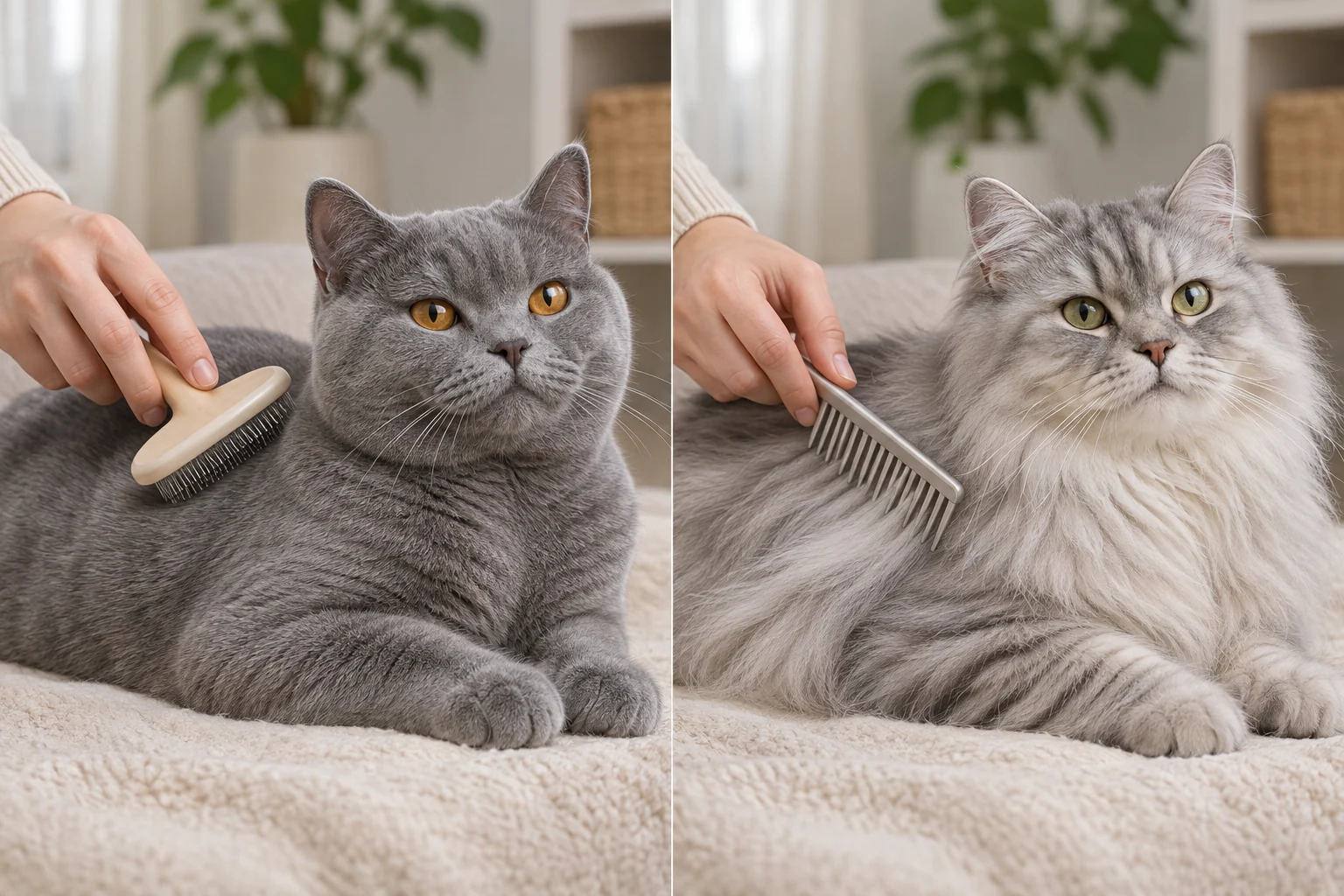
Pair coat care with routine nail trims, dental hygiene, and short daily play sessions. Never force grooming if a cat becomes tense; pause and build positive associations gradually with small treats.
Can a Scottish Straight Carry the Scottish Fold Mutation?
Yes—adult upright ear appearance alone is not a genetic test. 4 6 A 2016 genetic study identified a dominant variant in the TRPV4 gene (c.1024G>T) underlying both folded ears and feline osteochondrodysplasia, a progressive cartilage and bone disorder. 5 The UC Davis Veterinary Genetics Laboratory notes that even one copy (heterozygous) can affect cartilage development, while two copies cause severe skeletal disease. 4
A 2026 study documented a small subset of genetically heterozygous TRPV4 cats whose ears appeared folded in kittenhood before straightening in adulthood (7 of 55 heterozygous cats in that limited study cohort). 6 While this sample does not establish a population-wide prevalence rate, it proves that straight adult ears alone cannot always rule out the TRPV4 c.1024G>T variant when Scottish Fold ancestry is present. 6
If a cat comes from Scottish Fold lines, request its individual TRPV4 c.1024G>T DNA test result (offered by laboratories such as UC Davis) alongside parental screening records for hypertrophic cardiomyopathy (HCM) and polycystic kidney disease (PKD). 1 4 Schedule a veterinary exam promptly if any cat develops limping, stiffness, reluctance to jump, or tail pain. 4 5
Common Myths vs. Facts About Scottish Straight Cats
Clarifying registry and genetic facts protects buyers from misleading sales claims. 1 6
| Common Myth | Evidence-Informed Fact |
|---|---|
| “Upright ears guarantee a cat cannot carry the TRPV4 Fold variant.” | Research shows a subset of heterozygous TRPV4 cats develop straightened adult ears, making DNA testing essential when Fold ancestry exists. 6 |
| “Scottish Straight and British Shorthair are identical breeds.” | They are distinct pedigree populations with separate breed standards; only registry paperwork confirms pedigree. 1 2 |
| “All Scottish Straight cats are calm, silent lap potatoes.” | Breed profiles suggest gentle tendencies, but individual socialization and daily enrichment determine real activity and affection. 1 |
| “A negative TRPV4 test proves a cat is free of all genetic diseases.” | A TRPV4 test checks only that specific cartilage variant; still ask breeders about HCM and PKD screening. 1 4 |
What Should You Ask Before Choosing a Scottish Straight?
Use these six verification questions before paying a deposit to a breeder or adopting from a rescue:
- Which registry issued the cat’s pedigree, and what exact breed or variety is listed? Verify the printed certificate directly with the issuing registry.
- Does this cat have an individual TRPV4 c.1024G>T genetic test result? Request written lab documentation whenever Scottish Fold ancestry is involved. 4
- What cardiac (HCM) and kidney (PKD) screening was performed on the parents? Ask for actual veterinary reports rather than verbal assurances. 1
- Has a veterinarian completed a wellness exam and vaccination record? Review exam notes and upcoming booster schedules.
- How does this specific cat behave during brushing, play, and quiet alone time? Match observed habits to your household schedule.
- Can you meet the cat in person or via live video walkthrough? Confirm clean living conditions and fluid, pain-free movement.
For a broader preparation checklist, review our complete cat adoption guide.
Is a Scottish Straight a Good Fit for Your Home?
A Scottish Straight fits well in indoor homes ready to provide routine play, coat-appropriate combing, and preventive veterinary care. Because breed labels cannot guarantee whether a specific cat will enjoy being carried or living with active children and dogs, base your final decision on observed individual behavior and documented health screening. 1
Conclusion
The Scottish Straight cat offers rounded features and upright ears, though breed naming and show classifications vary across associations. 1 3 These cats suit indoor households seeking a companionable medium-sized pet, with the critical caveat that upright adult ears alone do not rule out the TRPV4 variant when Scottish Fold ancestry is present. 6 Your best next step is to request the individual cat’s pedigree paperwork and TRPV4, HCM, and PKD screening records before committing. 1 4
Frequently Asked Questions
Are Scottish Straight cats and Scottish Folds from the same breed group?
Yes in some registries and no in others: TICA includes both within its Scottish breed group, while the Canadian Cat Association judges them as separate breeds and CFA manages straight-eared cats within its Scottish Fold framework. 1 2 3 Always check the individual cat’s registration certificate.
Are Scottish Straight cats healthier than Scottish Folds?
Upright ears reduce the likelihood of expressing folded-ear cartilage disease, but straight adult ears alone do not prove a cat lacks the TRPV4 variant. 6 Request an individual TRPV4 genetic test and parental HCM/PKD records whenever Scottish Fold lines are involved. 1 4
How often should you brush a Scottish Straight?
TICA recommends combing shorthaired Scottish Straights once a week and longhaired Scottish Straights several times per week, increasing frequency during spring and autumn shedding. 1
Can you identify a Scottish Straight by its ears?
You can describe a cat’s ears as upright, but ear appearance alone cannot confirm pedigree or rule out TRPV4 genotype. 2 6 Rely on registry documents for ancestry and DNA testing for genetic status. 4
Are Scottish Straight cats good with children or other pets?
Many individual Scottish Straights adapt well to respectful children and calm pets, though temperament varies by cat. 1 Ask the caregiver about the specific cat’s social history and provide elevated, child-free resting perches.
References
- The International Cat Association (TICA). Scottish Straight Breed Profile.
- The Cat Fanciers’ Association (CFA). Scottish Fold Breed Profile.
- Canadian Cat Association (CCA-AFC). (2025). Scottish Fold and Scottish Straight Breed Standard (PDF).
- University of California, Davis Veterinary Genetics Laboratory. Scottish Fold Genetic Test.
- Gandolfi, B., Alamri, S., Darby, W. G., et al. (2016). A dominant TRPV4 variant underlies osteochondrodysplasia in Scottish Fold cats. Osteoarthritis and Cartilage, 24(8), 1441–1450.
- Matsumoto, Y., Ishii, R., Ukawa, H., et al. (2026). Straightened Small Pinnae in TRPV4 c.1024G>T Heterozygous Cats. Animal Genetics, 57(3), e70114.