
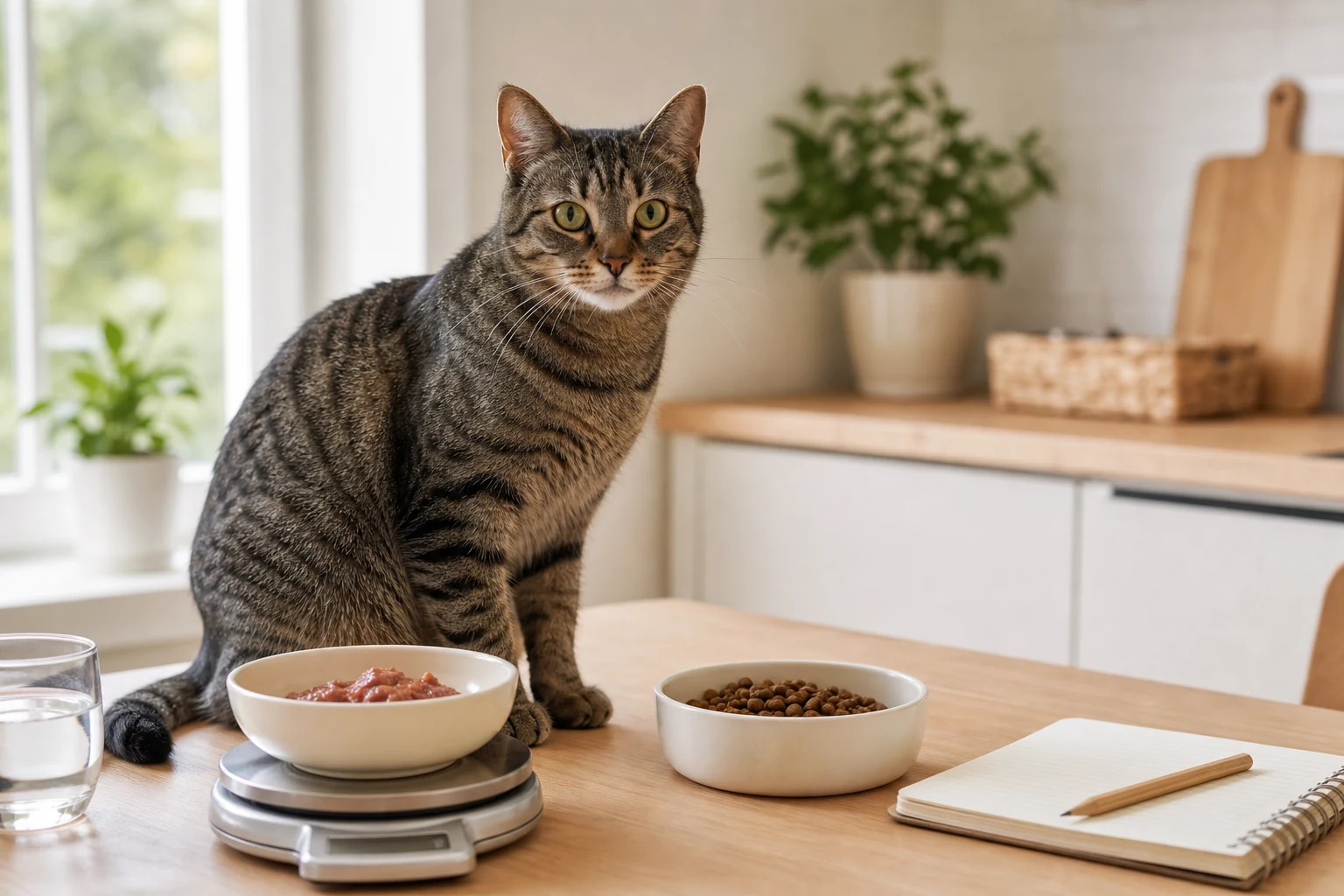
If your indoor cat is gaining weight on mixed feeding, the fix is usually not to quit wet food or dry food. It is to make both formats share one calorie budget, measure the dry portion more accurately, count treats, and track body condition before making another change.
Mixed feeding can be a smart routine for indoor cats. Wet food adds moisture and meal satisfaction, while dry food can work well in timed feeders, puzzle feeders, and small training rewards. The problem starts when wet food becomes an extra meal on top of a full dry-food ration, or when a "small handful" of kibble quietly becomes a daily habit.
This guide is for adult indoor cats who are otherwise eating normally but are slowly gaining weight. If your cat has diabetes, kidney disease, urinary disease, chronic vomiting or diarrhea, pregnancy, nursing, poor appetite, sudden weight change, or a prescribed diet, use this as background education and ask your veterinarian for an individual plan.
Table of Contents
- When is mixed feeding causing weight gain?
- How do you find the calorie drift in a mixed-feeding plan?
- How much should you reduce wet food, dry food, or treats?
- What mixed-feeding schedule helps indoor cats feel satisfied?
- How should you monitor weight without overcorrecting?
- What if your cat acts hungry after the adjustment?
- When should a veterinarian guide the weight plan?
- Conclusion: Adjust the budget, not just the bowl
- Frequently Asked Questions
- References
When is mixed feeding causing weight gain?
Mixed feeding is usually causing weight gain when the cat's total daily calories have crept above maintenance. That can happen even when each individual food looks reasonable.
Cornell Feline Health Center describes obesity as a common nutritional disorder in domestic cats and notes that excess weight should be taken seriously because it can affect health and quality of life 1. For indoor cats, the risk is easy to miss: lower activity, neuter status, food begging, multiple caregivers, and free access to dry food can all push calories upward.
The most common mixed-feeding mistakes are practical, not careless:
| What changed | Why weight gain follows | Better next step |
|---|---|---|
| Wet food was added, but dry food stayed the same | The cat is eating two full plans | Subtract wet-food calories from the dry-food allowance |
| Dry food is measured by a scoop | Scoops vary and kibble pieces settle differently | Weigh dry food in grams for one week |
| Treats are not counted | Small treats can erase a careful meal plan | Put treats inside the daily calorie budget |
| Multiple people feed the cat | Everyone assumes someone else measured | Use one written feeding log |
| Food puzzles are refilled casually | Enrichment becomes hidden grazing | Pre-measure the puzzle portion |
If you need the basic setup first, start with SnuggleSouls' guide on how to mix wet and dry cat food. This article focuses on the next step: adjusting the plan when your indoor cat is gaining weight.
How do you find the calorie drift in a mixed-feeding plan?
Find calorie drift by writing down every food source for seven days: wet meals, dry meals, treats, toppers, lickable snacks, puzzle feeder refills, and food stolen from another pet. Then convert each item to calories.
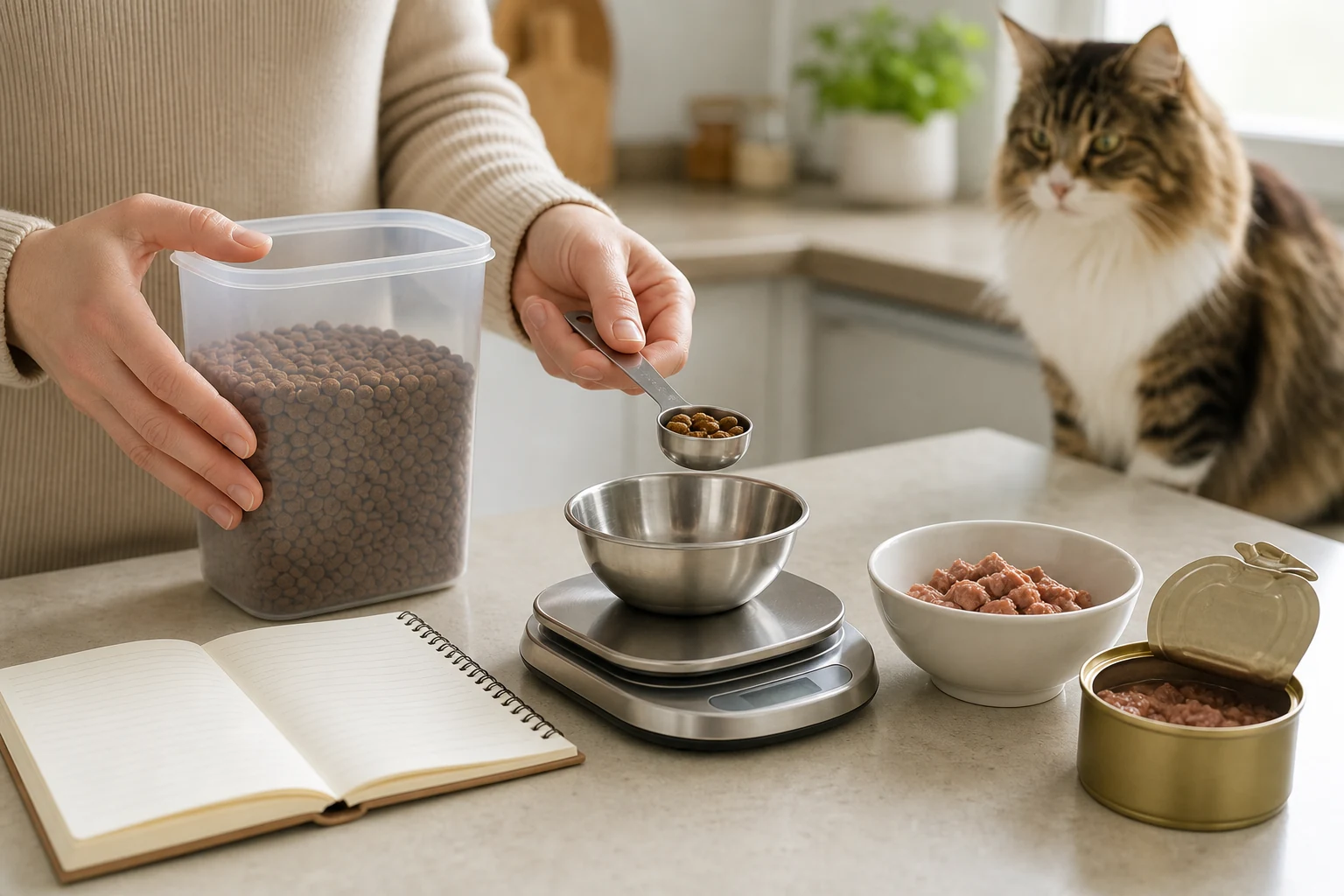
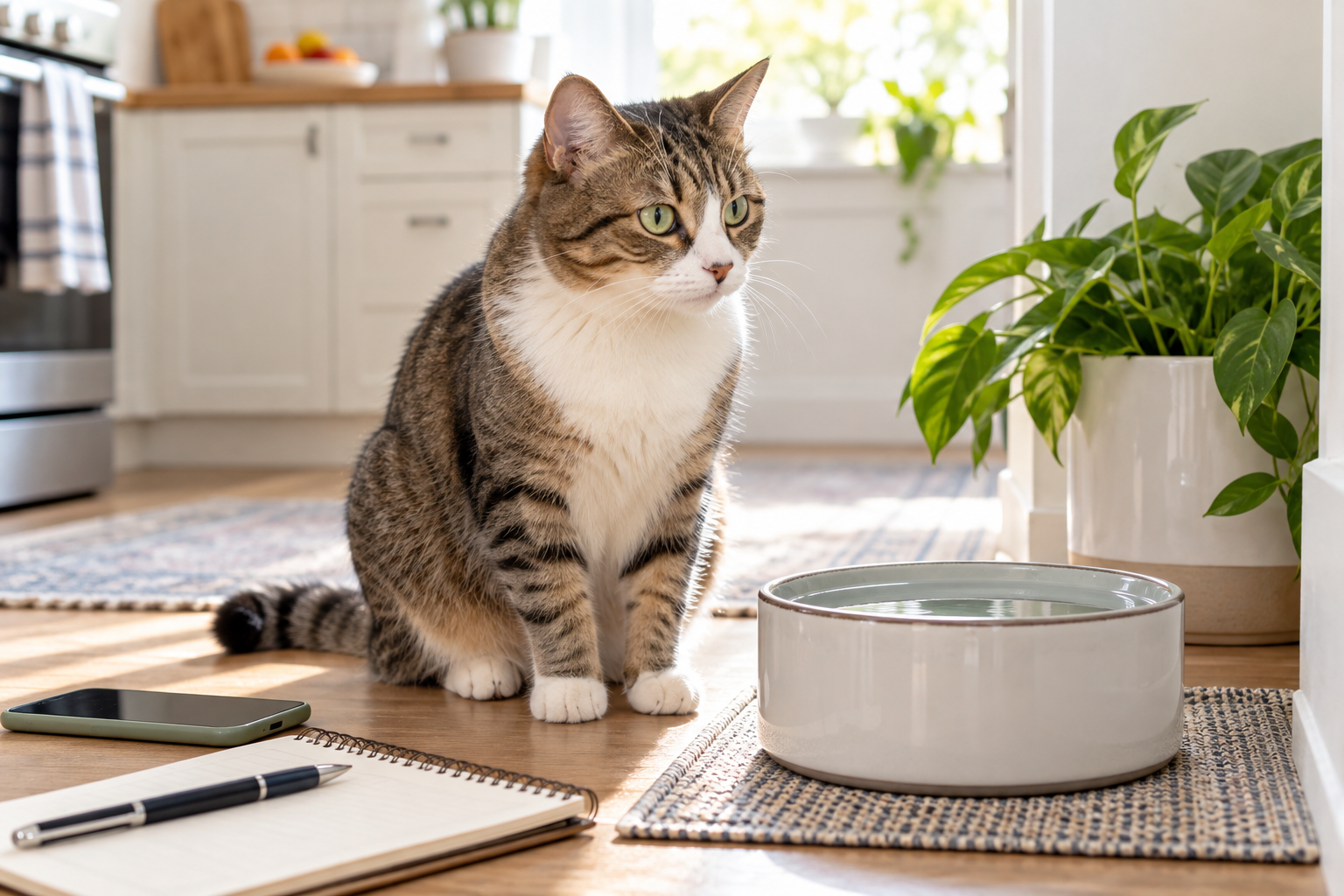
Adjusting mixed feeding starts with measuring both food formats by calories instead of guessing by bowl size.
Food labels are the starting point, not a personalized prescription. The FDA explains that a nutritional adequacy statement helps show whether a food is complete and balanced for a life stage when fed according to directions 4. AAFCO also notes that label terms and feeding directions have specific meanings, including calorie-related claims such as "light" or "low-calorie" 5. Your cat's actual body condition still decides whether the amount is working.
Use this audit:
- Write your cat's current weight and body condition.
- Record the exact wet food brand, recipe, can or pouch size, and calories.
- Weigh the dry food in grams instead of using only a cup line.
- Count treats, toppers, dental treats, pill pockets, and lickable snacks.
- Note who feeds the cat and when.
- Add the daily total for each day, then look for the highest-calorie pattern.
The SnuggleSouls cat calorie calculator can help estimate a starting target, but it should not replace veterinary advice for a cat who needs medical weight loss. The useful comparison is "estimated need" versus "what my cat actually ate this week."
How much should you reduce wet food, dry food, or treats?
For a healthy adult indoor cat with mild weight gain, start with small adjustments and track the result. A common practical step is reducing the easiest-to-overmeasure calories first: extra dry food, treats, and casual refills.
Do not make a sharp cut because cats can become seriously ill if they stop eating. Cornell's weight-loss guidance emphasizes a controlled plan and describes safe weight loss as slow and steady rather than sudden 2. For a cat who is clearly overweight or obese, your veterinarian should help set the target weight, calorie level, and recheck schedule.
Here is a safer order of operations:
| If the extra calories come from… | First adjustment | Why this is usually easiest |
|---|---|---|
| Dry food | Weigh the same scoop amount in grams, then reduce a small measured amount | Kibble is calorie-dense and easy to overpour |
| Treats | Cap treats inside the daily allowance | Treats often go uncounted across caregivers |
| Wet food | Keep meal timing, but reduce by a measured spoonful or use part-cans accurately | Preserves routine and moisture while trimming calories |
| Food puzzles | Fill once from the daily dry allowance | Keeps enrichment without adding a second ration |
| Multi-cat feeding | Feed separately or supervise meals | Prevents one cat from finishing another cat's calories |
If you are unsure what your current baseline should be, review SnuggleSouls' broader guide on how much to feed your cat. The important point is that wet food, dry food, and treats are not separate budgets. They are one budget split into useful parts.
A simple mixed-feeding recalculation
Suppose your cat's starting target is 210 kcal per day. If breakfast wet food provides 70 kcal and dinner wet food provides 70 kcal, that leaves 70 kcal for dry food and treats combined.
If treats average 15 kcal per day, the dry-food allowance is 55 kcal, not "whatever fits in the bowl." If the dry food is 400 kcal per cup or about 4 kcal per gram, that is roughly 14 grams of dry food for the day. Your product label may be very different, so always use the actual calories on your food.
This is why mixed feeding often fails by accident. The wet meals may be reasonable. The dry portion may be reasonable. Together, plus treats, they may be too much.
What mixed-feeding schedule helps indoor cats feel satisfied?
Many indoor cats do better with several predictable food moments rather than one or two large meals and a casually refilled bowl. The schedule should support satiety, monitoring, and enrichment without increasing calories.
Try a structure like this:
| Time | Food format | Goal |
|---|---|---|
| Morning | Measured wet meal | Hydration, routine, easy appetite check |
| Midday or afternoon | Small measured dry portion in a puzzle feeder | Slower eating and enrichment |
| Evening | Measured wet meal | Predictable meal and relationship time |
| Bedtime, if needed | Tiny dry portion from the daily allowance | Prevents overnight begging without adding calories |
The exact timing depends on your cat's age and household routine. SnuggleSouls' cat feeding schedule by age can help you adapt meal frequency for kittens, adults, and seniors.
For an indoor adult who gains weight easily, avoid leaving a full dry bowl available all day unless your veterinarian specifically supports that plan and the amount is still measured. Free access can also make it harder to notice appetite changes, especially in multi-cat homes.
What about automatic feeders?
Timed feeders can help if they dispense a pre-measured portion from the daily allowance. They do not help if they become a second feeding system on top of wet meals and treats.
Use the feeder for one clear job: spreading dry-food calories across the day. Write down the total dry-food grams that go into the feeder each morning, and do not refill it early unless the plan says to.
How should you monitor weight without overcorrecting?
Monitor with both scale weight and body condition. Weight tells you the trend; body condition tells you whether the cat is carrying extra fat, losing muscle, or changing shape.
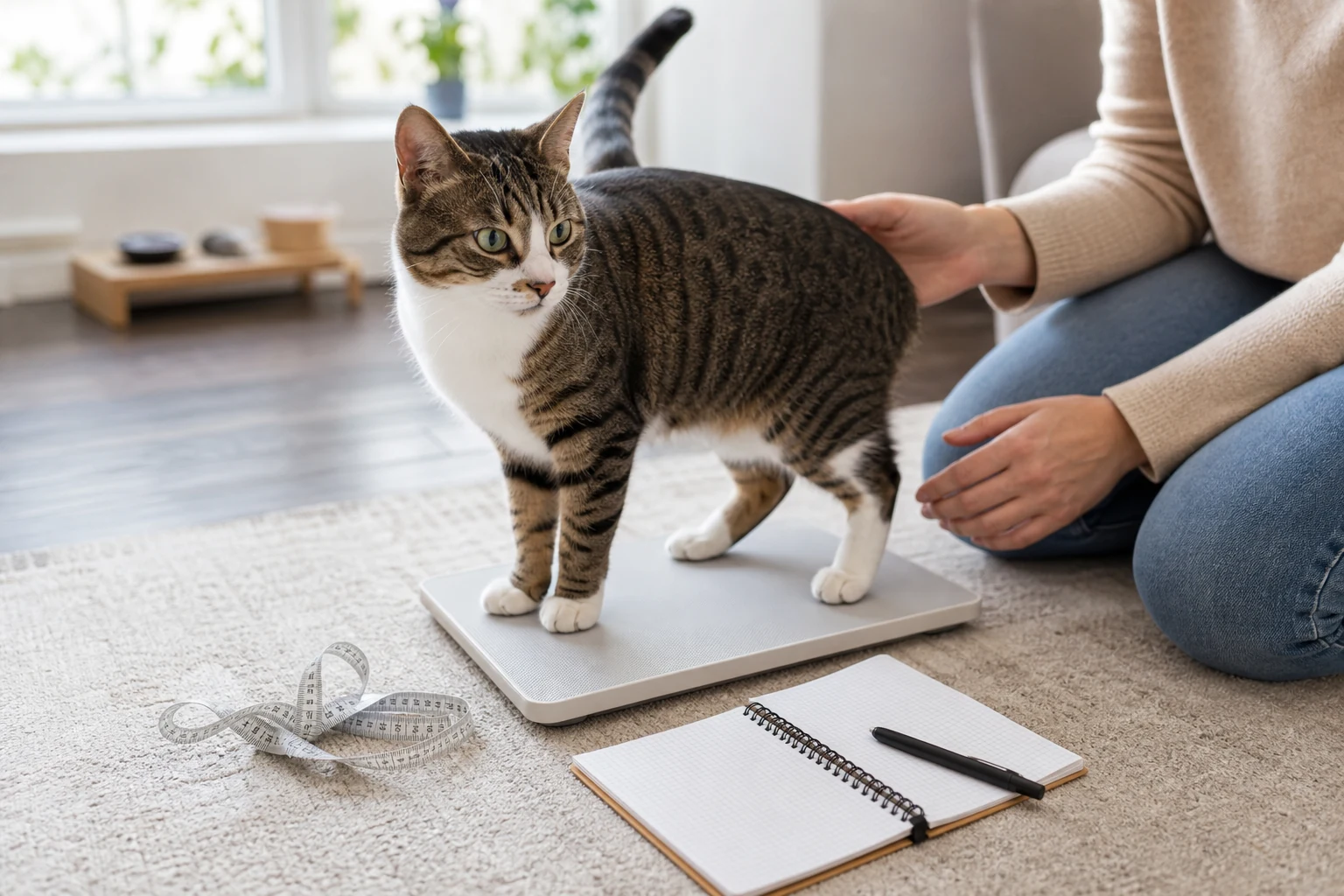
Weekly weight and body-condition checks show whether small portion changes are working safely.
MSD Veterinary Manual describes body condition scoring as a practical nutrition-assessment tool, with the 9-point cat scale using 5 as ideal 3. Because weight alone can be misleading, pair weigh-ins with a hands-on check of ribs, waist, belly pad, and muscle feel.
Use this monitoring rhythm:
- Weigh once weekly or every two weeks, at a similar time of day.
- Take one side-view and one top-view photo monthly if your cat tolerates it.
- Check whether ribs are easy to feel under a light fat cover.
- Watch the waist from above and the belly line from the side.
- Track appetite, stool, vomiting, thirst, energy, and begging.
- Adjust again only after you have a trend, not after one odd day.
The SnuggleSouls cat body condition and weight calculator can help you organize the shape check. For a cat who is already obese, losing weight too fast, not losing despite careful measuring, or living with a medical condition, use veterinary rechecks rather than home adjustments alone.
What if your cat acts hungry after the adjustment?
A cat may act hungry after a portion adjustment because the routine changed, the dry-food bowl is no longer available, meals are too far apart, boredom is clustering around food, or the calorie cut was too steep. Hunger can also be a medical sign when it is sudden, intense, or paired with weight loss.
Before adding more food, check these points:
| Pattern | More likely explanation | Safer response |
|---|---|---|
| Begging starts at the old refill time | Learned routine | Add play or a tiny pre-measured portion at that time |
| Begging improves with puzzle feeding | Boredom or fast eating | Use food puzzles from the daily allowance |
| Begging comes with weight loss | Possible medical issue | Schedule a veterinary exam |
| Begging comes with increased thirst or urination | Possible endocrine or kidney concern | Call your veterinarian |
| Begging is worse in a multi-cat home | Food competition | Feed separately and monitor who eats what |
SnuggleSouls' guide on why your cat is always hungry walks through the difference between normal food-seeking and warning signs. Do not ignore hunger that comes with weight loss, vomiting, diarrhea, increased thirst, increased urination, restlessness, weakness, or behavior change.
How can you add satisfaction without adding calories?
Use the same calories more strategically. Split meals into smaller portions, add water to wet food if your cat likes the texture, put part of the dry allowance in a puzzle feeder, and schedule play before meals.
Avoid replacing every complaint with a treat. That teaches the cat that louder begging changes the plan, and it makes the calorie record unreliable.
When should a veterinarian guide the weight plan?
Ask a veterinarian to guide the plan if your cat is obese, rapidly gaining, losing weight unexpectedly, eating less, vomiting often, having diarrhea, drinking or urinating more, pregnant, nursing, very young, senior, diabetic, on a prescription diet, or living with kidney, urinary, liver, thyroid, heart, or digestive disease.
Also seek urgent care if your cat stops eating for 24-48 hours, cannot urinate, collapses, has breathing trouble, has repeated vomiting, has severe diarrhea, may have eaten something toxic, has seizures, or declines rapidly. Food adjustments should never delay emergency care.
A veterinary team can do more than give a number. They can assign a target body condition, check for pain or disease, protect muscle, recommend an appropriate food, and set a recheck schedule. That matters because an overweight cat still needs enough protein, micronutrients, and safe eating behavior while losing fat.
Conclusion: Adjust the budget, not just the bowl
When an indoor cat gains weight on mixed feeding, the usual problem is not the idea of wet plus dry food. It is calorie drift: a full dry ration plus wet meals, uncounted treats, casual puzzle refills, or more than one person feeding without a shared log.
Start with a seven-day food audit, put wet food, dry food, treats, and toppers into one daily calorie budget, and make small measured changes. Then watch body condition and appetite for a few weeks before adjusting again. If the weight change is significant, sudden, or tied to illness signs, bring your veterinarian into the plan early.
Frequently Asked Questions
Should I stop dry food if my indoor cat is gaining weight?
Not always. Dry food can still work if it is measured accurately and counted inside the daily calorie budget. Because dry food is calorie-dense and easy to overpour, many cats need a smaller dry portion rather than a complete format change.
Is wet food better for an overweight indoor cat?
Wet food can help some cats feel satisfied because it contains more moisture and is naturally meal-based, but it is not automatically a weight-loss food. Calories still matter, and a cat can gain weight on wet food if the total daily amount is too high.
How often should I weigh my cat during a portion adjustment?
For mild home adjustments, weekly or every-two-week weigh-ins are usually enough to see a trend without reacting to daily fluctuation. If your veterinarian has prescribed a weight-loss plan, follow their recheck schedule.
Can I use treats while adjusting mixed feeding?
Yes, but treats should come out of the same daily calorie budget. Measure or count them before the day starts so treats do not become hidden extra calories.
Why is my cat gaining weight even though I measure the food?
Check whether the measuring cup is accurate, whether dry food is being packed differently, whether multiple people feed, whether treats or toppers are counted, and whether your cat is stealing food. Weighing dry food in grams for one week often reveals the issue.
When is weight gain in a cat a medical concern?
Call your veterinarian if weight gain is rapid, your cat seems lethargic, breathing is harder, the belly looks suddenly enlarged, appetite or thirst changes, urination changes, vomiting or diarrhea appears, or your cat has a known medical condition. A feeding adjustment should not replace a veterinary exam when other signs are present.
References
[1] Cornell Feline Health Center. (2026). Obesity. Cornell University College of Veterinary Medicine
[2] Cornell Feline Health Center. (2026). Ask Elizabeth: Care of Obese Cats. Cornell University College of Veterinary Medicine
[3] MSD Veterinary Manual. (2023). Overview of Nutrition: Small Animals. MSD Veterinary Manual
[4] U.S. Food and Drug Administration. (2020). "Complete and Balanced" Pet Food. FDA
[5] Association of American Feed Control Officials. (2023). Reading Labels. AAFCO
 Why Does My Cat Flinch When Touched While Sleeping? Startle, Trust, and Pain Clues">
 Cat Scratching Baseboards: Trim Guards and Route Fixes">
 EN
EN DE
DE ES
ES PT
PT