
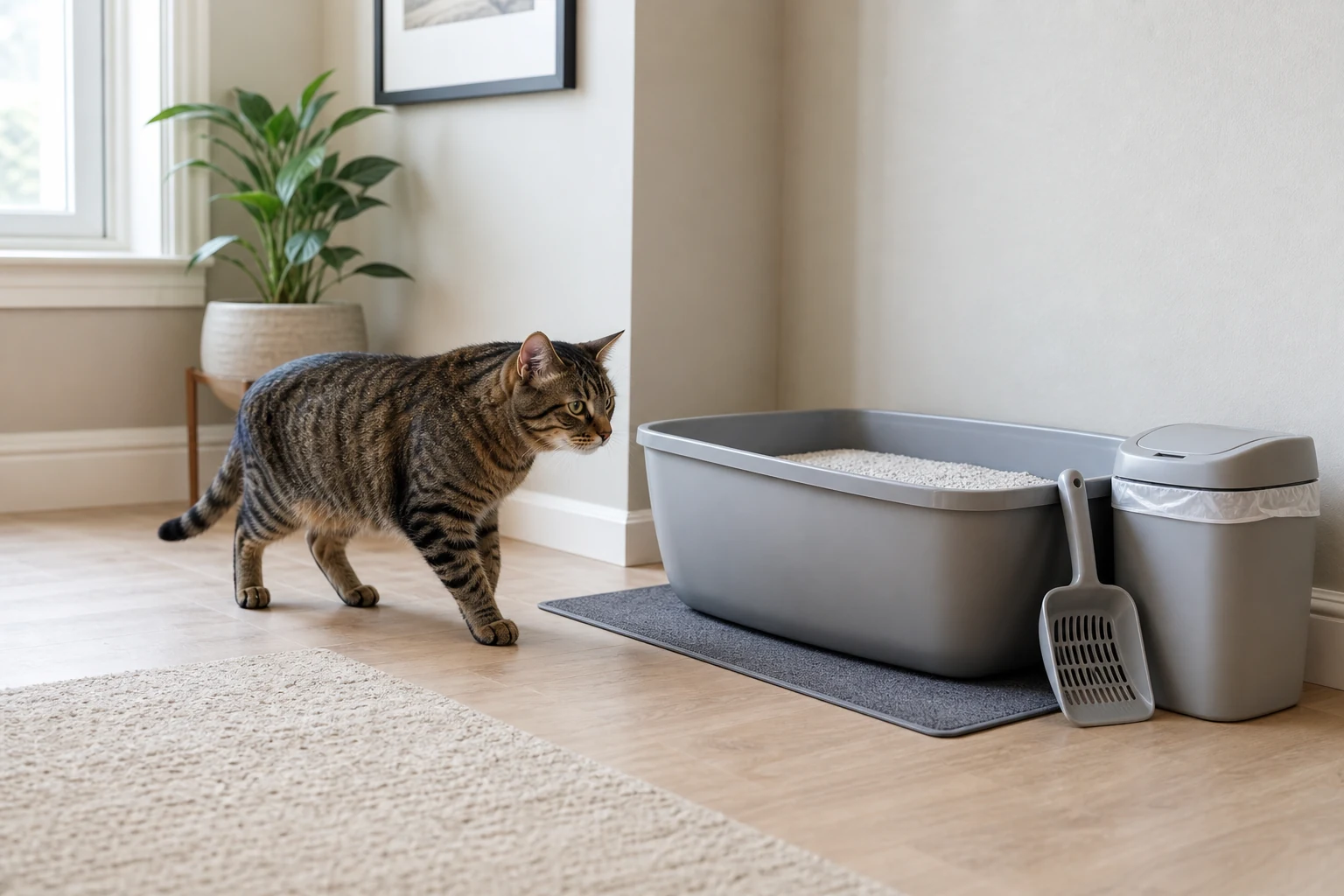
The best cat litter box setup gives your cat a large, clean box in a quiet, easy-to-reach location, with enough separate boxes for every cat to have a safe choice. Start with one box per cat plus one extra, scoop at least daily, and adjust the box to your cat's size, mobility, and preferences.
A good setup is not about hiding the box as completely as possible. It is about making a necessary daily activity feel safe and predictable. The right box can help prevent avoidable accidents, reduce tension in multi-cat homes, and make it easier for you to notice changes in urine or stool.
Table of Contents
- What is the best basic litter box setup?
- How big should a cat litter box be?
- Where should you put a cat litter box?
- How many litter boxes do cats need?
- What litter and box style do most cats prefer?
- How often should you clean a litter box?
- How should you adapt a litter box for a kitten or senior cat?
- What if your cat suddenly stops using the litter box?
- Conclusion: Build a setup your cat will choose
- Frequently Asked Questions
- References
What is the best basic litter box setup?
For many cats, the best starting setup is a large, uncovered rectangular box with an easy entrance, filled with a moderate layer of unscented litter and placed somewhere quiet but convenient. Keep a scoop and sealed waste container nearby so cleaning is easy to maintain.
Use this practical checklist:
- Use one litter box per cat plus one extra as a starting point, and place boxes in separate locations.
- Choose a box approximately 1.5 times your cat's nose-to-tail-base length.
- Give the cat a clear view and more than one way to leave the area.
- Keep the box away from food, water, and noisy appliances.
- Scoop urine clumps and stool at least once every day.
- Wash and refresh the box at least weekly; clean it sooner if residue or odor remains.
- Watch which box, litter texture, and depth your cat actually chooses.
If scatter still collects at an open-box exit, a flat mat is an optional add-on. Keep it outside the entrance and check that it stays flat and does not narrow the route.
An optional mat for scatter at the exit
Place it outside the box entrance and make sure it lies flat. A mat cannot compensate for a cramped or dirty box.

Frisco
Frisco Rectangular Cat Litter Mat, Beige, Large
Frisco Rectangular Cat Litter Mat, Beige, Large; Put litter in its place with this cat litter box mat from Frisco by Chewy. It's designed…
$12.49
Check price and availabilityWe may earn a commission if you buy through this Chewy link, at no extra cost to you. Product details and prices can change.
How big should a cat litter box be?
Bigger is usually better because a cat needs room to enter, turn, dig, choose a clean spot, eliminate, and cover waste without being cramped. Feline house-soiling guidelines recommend a rectangular box about 1.5 times the cat's length from nose to the base of the tail.1
Many standard commercial boxes are too small for a full-grown cat. A large storage container or mixing tray can work well when purpose-made boxes do not provide enough floor space. Any alternative must be stable, easy to clean, and modified so the entrance does not have sharp edges.
To check whether a box is actually big enough, measure your cat from the tip of the nose to the base of the tail and look for an inside length of at least 1.5 times that figure. The litter box size calculator turns that measurement into a minimum inside length and also estimates household box count and litter volume. For a long-bodied cat, our litter box guide for large cats explains how to check usable space and entry height.
| Cat's needs | Helpful box feature | Avoid |
|---|---|---|
| Average healthy adult | Large floor area and comfortable entry | A cramped box that forces awkward turning |
| Large or long-bodied cat | Extra-large rectangular box | Choosing by weight label alone |
| Cat that urinates high | Tall back and side walls with a lower entrance | A high entrance on every side |
| Cat with limited mobility | Low entry and non-slip approach | Tall walls the cat must climb over |
A covered box does not automatically create more usable space. Measure the inside floor area, check that your cat can turn comfortably, and remember that a lid can trap odors that humans do not immediately notice.
Where should you put a cat litter box?
Put each box in a quiet, accessible area where your cat will not feel trapped, startled, or blocked by another pet. The location should be convenient enough that the cat can reach it quickly and you can clean it daily.
Good locations often have:
- A clear, well-lit route at all hours.
- Low foot traffic without complete isolation.
- Distance from washing machines, dryers, furnaces, and sudden noises.
- More than one possible exit path.
- Enough space that another cat cannot guard the doorway.
Avoid putting the only box in a distant basement, behind a door that may close, beside food bowls, or in a narrow dead end. In a multi-story home, place at least one box on each level your cat uses and distribute the rest around the home.1 2 Boxes lined up together usually function like one toileting station rather than several meaningful choices.1
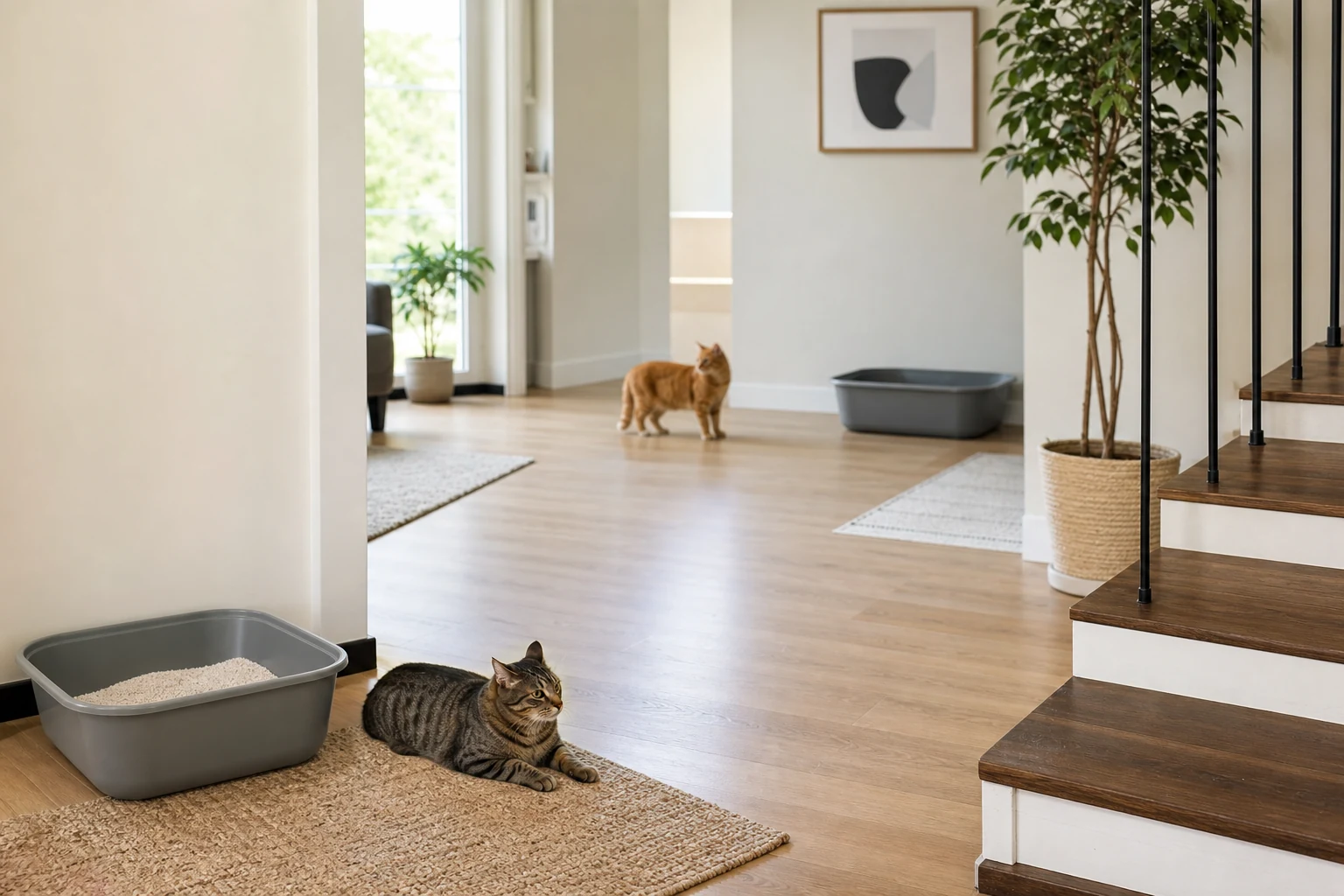
Placement is also behavioral. A timid cat may avoid a box near a busy hallway, while tension between cats can make an apparently clean box feel unsafe. If a cat avoids the box, use our litter-box avoidance checklist to check access, cleanliness, and other common setup factors before assuming the cat is being stubborn.
How many litter boxes do cats need?
The usual starting rule is one box per cat plus one extra. The AAFP/ISFM guidelines recommend two boxes in separate locations for a single-cat home and describe the extra-box formula as a rule of thumb for multi-cat homes, not an absolute quota.1
| Cats in the home | Common starting count | Layout check |
|---|---|---|
| 1 | 2 boxes | Put them in separate locations. |
| 2 | 3 boxes | Do not group all boxes in one room. |
| 3 | 4 boxes | Distribute them across floors and social groups where possible. |
In a multi-story home, provide at least one box on each level the cats use. Add or move boxes when one cat can wait outside, guard an entrance, or block another cat's route. Two boxes touching each other do not offer the same choice as two separated stations. For a home with an older cat, see our multiple-box setup for senior cats.
Add or reposition boxes when:
- One cat waits for another to finish.
- A cat ambushes or chases another near a box.
- One cat consistently avoids a particular floor or room.
- A cat urinates in one box but defecates in another.
- A senior cat cannot reliably reach the existing locations.
- Accidents happen when a favored box is dirty.
The right number is the number that lets every cat eliminate without delay, conflict, or discomfort.
What litter and box style do most cats prefer?
Many cats accept a large uncovered box with soft, fine-grained, unscented litter, but individual preferences matter. Strong perfumes, abrupt litter changes, uncomfortable textures, and dirty boxes can all contribute to avoidance. Cornell notes that box, litter, and location may each contribute to litter box aversion.3
If your cat reliably uses the current litter, do not change it merely because a new product looks more convenient. If you need to test an alternative, place a second box beside the familiar one temporarily and change only one variable at a time. Let your cat's consistent choice guide you.
Covered boxes can provide visual privacy and contain scatter, but they may feel cramped, restrict escape routes, or hold odor. Self-cleaning boxes may help some households, yet their movement and sound can frighten some cats. Keep a familiar, non-automated box available while introducing any new system. For a side-by-side comparison, see our covered vs. uncovered litter box guide.
How often should you clean a litter box?
Scoop every litter box at least once daily, and more often when several cats share a station or when a cat produces frequent waste. Merck Veterinary Manual also recommends cleaning the entire box at least weekly, with more frequent cleaning when more cats use it.4 Daily checks keep clean areas available and help you notice changes in urine or stool.
A simple routine works well:
| Task | Practical schedule | Why it matters |
|---|---|---|
| Remove stool and urine clumps | At least daily | Preserves clean choices and limits odor |
| Check litter level and scatter | Daily | Keeps digging depth comfortable and paths tidy |
| Top up compatible litter | As needed | Maintains a consistent surface |
| Empty and wash the box | At least weekly; sooner if odor or residue remains | Removes buildup that scooping cannot fix |
| Inspect box for scratches or damage | During each full wash | Deep scratches can retain odor and become harder to clean |
Use mild, unscented soap and rinse thoroughly. Avoid overwhelming fragrance or harsh cleaners that leave a strong smell. Replace the box when damage makes it difficult to clean. Use our litter-box cleaning schedule to build a repeatable routine.
Do not punish a cat for an accident. Clean the soiled area thoroughly with a pet-safe odor-removing product and investigate why the preferred box was not usable or appealing.
How should you adapt a litter box for a kitten or senior cat?
Kittens, senior cats, and cats with pain or limited mobility need an entrance they can cross comfortably and a box near the areas where they spend time. A low-entry side, stable footing, and unobstructed route can make a major difference.3
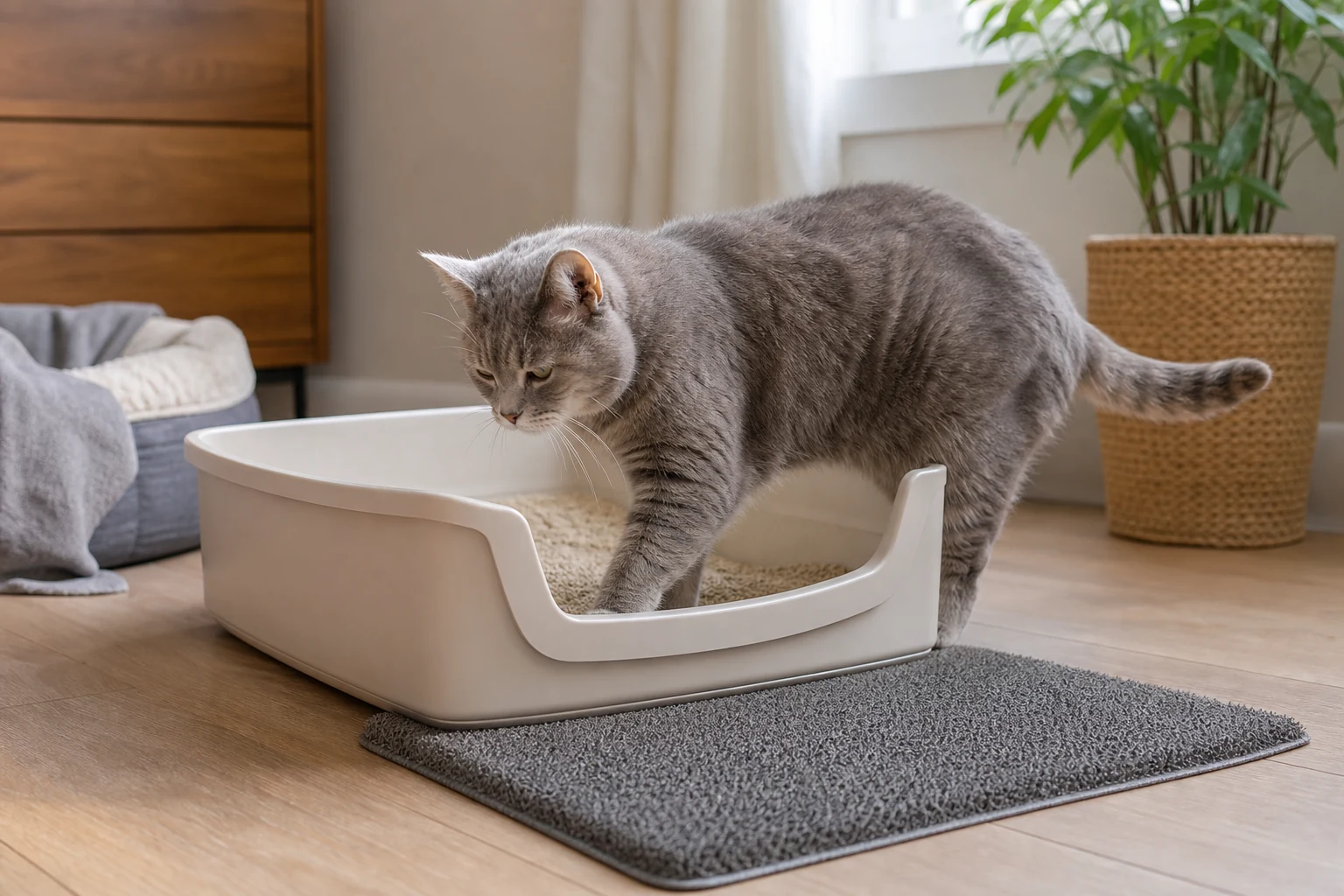
For a kitten, confirm that the box is easy to find and that the kitten can climb in without struggling. Keep boxes away from unsafe rooms and supervise access until household habits are established.
For an older cat, place at least one low-entry box on the same floor as favorite resting areas. A night-light can help when the route is dark, while a non-slip mat can improve footing on slick flooring. Our low-entry litter box guide for senior cats covers how to check the entrance and the full route.
What if your cat suddenly stops using the litter box?
Sudden house soiling is a reason to contact your veterinarian, especially when the cat previously used the box reliably. Medical discomfort, urinary disease, constipation, diarrhea, pain, mobility changes, and increased urine production can all affect litter box use.3
Seek urgent veterinary care if your cat repeatedly enters the box but produces little or no urine, strains, cries, or seems distressed. A suspected urinary blockage is an emergency and needs immediate veterinary attention.5
While arranging care, note:
- Whether the accident was urine, stool, or spraying on a vertical surface.
- Changes in frequency, volume, color, or consistency.
- Which boxes are still being used.
- Recent changes to litter, cleaning products, location, pets, or routines.
- Signs of pain, reduced appetite, hiding, or decreased activity.
Do not assume the cat is being spiteful. Review the setup, but contact a veterinarian before treating a sudden change as purely behavioral. For urinary signs, see our cat urinary warning signs while arranging veterinary advice.
Conclusion: Build a setup your cat will choose
The best cat litter box setup is roomy, clean, quiet, accessible, and distributed around the home. Use one box per cat plus one extra as a starting count, separate the stations, scoop daily, and adapt entrances and routes to each cat's mobility. If a cat suddenly avoids a box or struggles to urinate, contact a veterinarian instead of treating the change as a setup problem alone.
Most importantly, observe your cat's choices. Reliable litter box use tells you the setup is working; a sudden change is information that deserves a calm, prompt response.
Frequently Asked Questions
Is one litter box enough for one cat?
One box may work, but two boxes in separate locations give a single cat a backup when one is dirty, inaccessible, or associated with a frightening event. The common starting rule is one box per cat plus one extra.
Should litter boxes be covered or uncovered?
Many cats do well with uncovered boxes because they provide space, airflow, and clear exit routes. A covered box can work if it is genuinely large, kept very clean, and freely chosen by the cat.
Can I put a litter box next to the washing machine?
It is usually better to avoid that location. Sudden cycles, vibration, and noise can startle a cat while it is vulnerable and may make the box feel unsafe.
How deep should cat litter be?
Many cats do well with a starting layer of about 1–2 inches, but litter type, product directions, and your cat's digging behavior matter. Adjust gradually, and use our cat litter depth guide for signs that the layer is too shallow or too deep.3
Why does my cat use one litter box but ignore another?
The ignored box may differ in size, litter, cleanliness, accessibility, or perceived safety. Compare one factor at a time and remember that two nearby boxes may feel like one location to your cat.
References
[1] Feline Veterinary Medical Association and International Society of Feline Medicine. (2014). 2014 AAFP/ISFM Guidelines for Diagnosing and Solving House-Soiling Behavior in Cats. Read the guidelines
[2] The Ohio State University Indoor Pet Initiative. Litter Boxes. Read the litter box guidance
[3] Cornell Feline Health Center. Feline Behavior Problems: House Soiling. Read the Cornell guide
[4] Merck Veterinary Manual. (2025). Providing a Litter Box for a Cat. Read the Merck guide
[5] Cornell Feline Health Center. (2016). Feline Lower Urinary Tract Disease. Read the Cornell guide
 EN
 DE
 ES
 PT