
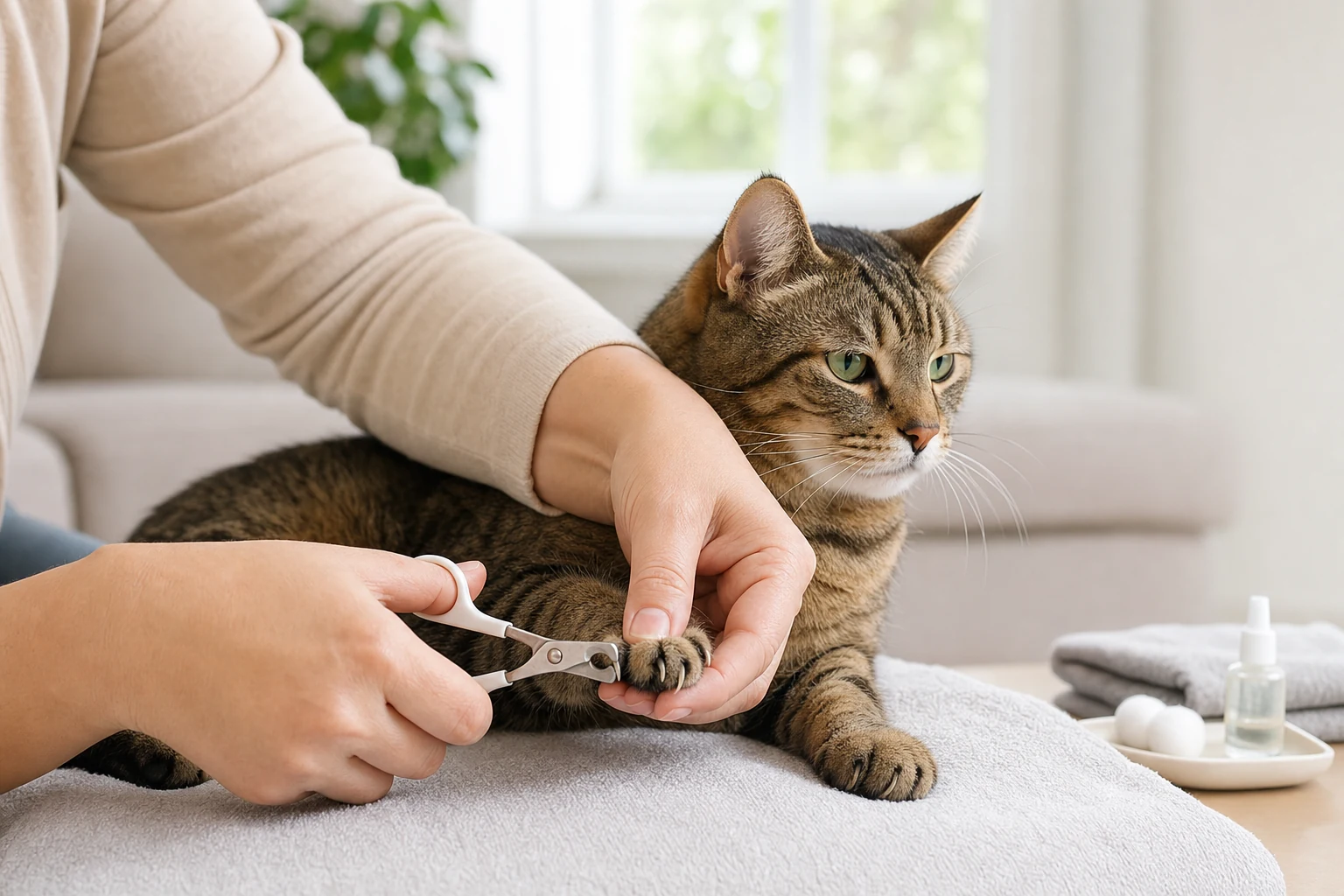
To trim cat nails safely at home, wait until your cat is relaxed, extend one claw gently, and cut only the sharp translucent tip at an angle parallel to the nail’s curve—well before the pink quick [1]. Reward after every single claw and stop before frustration builds.
Table of Contents
- Why do cats need their nails trimmed (and can they trim their own)?
- How often should you trim cat and kitten nails?
- What do you need before trimming?
- Where—and at what angle—should you cut a cat’s nail?
- How do you trim cat nails step by step (including alone)?
- How can you help your cat accept nail trims?
- What should you do if you cut the quick?
- When should you stop a nail-trimming session?
- When should a veterinarian or groomer trim the nails?
- Conclusion: Make each trim small and successful
- Frequently Asked Questions
- References
Why do cats need their nails trimmed (and can they trim their own)?
Cats cannot reliably trim all their own nails—scratching posts help shed loose outer nail sheaths every 2 to 3 months, but indoor cats still need regular tip trims so curved claws and front dewclaws do not snag fabrics or grow into paw pads [1].
- Normal nail shedding (“peeling”) vs. a claw falling out: Finding hollow, translucent, crescent-shaped claw husks near a scratching post is completely normal shedding of the outer nail layer. By contrast, if an entire bloody claw falls out or tears off at the base, keep the paw clean and contact a veterinarian—the nail usually regrows over several weeks if the nail bed is intact, though infection or trauma needs medical care.
- Signs a trim or vet check is overdue: Claws curving toward paw pads, snagging on carpets, limping, licking one toe, or swelling/odor around a nail bed.
How often should you trim cat and kitten nails?
Check indoor cat claws every 1 to 2 weeks and trim sharp tips every 2 to 4 weeks, starting gentle paw handling with kittens around 4 weeks of age and clipping tiny needle tips as soon as claws extend comfortably [1] [2]. Add a quick weekly paw check to your daily cat-care routines.
What do you need before trimming?
Set up sharp cat-specific nail clippers, high-value or lickable treats, bright lighting, and styptic powder or cornstarch before bringing your cat over, and store grooming tools safely afterward per our cat-proofing your home guide:
A small clipper for careful tip trims
Trim only a small visible tip while your cat is calm. Stop if your cat resists or you cannot see the quick; ask your veterinarian or groomer for a demonstration.
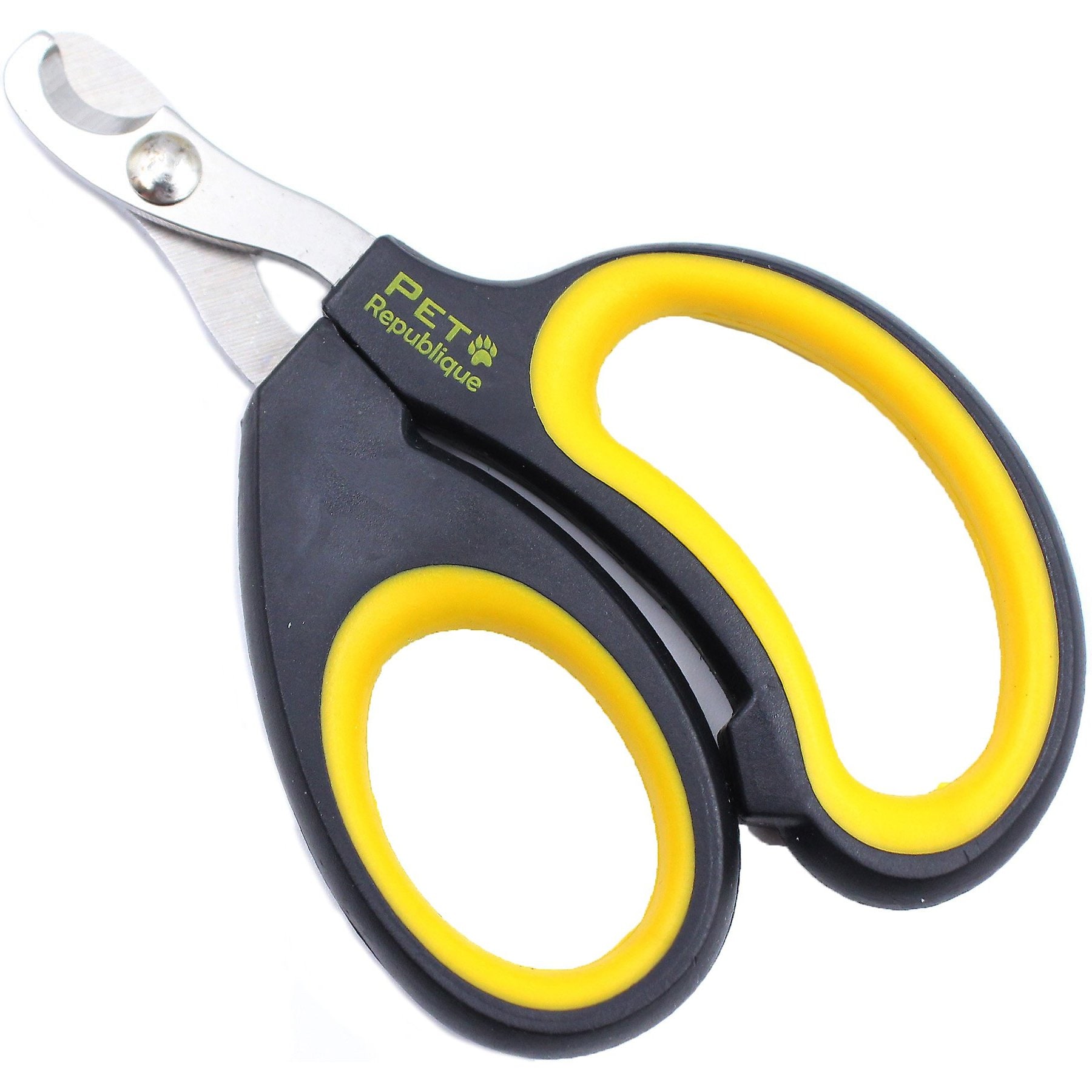
Pet Republique
Pet Republique Asymmetrical Cat Nail Clipper
These Pet Republique Mini Cat Nail Clippers make giving your kitty her mani-pedi less of a chore. With a non-slip grip and thick stainless…
$6.99
Check price and availabilityWe may earn a commission if you buy through this Chewy link, at no extra cost to you. Product details and prices can change.
Where—and at what angle—should you cut a cat’s nail?
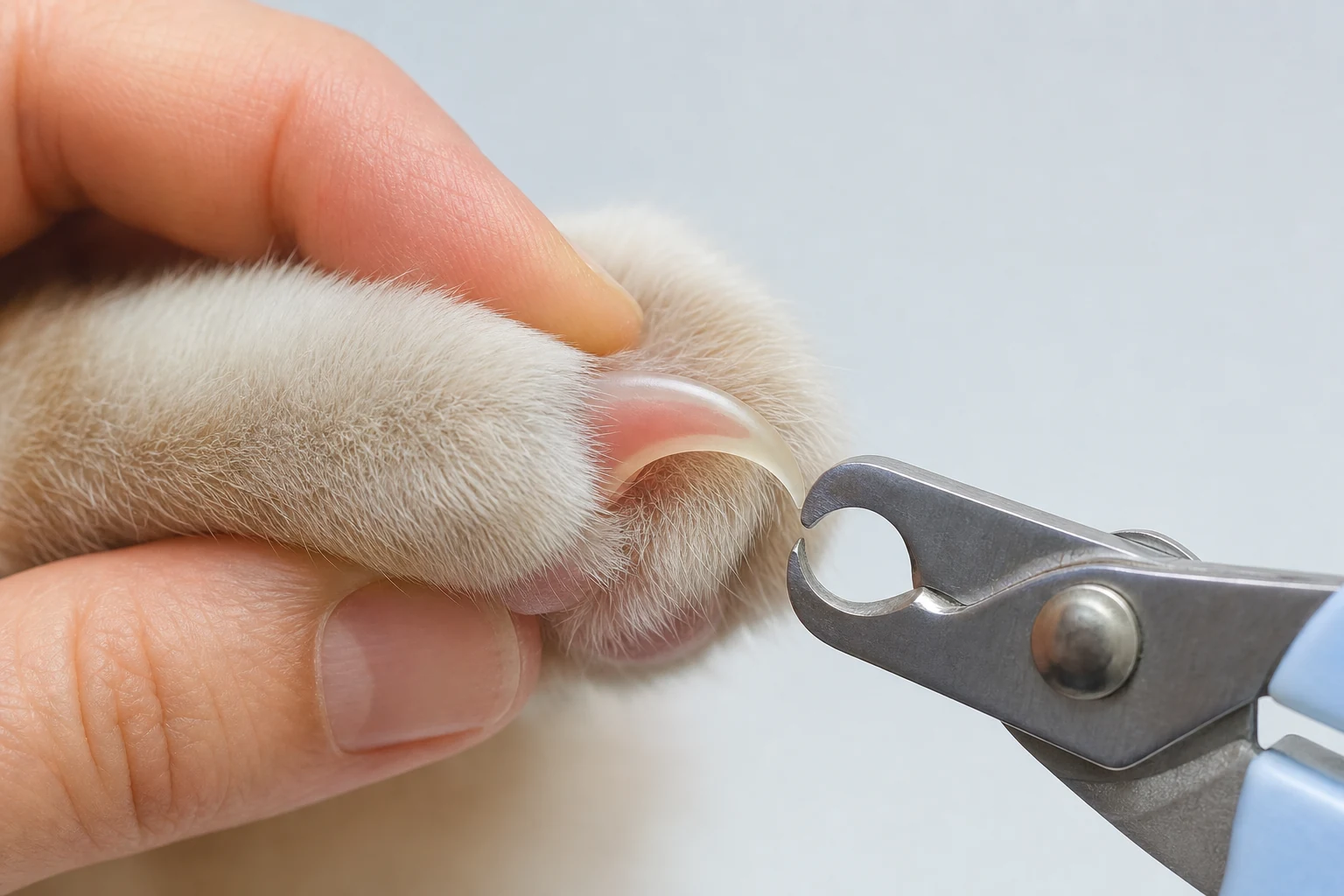
Cut only the narrow, translucent hooked tip 2 to 3 millimeters in front of the pink quick, holding the clipper blades at a 45-degree angle parallel to the natural downward curve of the claw so the nail does not split or crush [1].
| What you see | Safest response |
|---|---|
| Clear claw with visible pink quick | Angle blades parallel to the claw curve and clip only the translucent hooked tip |
| Dark claw with no visible quick | Remove a tiny 1–2 mm tip only, or ask a vet tech or groomer to demonstrate |
| Thick, split, swollen, or bleeding nail | Stop and contact a veterinarian |
| Claw curving into the paw pad | Arrange prompt veterinary care |
How do you trim cat nails step by step (including alone)?
You can trim your cat’s nails alone without a second person by letting your cat sit comfortably beside you on a bed or sofa, offering a lickable treat mat, and clipping 1 to 3 claws per relaxed session [2]:
- Choose a calm moment right after a meal or afternoon nap.
- Sit beside your cat (avoid pinning or scruffing) and gently cradle one paw in your non-dominant hand.
- Press the top of one toe pad softly to extend the claw into bright light.
- Identify the pink quick, align the clipper blades parallel to the tip, and make one crisp cut.
- Release the paw immediately, offer a treat, and stop as soon as your cat wants to walk away.
How can you help your cat accept nail trims?
Build trust over several days by pairing brief paw touches and the sound of clippers snapping dry pasta with treats before trimming a single real claw [2] [3]. Browse our cat behavior guides to spot early stress cues.

What should you do if you cut the quick?
If you accidentally nick the pink quick, stay calm, press a pinch of styptic powder or cornstarch onto the nail tip for 30–60 seconds until bleeding stops, and end the session for the day [1]. Call a veterinarian if bleeding continues past 5–10 minutes or the nail splits deeply.
When should you stop a nail-trimming session?
Stop immediately if your cat pulls its paw away repeatedly, flicks its tail, flattens its ears, growls, or tries to leave—continuing through a struggle risks nicking the quick or triggering defensive bites (see our warning signs before a cat bites and why cats hide).
When should a veterinarian or groomer trim the nails?
Schedule a veterinary or professional cat-groomer trim if a claw is embedded in the paw pad, a nail is torn or infected, or your cat becomes highly stressed during home handling [1]. Routine vet-tech or groomer nail trims typically cost around $15–$30 depending on your clinic and location.
Conclusion: Make each trim small and successful
Trimming your cat’s nails safely at home works best when you prioritize low stress and accurate tip placement over finishing all 18 claws in one sitting. Use sharp cat clippers angled parallel to the nail curve, stay well clear of the pink quick, reward every small step, and ask your veterinarian for help whenever a claw looks damaged, ingrown, or painful [1] [2].
Frequently Asked Questions
When can you start trimming a kitten’s nails—and how do you trim them alone?
You can begin gentle paw touches and kitten-nail conditioning as early as 4 weeks of age, clipping just the tiny needle tips once your kitten sits calmly in your lap [2]. To trim nails alone, place a lickable treat on a mat in front of your cat and clip 1 or 2 claws per relaxed session without restraining it.
Why are my cat’s nails peeling or shedding—and do torn claws grow back?
Cats naturally shed (“peel”) their hollow outer nail sheaths every 2 to 3 months as new claw layers grow underneath, which is normal and healthy [1]. If an entire claw is torn or falls out with bleeding, a new claw usually grows back over several weeks as long as the nail bed is undamaged, though a vet should check for infection or pain.
Can I use regular human nail clippers on my cat?
While small human nail clippers can occasionally snip a tiny kitten tip, cat-specific scissor or pliers-style clippers are much safer for adult cats because curved feline blades cut cleanly without crushing thick nail layers [1].
How many nails does a cat have?
Most cats have 18 nails total: 5 claws on each front paw (including the higher inner dewclaw) and 4 claws on each back paw. Polydactyl cats have extra toes on one or more paws that also require regular nail checks.
Do scratching posts replace nail trimming?
No—scratching posts help cats shed outer nail husks and stretch muscles, but they do not shorten curved claw tips or front dewclaws reliably, so indoor cats still benefit from trims every 2 to 4 weeks [1].
References
[1] VCA Animal Hospitals. Nail Trimming and Nail Care in Cats.
[2] American Society for the Prevention of Cruelty to Animals (ASPCA). Cat Grooming Tips: Nail Trimming.
[3] Feline Veterinary Medical Association and International Society of Feline Medicine. AAFP and ISFM Feline Environmental Needs Guidelines.