
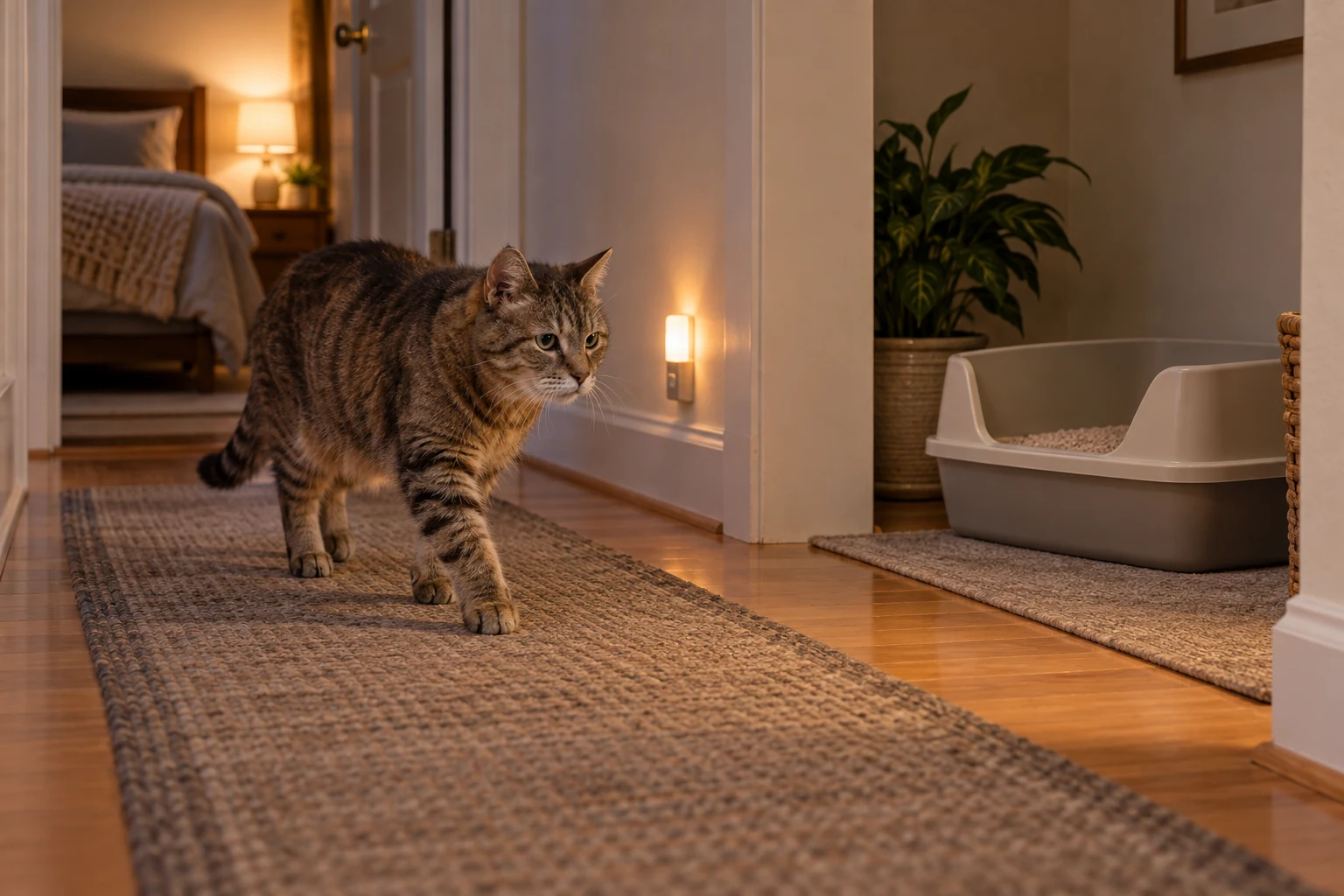
A senior cat's nighttime litter box route should be short, visible, non-slip, and open, with flat rugs, gentle lights, clear doors, and a low-entry box.
This guide focuses on the path between rest and relief: rugs, lights, doorway access, box distance, and the small obstacles that become bigger at 2 a.m. The goal is to make toileting easier without moving everything at once or startling a cat who already depends on routine.
Table of Contents
- Why does a senior cat need a safer nighttime litter box route?
- How do you map the nighttime route before moving anything?
- What rugs, lights, and door access changes make the route safer?
- How close should the litter box be to the sleep area?
- What should you avoid on a senior cat's night route?
- When should a nighttime litter box problem mean a vet call?
- What should you track after changing the route?
- Conclusion:
- Frequently Asked Questions
- References
Why does a senior cat need a safer nighttime litter box route?
A senior cat may need a safer route because aging can change mobility, vision, confidence, bladder habits, and tolerance for household obstacles. The 2021 AAFP senior-care guidelines specifically encourage supports such as night lights, ramps, and easier access for aging cats 1.
Night makes small barriers harder. A cat who crosses the hall easily at noon may wake stiff after a long nap, hesitate at a shiny floor, or avoid a dark doorway. Cornell notes that older cats should have easy access to food, water, and litter boxes so they do not have to climb stairs if they choose not to 2.
This is similar to helping a senior cat reach bedroom water at night, but the litter box has a higher urgency. A cat who is unsure of the route may delay, rush, eliminate beside the box, or choose a nearer soft surface.
The fix is not only "add a box." A safer night route combines:
- a low-effort distance from the main sleeping area;
- firm traction from bed or favorite nap spot to the box;
- soft, steady light that does not glare;
- doors that stay open wide enough all night;
- a box the cat can enter, turn inside, and leave without pain or fear;
- a clear exit if another pet appears.
How do you map the nighttime route before moving anything?
Map the route by watching the path your cat already chooses from evening through early morning. Start at the places where your cat sleeps, then follow the exact floor path to the nearest litter box as if you were moving at cat height.
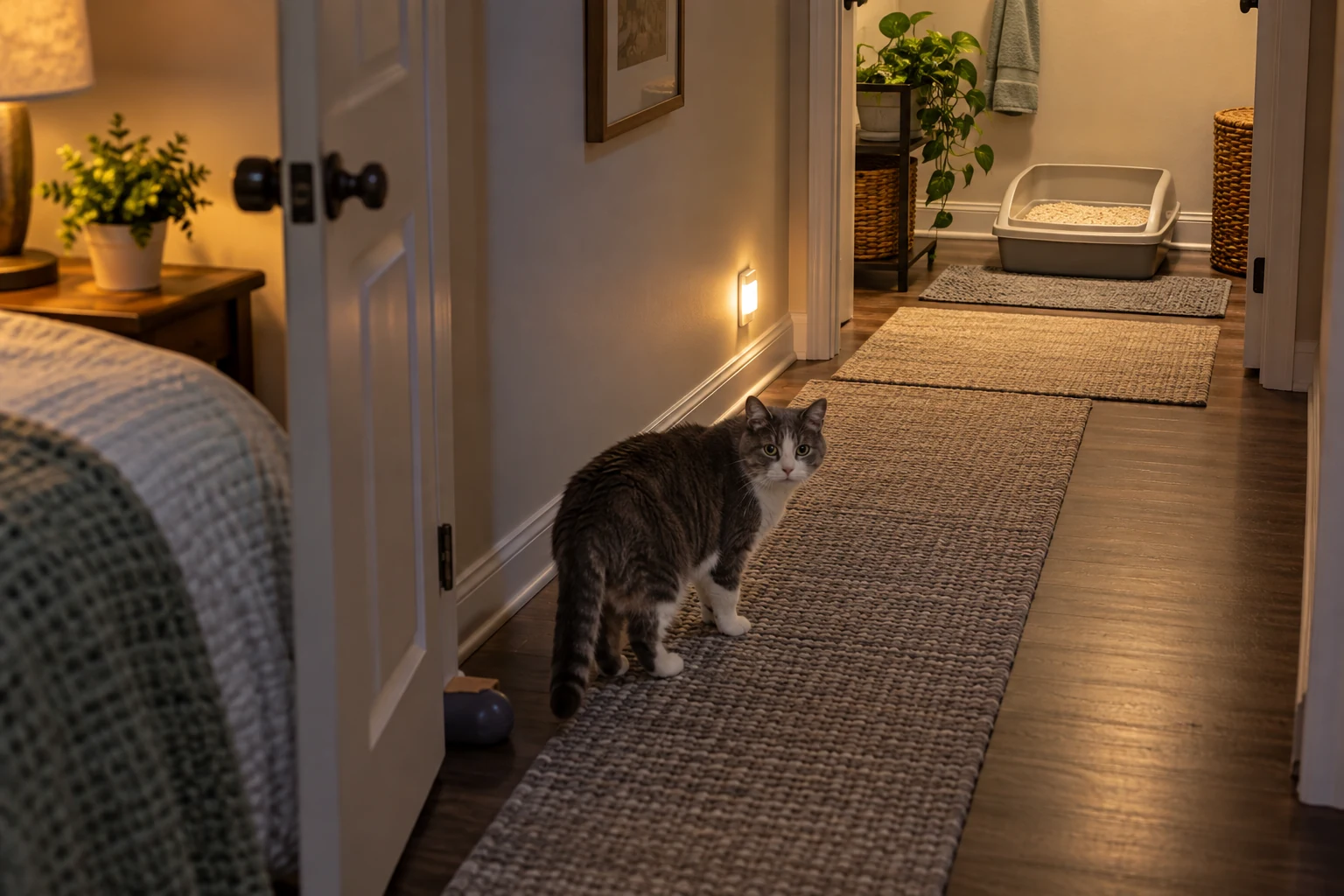
Ask these questions before you buy anything:
- Where does your cat sleep most often after dinner?
- Which litter box does your cat use overnight?
- Does the route include stairs, slick flooring, thresholds, tight corners, or closed doors?
- Does your cat walk along walls, furniture, or baseboards for confidence?
- Does another cat, dog, or child block the route?
- Is the box visible from the doorway, or hidden around a blind corner?
- Is there enough room to turn around near the box?
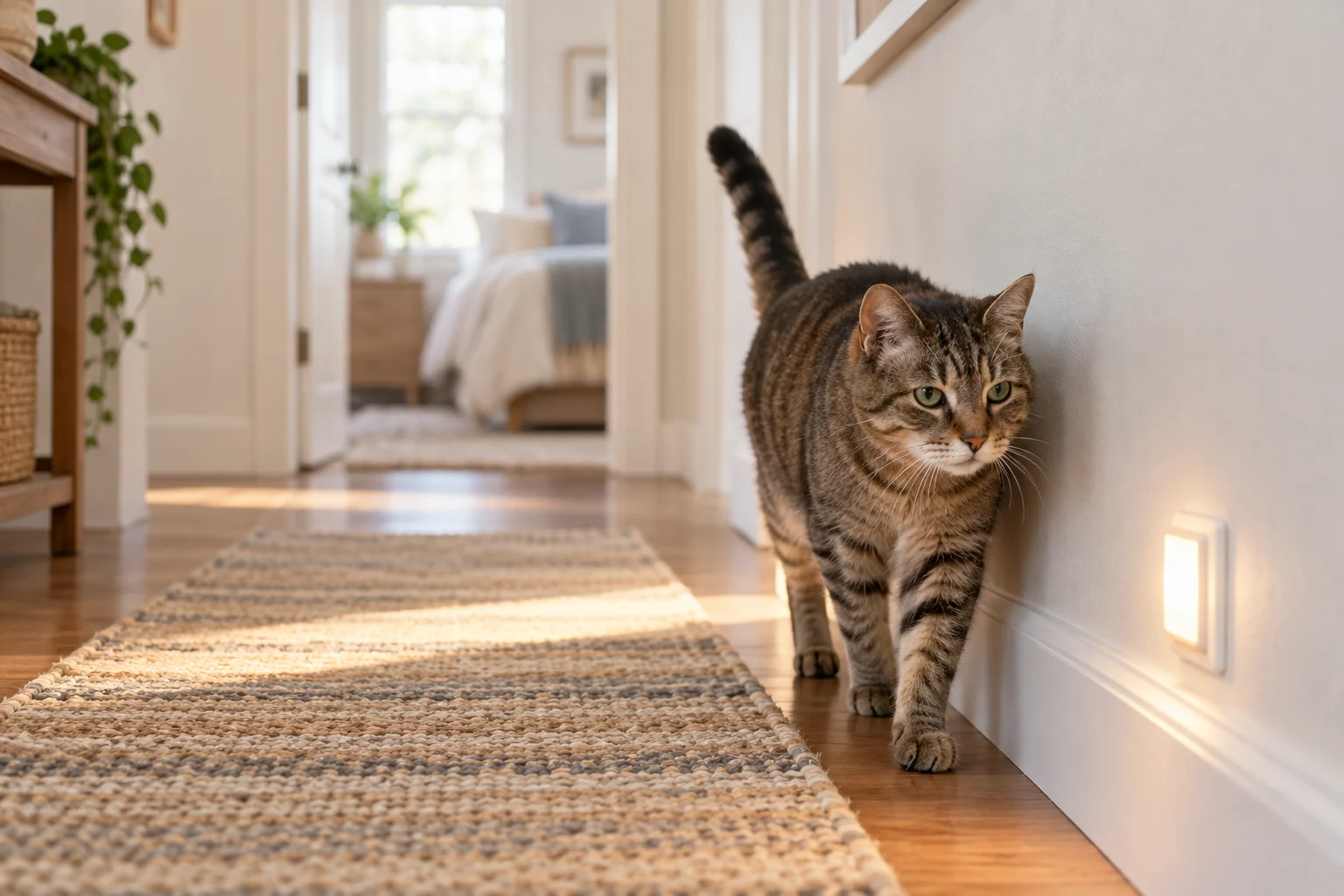
If your senior cat walks along walls, that may be a clue that edges and predictable landmarks feel reassuring. You do not have to force the route into the center of a hallway. Instead, make the route your cat already trusts safer and easier to travel.
Use a phone note or simple sketch. Mark sleep spots, water, litter boxes, stairs, dark areas, doors, slick floors, and social pinch points. Then choose the smallest change that removes the biggest barrier.
What rugs, lights, and door access changes make the route safer?
The most useful changes are flat non-slip rugs, low gentle night lights, and doors that cannot swing shut. These changes help a sleepy senior cat keep balance, see landmarks, and reach the box without waiting for a person.
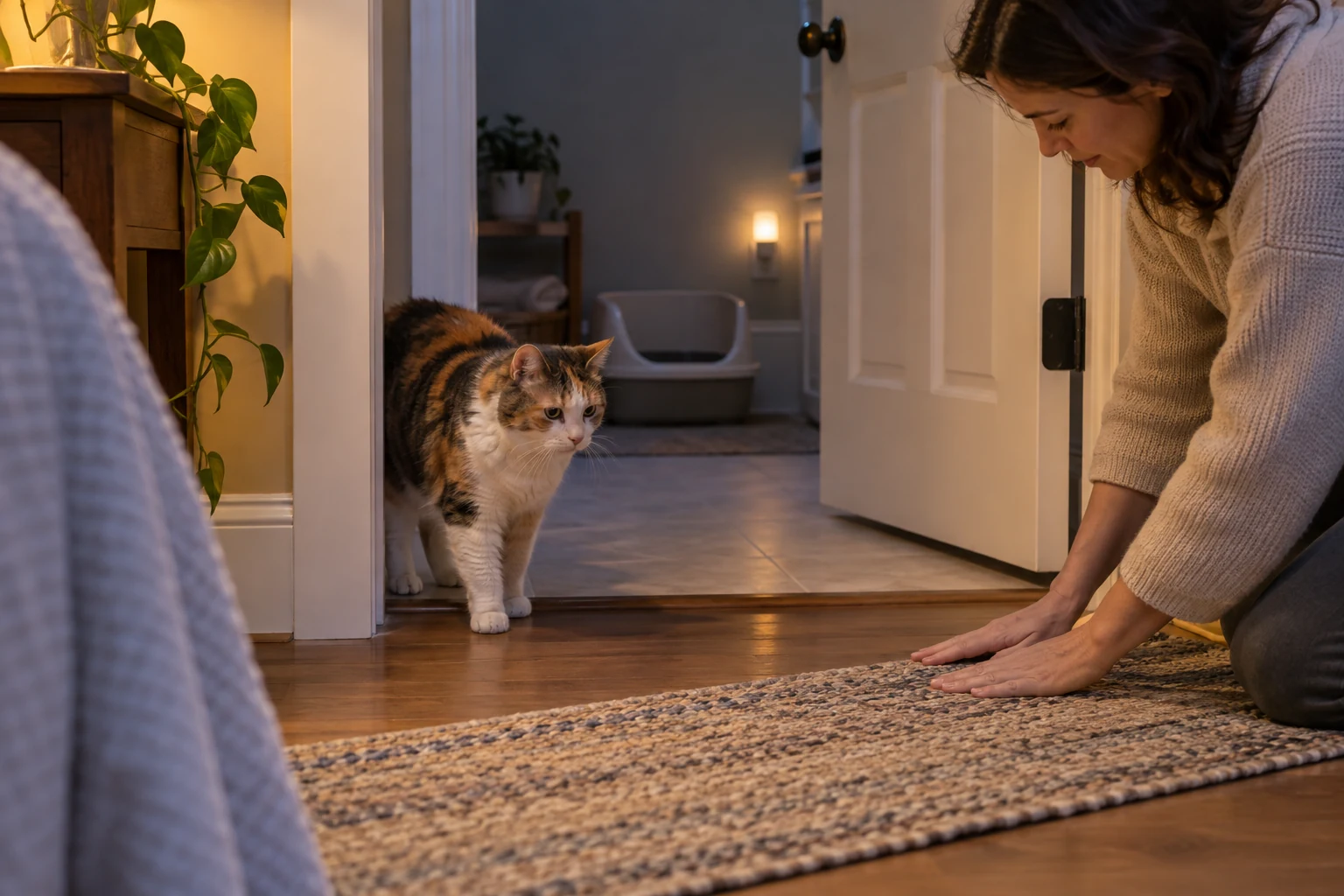
For traction, choose rug runners or mats that lie flat and do not slide. Avoid loose towels, curled corners, thick piles that catch claws, and small mats that scoot when a cat steps onto them. If your cat has arthritis signs, combine route traction with broader changes from how to help an arthritic cat at home.
For light, use a soft night light near the route, not a bright lamp that shines into your cat's eyes. Cornell's senior-cat guidance says nightlights can help older cats with poor vision navigate 2. Place lights near turns, thresholds, and the litter area so the path has landmarks instead of sudden bright spots.
For doors, test the route at bedtime. A door that is open at 9 p.m. may drift closed by midnight. Use a safe door stop, latch, pet door, or chosen open-door routine only if it does not create a tripping hazard or trap paws. If privacy matters, leave the door open enough for your cat's shoulders and hips, not just a narrow crack.
| Route feature | Better choice | Problem to avoid |
|---|---|---|
| Floor | Flat rug runner with a non-slip backing | Loose towel, curled corner, shiny bare floor |
| Light | Warm low night light near turns and box area | Bright glare, total darkness, light blocked by furniture |
| Door | Door propped open securely | Door that drifts shut, narrow gap, wedge in the walking path |
| Threshold | Clear, visible, low step-over point | Raised clutter, shoes, laundry, storage bins |
| Exit | Space to leave the box in more than one direction when possible | Dead-end corner where another pet can trap the cat |
How close should the litter box be to the sleep area?
The box should be close enough that your cat can reach it while sleepy, stiff, or urgent without using stairs or crossing a tense route. There is no perfect distance for every home. The real test is whether your cat uses the route calmly and consistently.
If the only box is downstairs, in the basement, behind a laundry door, or across a long slick hallway, add a closer option before accidents become a habit. Ohio State's Indoor Pet Initiative recommends easily accessible boxes and notes that low-sided boxes can help older cats who have trouble getting in and out 3.
For multi-floor homes, start with multiple litter boxes for senior cats so stairs are not the only choice. For a cat who sleeps in your bedroom or a nearby room, a quiet nighttime box on that floor may be more helpful than another box beside the original one.
The route ends at the box, so the box itself matters too. A low-entry litter box for senior cats should allow your cat to step in without a high leg lift, turn without twisting tightly, and leave without backing into furniture.
Try this order:
- Keep the trusted original box in place.
- Add the nighttime box near the route where hesitation or accidents happen.
- Use the same litter at first.
- Keep both boxes clean and available.
- Move or remove a box only after your cat has used the new option reliably.
What should you avoid on a senior cat's night route?
Avoid any change that makes the route less predictable. Senior cats often do better with small stable improvements than with a sudden full-room rearrangement.
Skip these common mistakes:
- moving the only trusted box overnight;
- hiding the box in a closet, cabinet, or room where the door may close;
- using a top-entry or high-sided box for a stiff cat;
- placing scented products near the box;
- putting food and litter directly beside each other unless a very frail cat needs everything close;
- adding thick rugs that bunch or catch claws;
- leaving laundry baskets, shoes, or storage bins in the pathway;
- placing the box beside loud appliances, vents, or unpredictable household traffic.
Ohio State notes that cats can avoid a box after a negative experience, including dirty litter or being startled near the box 3. Cornell also explains that medical problems, box aversion, and site preferences can all contribute to house soiling, so the setup should support comfort rather than create another reason to avoid the area 4.
If you need a broader refresher on box size, litter depth, placement, and cleaning, use the best cat litter box setup guide as your baseline. This nighttime route plan works best when the box itself is already appealing.
When should a nighttime litter box problem mean a vet call?
Call your veterinarian if a new nighttime litter problem appears suddenly, repeats, or comes with changes in urination, stool, movement, appetite, thirst, awareness, or pain. A safer route can reduce barriers, but it cannot diagnose urinary disease, constipation, arthritis, kidney disease, diabetes, vision loss, cognitive change, or pain.
Cornell's house-soiling guidance lists medical problems, mobility changes, and cognitive issues among reasons a cat may have litter box trouble 4. The AAHA/AAFP litter box guidance also emphasizes that box access and entry height matter for kittens and senior cats 5.
Contact a vet promptly if you notice:
- repeated box trips with little or no urine;
- crying, straining, or licking the urinary area;
- blood in urine or stool;
- sudden accidents in a cat who was previously reliable;
- painful defecation, constipation, vomiting, or repeated diarrhea;
- drinking much more than usual or producing much larger urine clumps;
- new stiffness, missed jumps, limping, falling, or reluctance to use stairs;
- new confusion, circling, staring, getting stuck, or seeming lost at night;
- hiding, not eating, collapse, breathing trouble, or rapid decline.
A male cat who is straining and passing little or no urine needs urgent veterinary care. Any cat with severe distress, collapse, suspected poisoning, trauma, repeated vomiting, or breathing trouble also needs urgent help.
If route problems appear with stiffness or hesitation, compare your observations with signs that an older cat has arthritis and bring notes or video to your veterinarian.
What should you track after changing the route?
Track the route for two weeks after each change. The goal is to learn whether the new setup actually makes overnight toileting calmer, not just tidier to human eyes.
Write down:
- which box was used overnight;
- whether urine and stool landed inside, beside, or away from the box;
- whether your cat paused at doors, thresholds, or slick floors;
- whether rugs stayed flat after normal household movement;
- whether another pet approached or blocked the route;
- whether your cat seemed stiff after waking;
- any change in appetite, thirst, grooming, play, or sleep;
- any accident timing, location, and surface.
Change one thing at a time when possible. If you add a rug, a light, and a new box on the same night, you may not know which part helped or bothered your cat. For urgent medical signs, do not wait two weeks. Use the route notes as veterinary context and call sooner.
Keep the winning setup boring and consistent. A senior cat does not need a perfect designer route. They need a route that is open at night, smells familiar, feels stable underfoot, and leads to a clean usable box every time.
Conclusion:
A safer senior-cat nighttime litter box route is usually built from small practical details: a shorter distance, a low-entry box, flat non-slip rugs, soft night lights, open doors, and clear exits. Those details can prevent hesitation before it turns into accidents or stress.
Start with the path your cat already uses, remove the biggest barrier, and track what changes. If accidents, straining, pain signs, thirst changes, confusion, or rapid decline appear, involve your veterinarian. For more step-by-step home setup support, browse the SnuggleSouls Daily Care guides.
Frequently Asked Questions
Should I leave a light on for my senior cat at night?
A soft night light can help many senior cats, especially if vision, confidence, or orientation has changed. Place it near turns, thresholds, and the litter area rather than shining a bright light into the room.
Is a rug runner safe near a cat litter box?
Yes, if it lies flat, does not slide, and does not have loose loops that catch claws. Avoid towels or small mats that shift underfoot because they can make a stiff cat feel less stable.
Should I move the litter box closer to my senior cat's bed?
Often, adding a closer nighttime box is safer than suddenly moving the only trusted box. Keep the original box available, use familiar litter, and let your cat show you whether the new route feels easier.
How do I keep the litter box door open at night?
Use a stable door stop, latch, pet door, or open-door routine that cannot pinch paws or sit in the walking path. Check the doorway before bed because a door that drifts shut can make the box inaccessible.
Why does my senior cat pee beside the box only at night?
Night-only accidents may mean the route is too dark, slippery, far, blocked, or difficult after sleep. They can also point to pain, urinary disease, increased thirst, constipation, cognitive changes, or vision problems, so call your veterinarian if the pattern is new or repeated.
Can I put the litter box in my bedroom for an older cat?
You can, if the box is clean, low-entry, and placed where your cat can use it calmly without being trapped or startling you awake. Many homes do better with a nearby hallway, bathroom, or quiet corner close to the bedroom rather than directly beside the bed.
References
[1] Ray, M., Carney, H. C., Boynton, B., Quimby, J., Robertson, S., St Denis, K., Tuzio, H., & Wright, B. (2021). 2021 AAFP Feline Senior Care Guidelines. 2021 AAFP Feline Senior Care Guidelines
[2] Cornell Feline Health Center. (n.d.). Loving Care for Older Cats. Loving Care for Older Cats
[3] The Ohio State University Indoor Pet Initiative. (n.d.). Litter Boxes. Litter Boxes
[4] Cornell Feline Health Center. (2015). Feline Behavior Problems: House Soiling. Feline Behavior Problems: House Soiling
[5] American Animal Hospital Association. (2021). General Litter Box Considerations. General Litter Box Considerations

 EN
EN DE
DE ES
ES PT
PT