
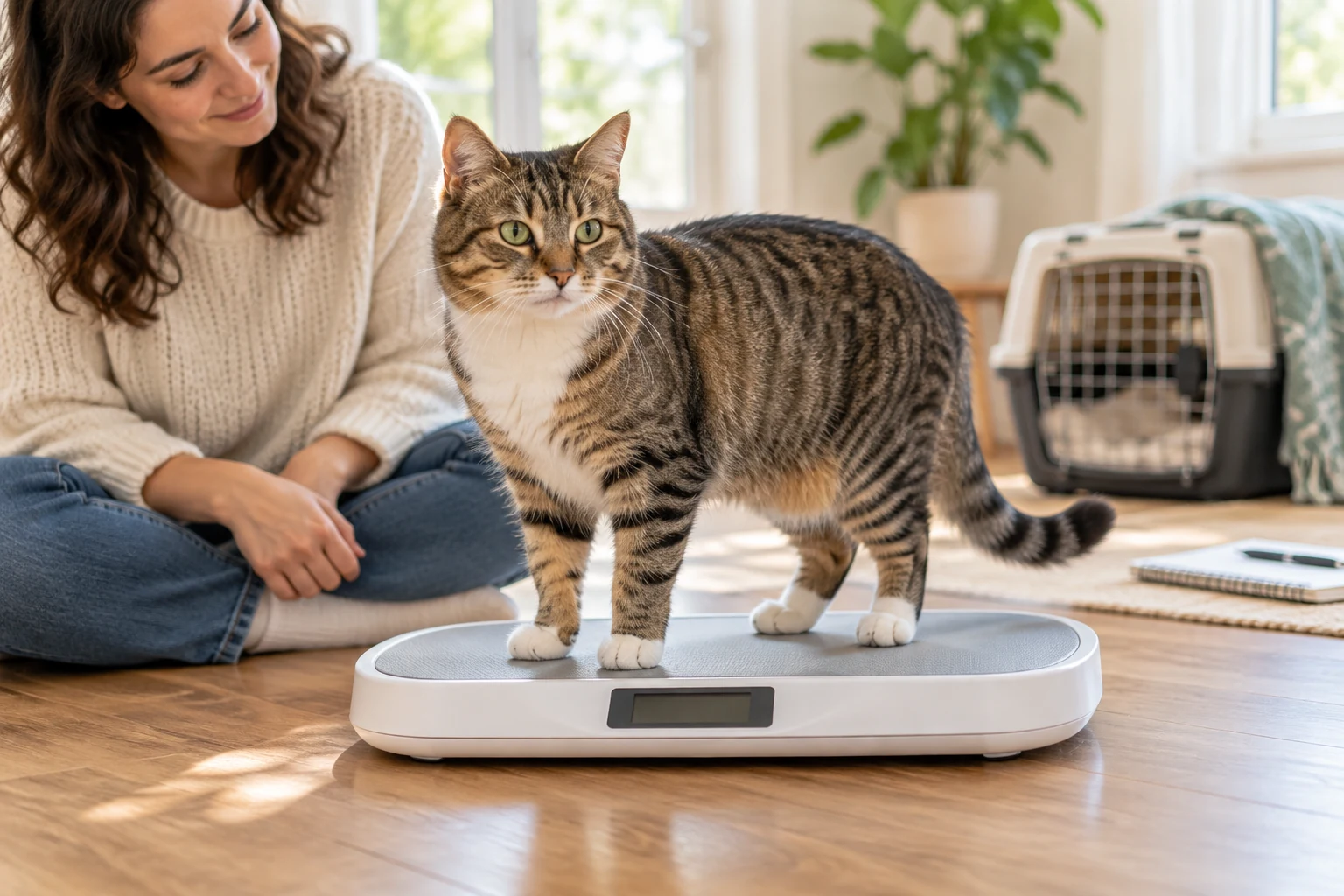
If you are wondering how to weigh a cat at home, start with a low pet or baby scale your cat can step onto; if your cat will not stay on it, a familiar carrier on a stable scale may be easier. A bathroom-scale subtraction can provide a rough estimate for a cat who is comfortable being held, but it may not capture a small change accurately. For a veterinarian-directed plan, ask which scale and method your clinic wants you to use. 1 3 4
A cat does not need to sit perfectly still for a useful reading. The goal is a calm, repeatable method that fits your cat and your equipment. If a weigh-in turns into chasing or restraint, stop and try a different approach or ask your veterinary team for help.
Which home weighing method should you choose?
Choose a method your cat can tolerate and your scale can support safely. A pet or baby scale gives a direct reading; a carrier can help with a cat who keeps moving; a bathroom scale is a fallback estimate when the cat is comfortable being picked up.
| Your cat’s situation | Method to try first | Important limit |
|---|---|---|
| Steps onto a low platform without distress | Pet or baby scale | Check that the scale can register the level of detail your vet needs. |
| Settles in a familiar carrier | Carrier plus empty-carrier subtraction | The carrier must sit level and securely on the scale, and you need to weigh the same carrier setup without the cat. |
| Is comfortable being held and you have a bathroom scale | Weigh yourself, then yourself with the cat, and subtract | The result is an estimate. Human scales may round small differences. |
| Is frightened, painful to handle, or difficult to keep safe | Stop and ask the veterinary team | A clinic can help choose an appropriate scale and low-stress approach. |
For cats or small dogs, VCA recommends a home scale that can measure in small increments, such as a baby scale accurate to ounces. If your vet is monitoring a specific health or weight-management plan, use the method they specify instead of switching between home methods. 4
A scale designed for weighing pets
A pet scale can make routine readings easier if your cat will stand on it calmly. Keep sessions short and safe, and ask your veterinarian to confirm concerning changes.
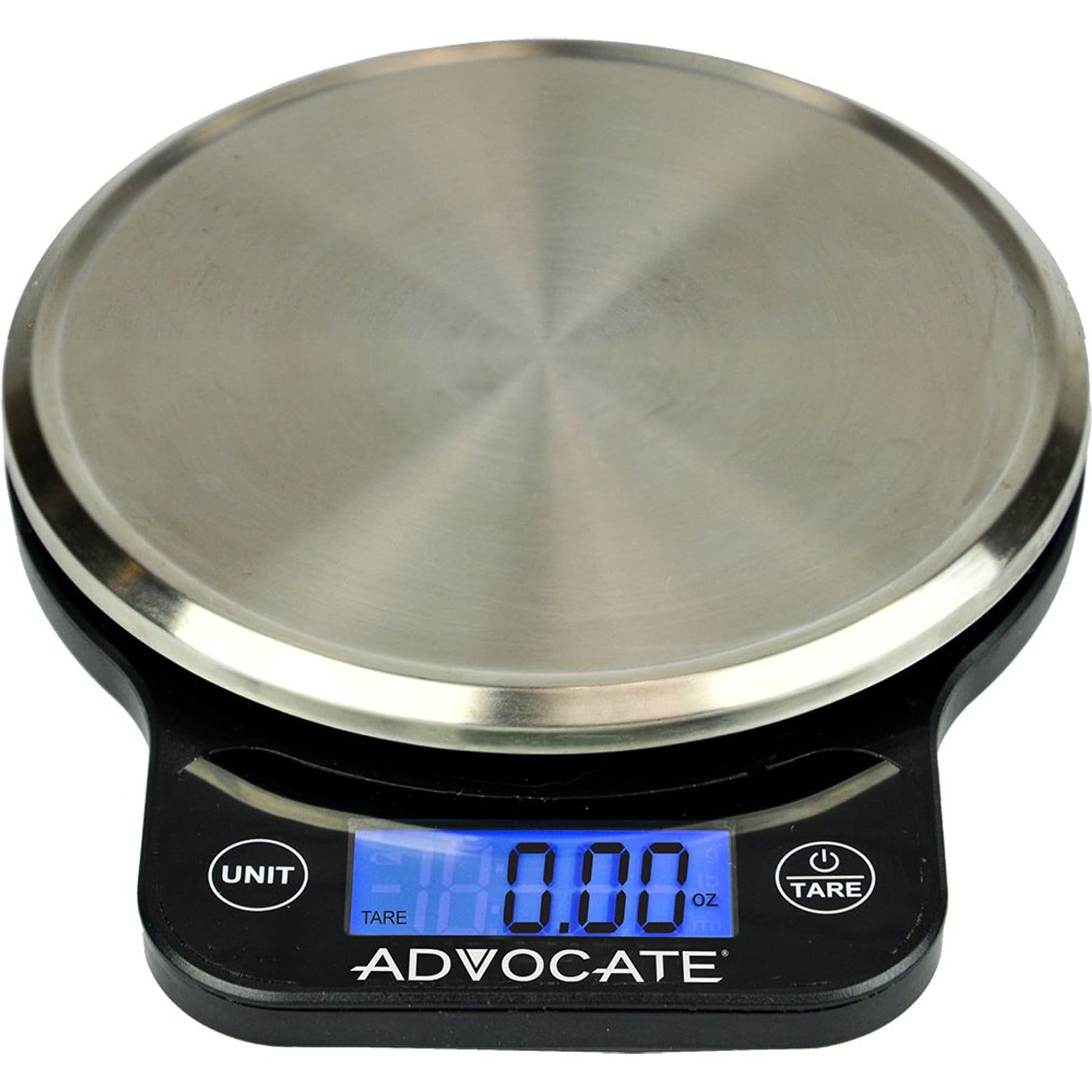
Advocate
Advocate Universal Digital Household Scale
Advocate Universal Digital Household Scale; For precise everyday measurements, try the Advocate Universal Digital Household Scale. This portable scale is great for measuring your…
$32.95
Shop ChewyWe may earn a commission if you buy through this Chewy link, at no extra cost to you. Product details and prices can change.
What should you compare when choosing a cat scale?
Compare the scale’s capacity, the smallest weight it registers, its displayed increment across your cat’s weight range, tray size, stability, tare and hold features, and how easy it is to clean. A larger capacity alone does not mean a scale will show small changes clearly. Check the manufacturer’s specifications for the exact model and range, and ask your veterinary team which measurement resolution is appropriate when a small change affects care.
| Manufacturer-listed model | Capacity and displayed increment | Platform or tray | Features to compare |
|---|---|---|---|
| Beurer Polly baby scale 7 | 100 g–180 kg; 10 g to 5 kg, 50 g to 50 kg, then 100 g to 180 kg | Removable tray, 50 × 27 cm | Hold and tare. Check regional availability and that the increment at your cat’s weight suits the purpose. |
| Brecknell MS-15 animal scale 8 | 20 kg / 44 lb capacity; 5 g / 0.01 lb readability listed | 23 × 11 in / 584 × 292 mm tray | Hold; manufacturer lists medical/veterinary use. Confirm current configuration, service and suitability with your clinic. |
These are manufacturer-listed specifications, not an independent accuracy test or a product endorsement. The cited pages do not provide a confirmed US price. Compare the current model, availability, tray fit, cleaning instructions and return terms before buying. If you want a printable place to record readings, use the blank cat weight record sheet. For a medical decision, ask your veterinary team whether a clinic measurement is needed.
How do you weigh a cat on a pet or baby scale?
Set the scale on a stable, level floor and follow its instructions for capacity, units, and zeroing. If your cat prefers a softer surface, the AAFP Cat Friendly Practice Guide describes placing a towel on the scale and zeroing it before the cat steps on. 1
Try this calm setup:
- Put the scale where your cat is already comfortable, rather than carrying them to a high counter.
- Confirm the scale is stable, set the unit, and check that it reads zero.
- Add a thin towel or mat if needed, then zero the scale again with it in place.
- Let your cat step on or settle in their own time. Wait for the display to settle before recording.
- Write down the reading, unit, date, and any change in the setup.
If your cat steps off before the display settles, do not hold them down. Try the carrier method, use short voluntary practice sessions, or leave the weigh-in for another day.
How can you weigh a cat in a carrier?
A familiar carrier can help when a cat will not stand still on an open platform. Cats Protection describes weighing a cat in a carrier and subtracting the carrier’s weight; the AAFP guide also describes weighing a cat with the carrier or towel, then weighing those items separately to get the cat’s weight. 1 3
- Check that the scale is wide and stable enough for the carrier to sit flat. Do not balance a carrier across an undersized platform.
- Weigh the empty carrier with the same bedding and other items you plan to leave inside.
- If the scale has a tare function, zero it with the empty carrier setup. Otherwise, record that empty weight.
- Let the cat enter the carrier voluntarily when possible, then weigh the carrier with the cat inside.
- Subtract the empty carrier weight from the combined reading.
For example, if the carrier and cat weigh 5.40 kg together and the same empty carrier setup weighs 0.90 kg, the estimated cat weight is 4.50 kg. Keep the bedding and accessories the same between the two readings; changing them changes the amount you need to subtract.
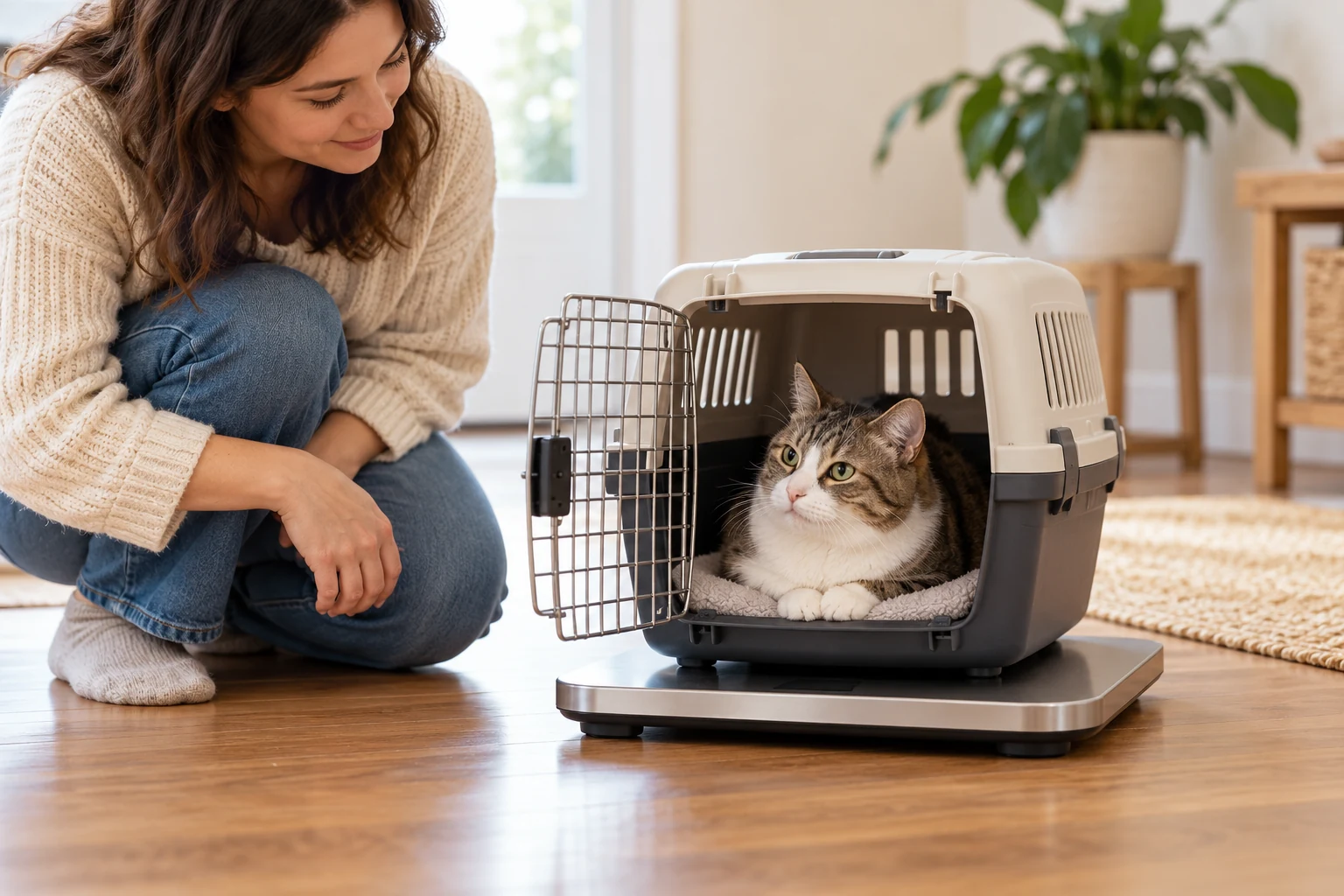
If the carrier rocks, does not fit securely, or your cat becomes distressed, stop. A stable direct scale or a weigh-in at the clinic is safer than trying to balance the carrier.
What if your cat will not sit still?
Your cat can stand briefly instead of sitting, and the goal is a settled display—not a perfect pose. If your cat is uneasy around the scale, build familiarity in short sessions rather than trying to complete the whole weigh-in at once.
The FelineVMA’s positive-reinforcement toolkit describes cooperative care and targeting as ways to guide a cat toward a location, including onto a scale, by rewarding voluntary movement rather than forcing it. 2 You can adapt that idea at home:
- Leave the scale in a familiar room so your cat can investigate it.
- Reward calm interest, then a paw on the platform, and later a brief step onto it.
- Keep each practice short and let your cat leave whenever they choose.
- Use only a treat or portion that fits your cat’s feeding plan.
- Stop if your cat shows fear, pain, or mounting distress; ask your vet if handling has become difficult.
If weighing is needed for illness or treatment and your cat cannot manage a home scale, contact the clinic. Your veterinary team can discuss a low-stress clinic weigh-in or another suitable method.
Is the bathroom-scale method accurate?
The person-and-cat method is convenient, but treat it as an estimate. It works best when the cat can be held comfortably and the scale provides stable readings; it may not show small changes as clearly as a baby or pet scale. VCA recommends a scale accurate to small increments for home checks, and a veterinary practice cautions that household bathroom scales may be too imprecise for monitoring small feline weight changes. 4 5
If you try it:
- Put the scale on a hard, level floor and use the same unit for both readings.
- Weigh yourself and record the number.
- Step off and let the scale reset.
- Pick up your cat only if both of you are comfortable and you can hold them securely.
- Weigh yourself with your cat, then subtract your weight alone from the combined reading.
For instance, 72.6 kg with your cat minus 68.2 kg alone gives an estimated cat weight of 4.4 kg. Take both readings on the same scale close together, and note that you used the bathroom-scale method.
Do not use this estimate to make medication or treatment decisions. If a small change matters to your cat’s care, confirm the measurement with your veterinary team or ask whether a baby or pet scale is appropriate.
What if the scale gives an unexpected reading?
Before reacting to a surprising number, verify the unit, put the scale back on a hard, level surface, and check the carrier tare if you used one. Repeat the reading once the display resets and under the same conditions; do not average an unstable display or use a rough estimate to change treatment. If the difference remains or could affect care, ask your veterinary team to confirm it on an appropriate scale. 5
| If the reading… | Check this first |
|---|---|
| Looks roughly half or double the last reading | Confirm the scale is set to the same unit. A veterinary practice specifically flags a pounds-versus-kilograms mix-up as a cause of a dramatic apparent change. 5 |
| Changes after you move the scale | Put it on a hard, level floor and use the same spot for comparisons. Let the display reset between readings. |
| Comes from a carrier weigh-in | Reweigh the empty carrier with the same bedding and accessories; those items change the amount to subtract. 5 |
| Will not settle while your cat moves | Do not record an unstable display or hold your cat down. Try a voluntary practice session or stop and ask your clinic about a suitable weigh-in. 2 |
If the setup checks do not resolve a reading that matters to your cat’s care, ask your veterinary team to confirm it on an appropriate scale.
How do you record a useful home weigh-in?
Record the scale and method with the number so you can compare like with like. A reading taken on a baby scale is not directly interchangeable with one estimated from a bathroom scale or a different carrier setup.
For each entry, note:
- Date and weight, including the unit
- Scale and method: direct scale, carrier subtraction, or person-and-cat subtraction
- Any change in carrier bedding, mat, scale location, or weighing conditions
- Relevant context your vet asked you to track, such as appetite or a diet-plan change
The Cat Weight & Body Condition Tracker can keep dated entries and weighing-method notes together for a veterinary conversation. A weight number is only one part of the picture; the body condition and muscle condition score guide explains what a scale cannot show about body shape and muscle.
If you are deciding how often to take readings, see our guide to how often to weigh your cat. Follow your veterinarian’s schedule for a medical or weight-management plan.
When should you stop and contact a veterinarian?
Contact your veterinary team about unexplained or continuing weight change, especially if appetite, activity, thirst, or litter-box habits have also changed. A home log can make the timeline easier to explain, but it cannot identify the cause.
Do not delay urgent care to get a weight if your cat is having trouble breathing, collapses, has a seizure, cannot urinate, or is repeatedly vomiting. Cornell lists these among conditions that need emergency veterinary attention. 6
Conclusion
The best way to weigh your cat at home is the one that produces a stable reading without frightening or restraining them. Start with a low pet or baby scale, try a familiar carrier and subtract its empty weight if your cat keeps moving, and treat bathroom-scale subtraction as an estimate. Keep the method consistent, log what you used, and ask your vet when a more precise reading or a change in care is involved.
Frequently Asked Questions
Can I weigh my cat in a carrier?
Yes, if the carrier fits securely on the scale. Weigh the empty carrier with the same bedding and accessories, then subtract that weight from the carrier-plus-cat reading. If the carrier rocks or does not fit, use another method or ask your clinic. 1 3
What is the easiest way to weigh a cat who will not sit still?
Try a familiar carrier if it can sit flat on your scale. You can also let your cat get used to a low scale over several short sessions, rewarding voluntary steps onto it. Stop if the cat becomes frightened or handling is painful. 2
Can I use a bathroom scale to tell whether my cat lost a small amount?
It can provide a rough estimate for some cats, but a human scale may round small differences or fluctuate between readings. For a small change that matters to your cat’s care, ask your veterinarian whether a more precise scale or clinic weigh-in is needed. 4 5
How often should I weigh my cat at home?
The right interval depends on your cat’s age, health, and reason for monitoring. Follow your veterinarian’s instructions, or read our guide on how often to weigh your cat for a situation-by-situation overview.
References
[1] American Association of Feline Practitioners. (2023). Cat Friendly Practice Guide. AAFP guide
[2] Feline Veterinary Medical Association. (2026). Positive Reinforcement Techniques to Prevent Unwanted Behaviors. FelineVMA
[3] Cats Protection. (n.d.). Is my cat the right weight? Cats Protection
[4] VCA Animal Hospitals. (n.d.). How to know if your pet is overweight. VCA
[5] Exclusively Cats Veterinary Hospital. (n.d.). Weighing your cat at home. Exclusively Cats Veterinary Hospital
[6] Cornell University College of Veterinary Medicine. (n.d.). Emergency and Critical Care. Cornell University
[7] Beurer. (n.d.). Polly multifunctional pet scale. Manufacturer specifications
[8] Brecknell. (n.d.). MS-15 animal weighing scale. Manufacturer specifications