
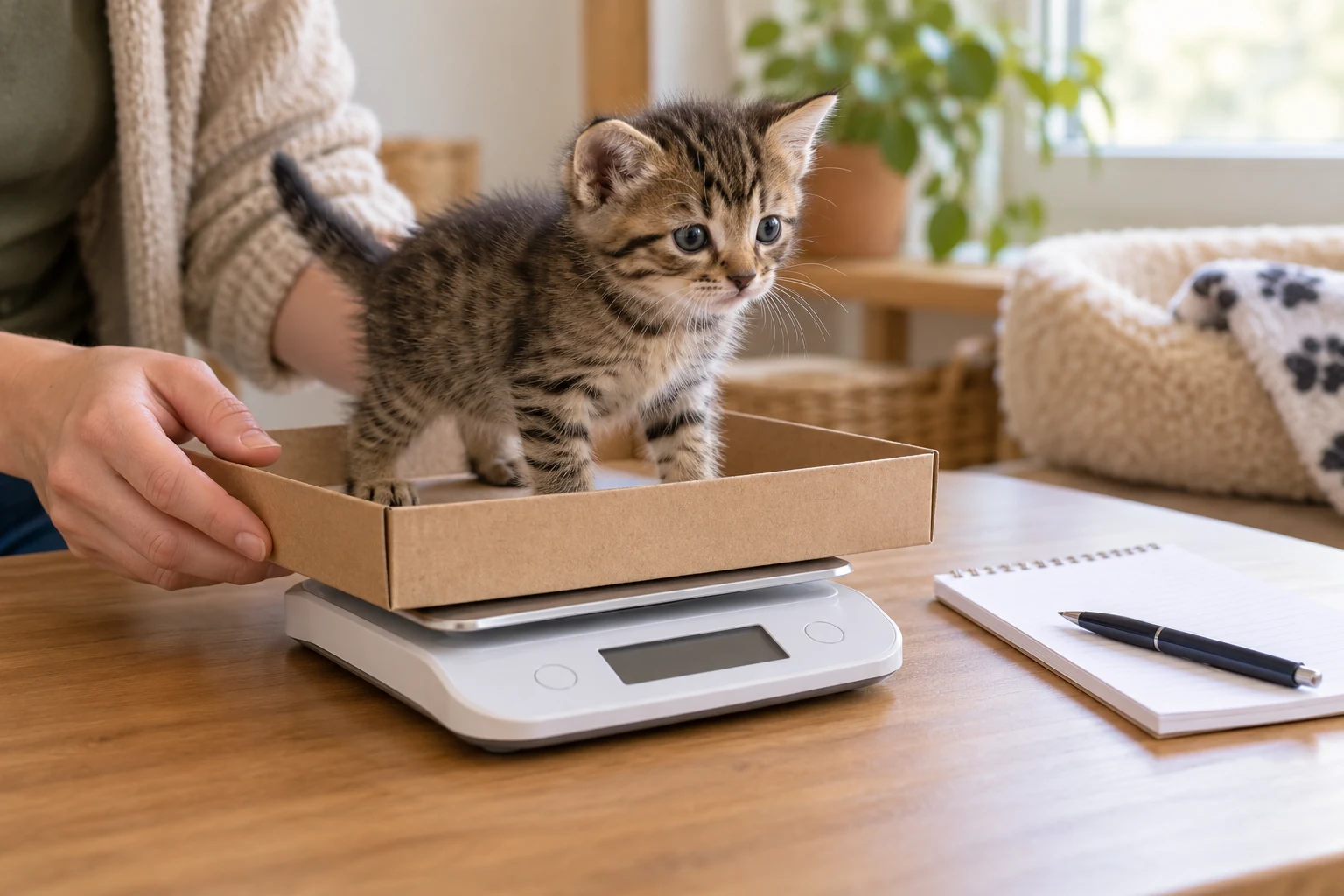
The ASPCApro kitten weight chart gives daily reference ranges for kittens from 1 to 56 days old. The weekly figures below show the range on the last day of each week; they are reference points, not required targets or a diagnosis. ASPCApro says its ranges reflect typical gains of 7–15 grams a day and should be read alongside developmental milestones when estimating age. 1
A chart can help you spot a pattern, but a kitten's exact age, health, and care situation matter. This guide shows how to read the chart, keep a useful record, and decide when to contact the veterinarian or rescue team—and you can compare life-stage milestones in human years with our Cat Age Calculator. It does not extend the ASPCApro table beyond eight weeks or calculate a growth percentile.
What does the ASPCApro kitten weight chart show?
ASPCApro's chart covers eight weeks, from day 1 through day 56. It lists a weight range for each day of each week, so the value for “Week 3,” for example, changes between day 15 and day 21. The table below is a compact excerpt of the Day 7 value in each week, not a range that applies to all seven days. 1
| Age in the chart | Final day shown | ASPCApro weight range |
|---|---|---|
| Week 1 (days 1–7) | Day 7 | 142–190 g |
| Week 2 (days 8–14) | Day 14 | 191–295 g |
| Week 3 (days 15–21) | Day 21 | 240–400 g |
| Week 4 (days 22–28) | Day 28 | 289–505 g |
| Week 5 (days 29–35) | Day 35 | 338–610 g |
| Week 6 (days 36–42) | Day 42 | 387–715 g |
| Week 7 (days 43–49) | Day 49 | 436–820 g |
| Week 8 (days 50–56) | Day 56 | 485–925 g |
If you know the kitten's age in days, compare the measurement with that exact day in the full ASPCApro chart rather than using the weekly endpoint above. The bands overlap widely; a number inside the table does not prove that a kitten is healthy, and a number outside it does not identify a cause. The chart was designed to be used with developmental signs, not as a stand-alone test. 1
Weight can help estimate age, but it is not an age test. ASPCApro says weight-based estimates are most reliable until about 10 weeks in kittens with good body condition; it also recommends considering signs such as eye development, walking, and teeth. If the kitten's history is unknown, record the age as an estimate and ask a veterinarian or rescue professional to assess it. 2
What chart should you use after 8 weeks?
The ASPCApro day-by-day table ends at 56 days. For kittens from 8 weeks onward, WALTHAM offers a separate growth-chart tool through adulthood for cats expected to reach an adult weight of 2–7 kg. Its curves need at least two measurements spaced two weeks apart, starting at age 8 weeks or older, before the growth bands appear. The systems overlap at eight weeks, but they were built for different uses; do not treat them as one continuous scale. 5
This is a different kind of chart from the ASPCApro table: it compares a kitten's trajectory with growth curves rather than giving one broad gram range for each week. WALTHAM's published study developed the underlying standards from healthy, intact domestic shorthair kittens; WALTHAM describes its tool as suitable for purebred and mixed-breed cats in its stated adult-weight range. The paper's comparison group included only four underweight kittens, so a curve is a prompt for veterinary discussion, not a diagnosis or feeding prescription.
Ask your veterinarian to interpret a curve for a kitten with a health condition, an uncertain age, or an adult size outside that range. 5 6
How often should you weigh a kitten?
Use the schedule from the veterinarian or rescue responsible for the kitten. There is no single home-weighing interval that fits every kitten and every care plan. For example, the Kentucky Humane Society's foster instructions ask caregivers in its program to weigh kittens daily, and twice daily for kittens younger than two weeks. That is a program-specific protocol, not a universal prescription. 3
If you are caring for an unweaned kitten, a bottle baby, or a foster litter, ask the supervising team for the exact schedule and what change should trigger a call. For routine growth tracking, WALTHAM recommends checks every 2–4 weeks through six months, then every 1–3 months until the kitten is fully grown; this interval does not replace a closer schedule set for illness or neonatal care. The same age- and situation-based approach is explained in our guide to how often to weigh your cat. 5
A scale for tracking kitten growth
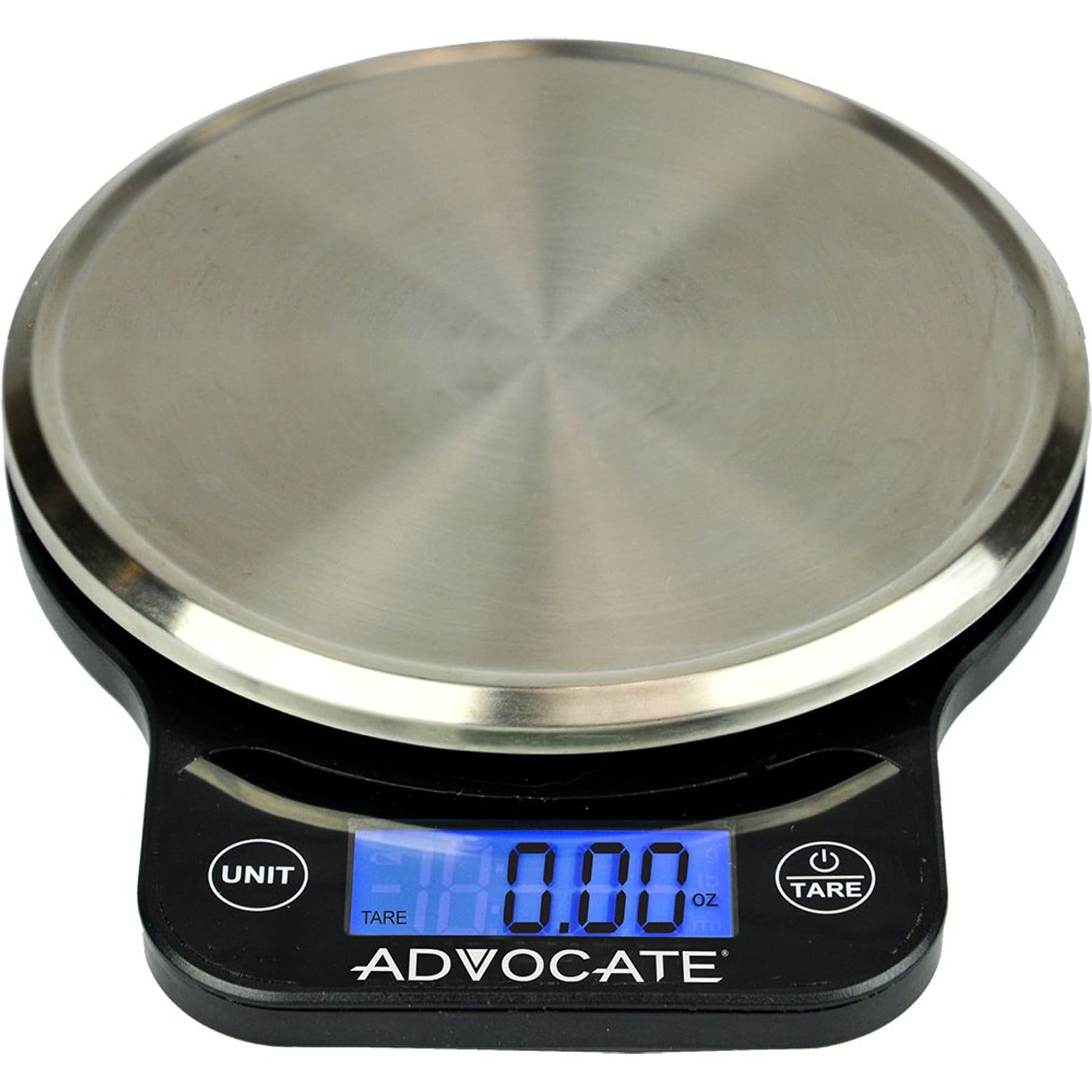
A pet scale can help you record growth at regular intervals if the kitten can be weighed safely and accurately. Ask your veterinarian what interval and expected trend fit your kitten’s age and health.
Advocate
Advocate Universal Digital Household Scale
Advocate Universal Digital Household Scale; For precise everyday measurements, try the Advocate Universal Digital Household Scale. This portable scale is great for measuring your…
$32.95
Shop ChewyWe may earn a commission if you buy through this Chewy link, at no extra cost to you. Product details and prices can change.
How should you record each weigh-in?
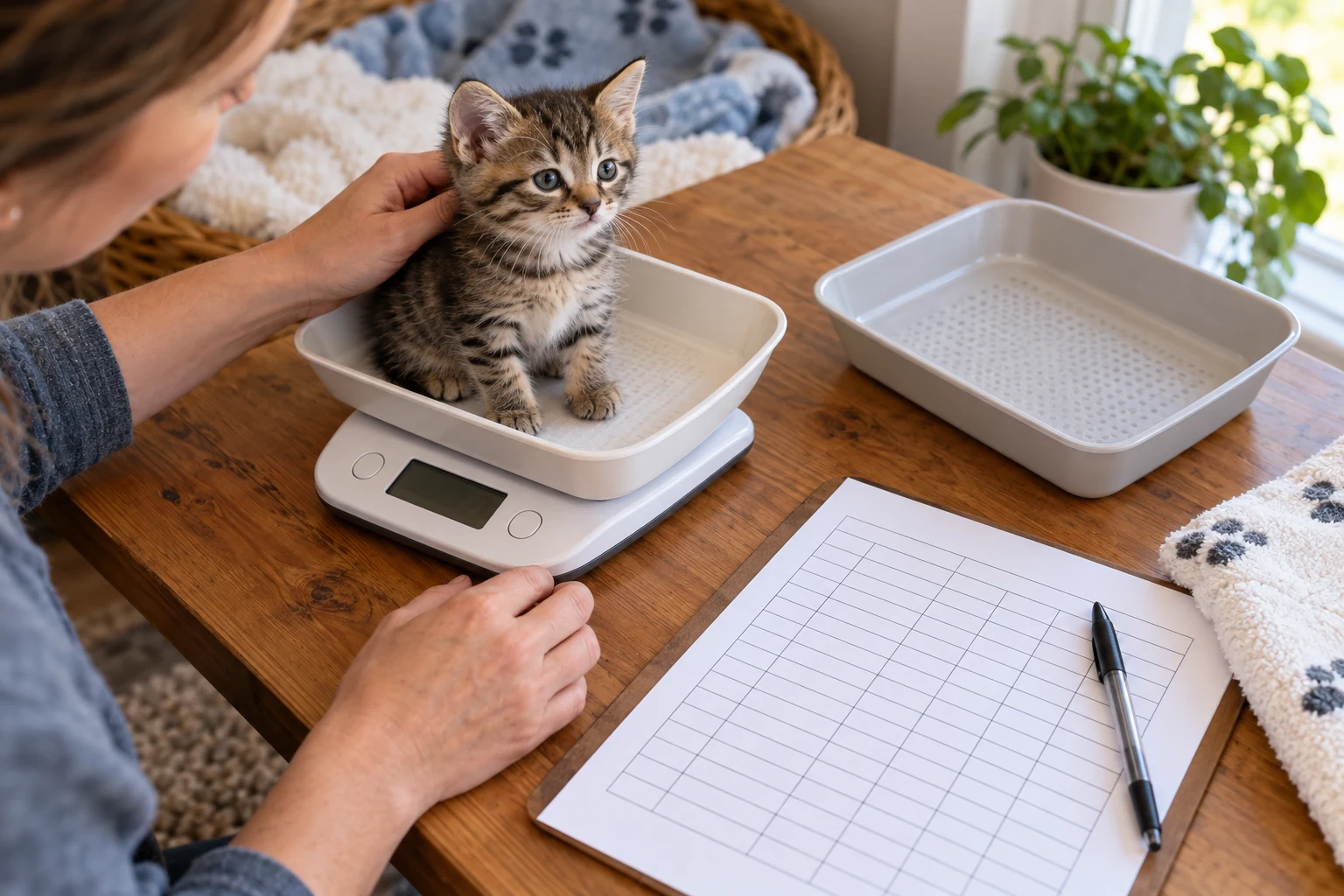
A useful log lets another caregiver or a veterinary professional identify the kitten, measurement, date, and circumstances without guessing. Use a scale that reads in grams, follow the care team's instructions, and keep each kitten's entries separate. Kentucky Humane Society also recommends weighing at a consistent time and using grams for kittens under a pound in its foster guidance. 3
For each measurement, record:
- The kitten's identifier and the exact date; add the age in days if it is known or clearly mark it as estimated.
- The weight in grams and the scale or method used.
- Whether the kitten was weighed under the same routine as the previous entry, plus relevant observations such as nursing or appetite changes and signs of illness.
- Any care-plan change or instruction from the veterinarian or rescue team.
When a reading looks surprising, first check that you have the right kitten, unit, scale, and container tare. Do not average measurements taken on different scales or at unrelated times and call the result a growth rate. If the discrepancy remains, share the dated readings with the care team rather than trying to correct it with a feeding change. If you are trying to distinguish a setup issue from a real weight trend, see our guide to why a cat’s weight may fluctuate; for a kitten, still follow the schedule set by its veterinarian or rescue team.
What if a kitten is not gaining weight?
Contact the kitten's veterinarian or supervising rescue team promptly if the record shows weight loss or a stall against the schedule they gave you. Kentucky Humane Society's newborn foster protocol asks caregivers to contact its team if weight stays level for more than a day or drops; it notes particular urgency for kittens under a week old. Follow your own care team's instructions if they set a different threshold. 4
Call sooner if the kitten is not nursing or eating as usual, seems unwell, or has another concerning change. Do not wait for the next chart boundary, and get veterinary or rescue guidance before changing formula or adding a supplement. A weight log helps the professional assess what is happening; it cannot explain why the kitten is small or not gaining. 4
What can a weight tracker tell you?
A dated record can make a trend easier to review and share. The Cat Weight & Body Condition Tracker keeps dated measurements and notes, but it does not plot kitten growth percentiles or set a kitten's target weight. For a neonatal or bottle-fed kitten, follow the care team's gram-based log and schedule; use any general tracker only as an additional record, not as the source of a growth judgment.
The chart is a reference, not a percentile calculator. Use the kitten's exact date, the original gram reading, and the veterinarian or rescue team's interpretation together rather than expecting the tool to decide whether growth is on track.
Conclusion
Use the ASPCApro chart as a short-range reference for kittens up to eight weeks, and compare the correct day rather than treating a weekly endpoint as a pass line. Keep consistent, individual records and follow the veterinarian or rescue team's weighing schedule. A weight stall or loss is a reason to contact the care team, not to change feeding on your own.
Frequently Asked Questions
How much should an 8-week-old kitten weigh?
On day 56, the ASPCApro chart lists 485–925 g. It is a broad reference range, not a guaranteed healthy-weight interval for every kitten; the full chart and a professional assessment provide more context. 1
How much weight should a kitten gain each day?
ASPCApro says its chart ranges reflect typical gains of 7–15 g per day. That is a description of the chart, not a rule that every kitten must gain the same amount each day. Use the schedule from the veterinarian or rescue team and report a stall or loss as instructed. 1
Can I use a weight chart to tell how old a kitten is?
Weight is one clue, but it cannot establish age by itself. ASPCApro says weight estimates are most reliable until about 10 weeks when body condition is good, and recommends checking developmental signs as well. 2
Can I use the SnuggleSouls tracker for a newborn kitten?
It can keep dated measurements and notes, but it does not calculate kitten percentiles or decide whether growth is on track. Follow the veterinary or rescue team's gram-based monitoring instructions; the SnuggleSouls tracker can serve as an additional history when useful.
References
[1] ASPCApro. (2023). Kitten Age & Weight Chart. ASPCApro PDF
[2] ASPCApro. (n.d.). How to Determine a Kitten's Age. ASPCApro
[3] Kentucky Humane Society Foster Hub. (n.d.). Weighing Kittens. Foster Hub
[4] Kentucky Humane Society Foster Hub. (n.d.). Pregnant and Nursing Cats. Foster Hub
[5] WALTHAM Petcare Science Institute. (n.d.). WALTHAM Kitten Growth Charts. WALTHAM
[6] Salt, C., German, A. J., Henzel, K. S., & Butterwick, R. F. (2022). Growth standard charts for monitoring bodyweight in intact domestic shorthair kittens from the USA. PLOS ONE