
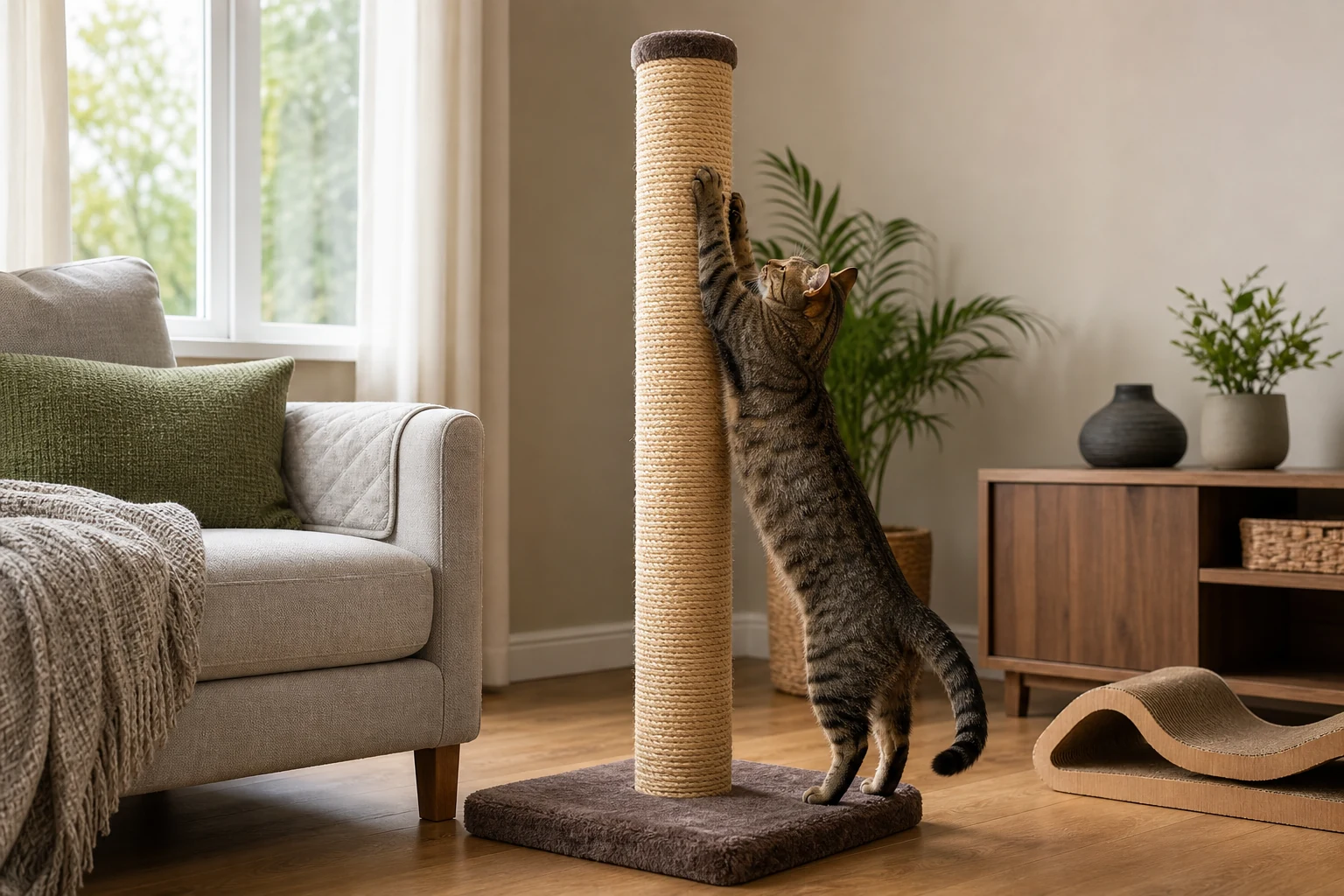
The best scratching post is one your cat will use: stable, tall enough for a full stretch if they scratch upright, and covered in a texture they accept. If your cat scratches rugs, start with a horizontal pad; if they target furniture, place a vertical post beside it. Offer options and reward voluntary use—no single material suits every cat.
Scratching is normal feline behavior. Cats use it to stretch, maintain their claws, and leave visual and scent marks, so the goal is to offer a satisfying place to scratch rather than stop the behavior 1.
Table of Contents
- Which scratching-post shape matches my cat?
- Which scratching-post material should I choose?
- What makes a scratching post safe and sturdy?
- Where should I put a scratching post?
- How do I train my cat to use a scratching post?
- How many scratching surfaces does one cat need?
- How can I protect furniture while my cat learns?
- When can a change in scratching signal a problem?
- Conclusion
- Frequently Asked Questions
- References
Which scratching-post shape matches my cat?
Start with the surface and posture your cat already chooses. A cat that reaches up for a sofa arm usually needs a vertical post; one that rakes a rug is more likely to try a horizontal scratcher. Some cats prefer an angled board, so offer it as a test rather than assuming one shape suits every cat 1.
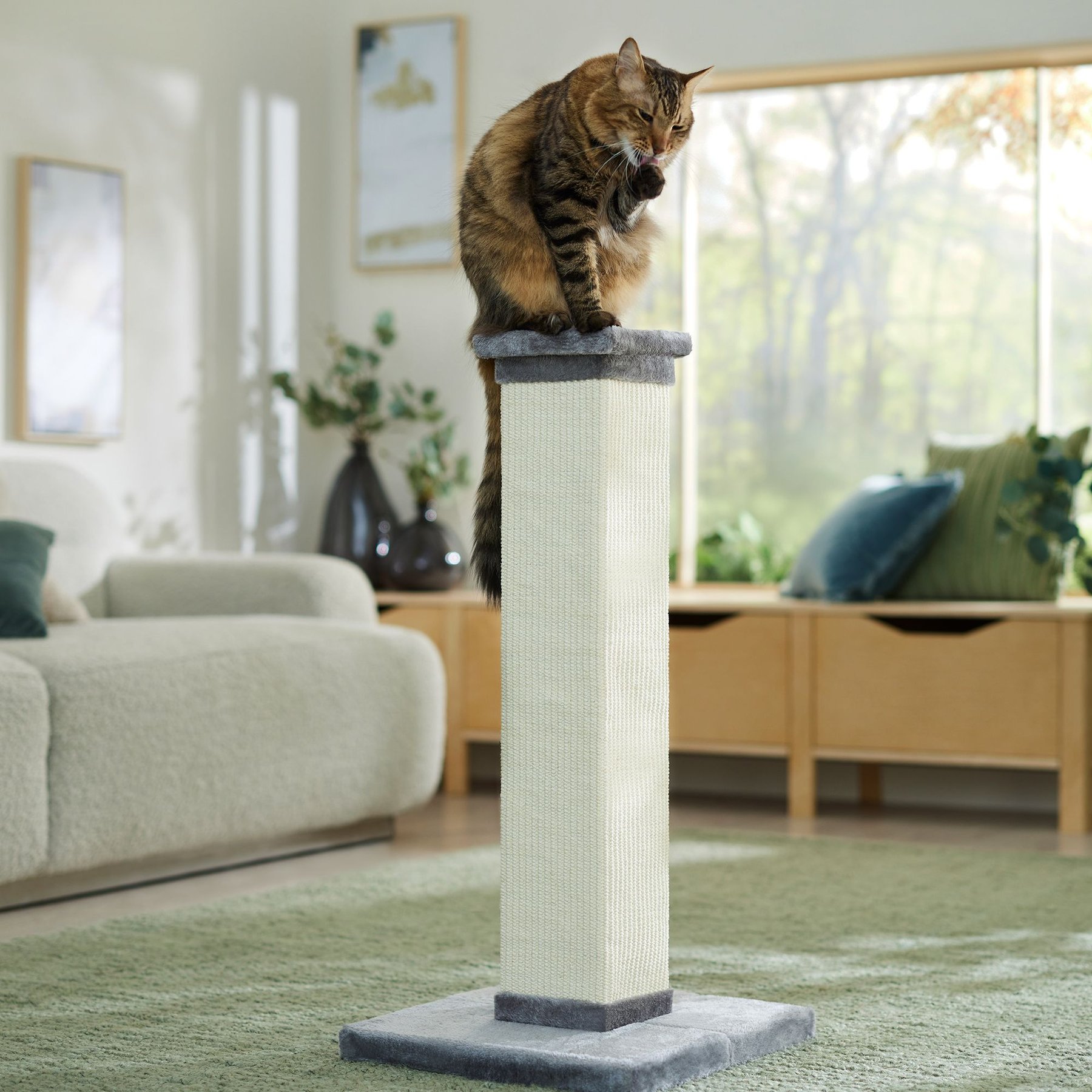
If your cat stretches upright and you want to test sisal, a tall post is one option. Cats that scratch rugs or carpet may prefer a horizontal surface instead.
A tall sisal post for upright scratchers
Choose this shape only if your cat stretches up to scratch. Check that the base stays steady and place it beside the current target.
Frisco
Frisco 33-in Heavy Duty Sisal Cat Scratching Post, Gray
From frisky kittens to spunky senior cats, felines love to scratch—and this 33.5-inch cat scratching post, from Frisco by Chewy, gives your furry friend…
$31.58
Check price and availabilityWe may earn a commission if you buy through this Chewy link, at no extra cost to you. Product details and prices can change.
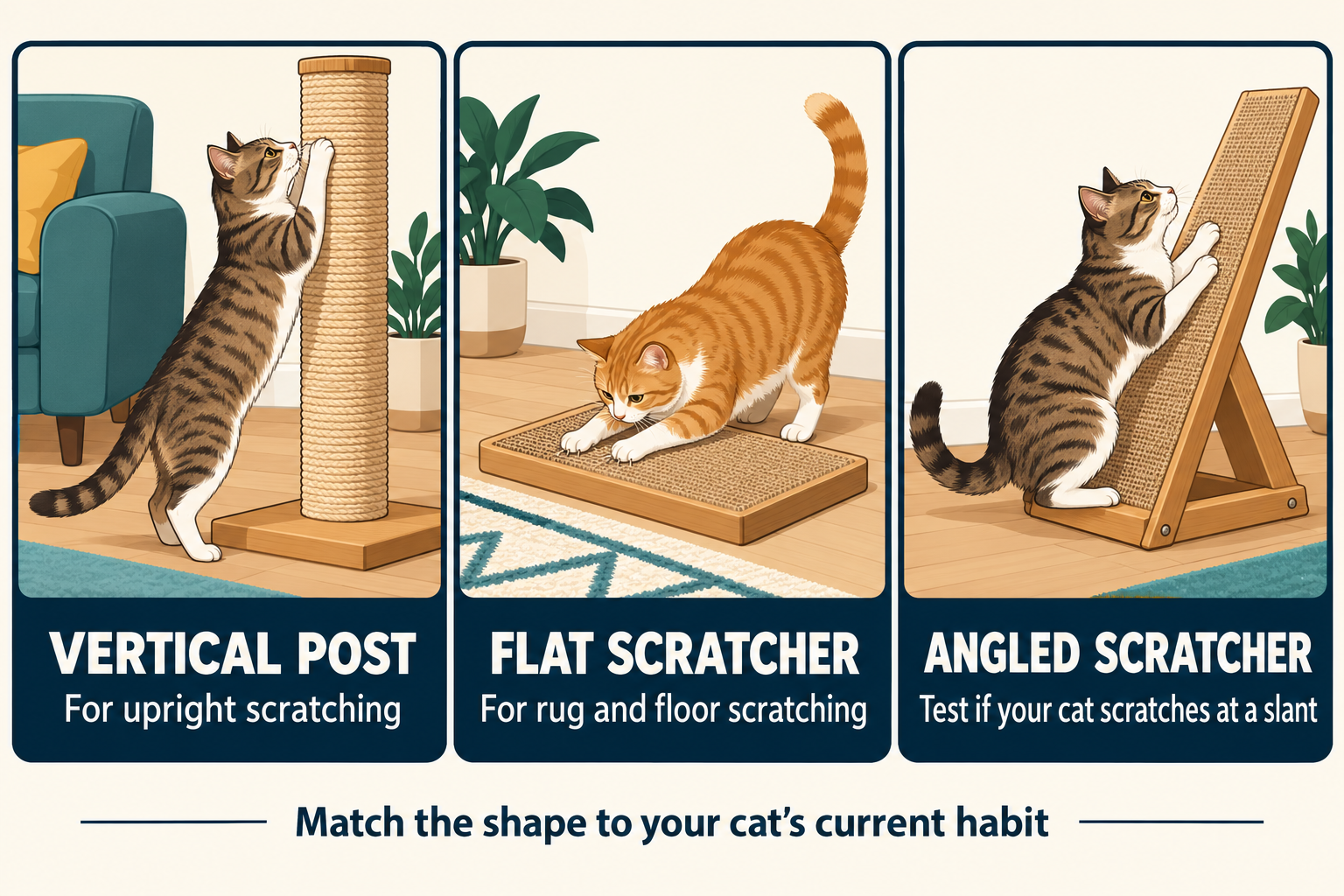
Match the scratcher’s angle to the way your cat already scratches, then check whether they choose it consistently.
| What your cat scratches now | First shape to try | Setup note |
|---|---|---|
| Sofa arm, chair side, or doorframe | Vertical post or cat tree | The post should allow a full upward stretch and stay steady. |
| Rug, mat, or floor-level surface | Horizontal scratch pad | Place it at the rug’s edge or beside the area your cat targets. |
| Slanted furniture edge or mixed surfaces | Angled scratcher | Try it near the current target; change one feature at a time. |
| Several different surfaces | A vertical post plus a flat or angled pad | Keep both available while you learn the cat’s preference. |
Observe before buying: note where the cat scratches, whether their forepaws reach upward or stay near the floor, and what texture they choose. A post that matches those habits is a better first test than a product selected only by appearance.
Which scratching-post material should I choose?
There is no proven best material for every cat. Sisal rope, sisal fabric, corrugated cardboard, carpet, and wood can all work; choose a safe surface that resembles what your cat already scratches, then offer another texture if they ignore it 1.
| Material | Good first test for | What to check |
|---|---|---|
| Sisal rope | Cats that like a coarse, rope-like surface | Replace or repair it if strands loosen or fray. |
| Sisal fabric | Cats that prefer a broad, continuous rough surface | Check that the fabric is firmly attached and does not peel away. |
| Corrugated cardboard | Cats that scratch rugs or enjoy tearing and shredding | Expect debris and replace it when it is too worn to grip. |
| Carpet | Cats already choosing carpet or rugs | A carpet-covered post may blur the difference between the post and household rugs. |
| Smooth, unfinished wood | Cats drawn to outdoor or wooden surfaces | Avoid splinters, sharp edges, coatings, or loose pieces. |
One internet-based owner survey of 4,331 responses found that rope was the most frequently used substrate when offered and that taller upright posts were associated with less reported unwanted scratching. The authors still described their results as a starting point because cats have individual preferences and owner surveys cannot prove that one material caused the outcome 2. A pilot paper questionnaire with 116 responses from one veterinary practice did not find a clear relationship between scratching frequency and post material, angle, length, or location 3. Together, these studies support testing options—not promising a universal winner.
If you are comparing surfaces because your cat scratches rugs, see our guide to redirecting carpet scratching.
What makes a scratching post safe and sturdy?
A vertical post should be taller than your cat’s stretched body length, with a base or mounting system that does not rock when the cat leans into it. AAFP guidance recommends a sturdy post that lets the cat fully stretch; the exact size depends on the cat and the post design 1.
Use this quick checklist before setting it up:
- Height: Your cat can extend upward without running out of surface.
- Stability: The post does not tip, slide, or wobble during a firm scratch.
- Grip: The surface catches claws without being painful or slippery.
- Construction: No sharp edges, exposed staples, loose hardware, or long unraveling strands.
- Access: The cat can reach the surface without having to jump farther than is comfortable.
- Wear: You can replace or repair the scratch surface before it becomes unstable or unsafe.
A 3-foot post appears in an owner survey as a useful reference point, not a minimum that fits every home. Measure against your own cat’s full stretch and favor stability over a tall but wobbly tower 2.
Where should I put a scratching post?
Put the scratcher beside the place your cat already scratches, then add options near favorite resting spots and well-used routes. A post hidden in a rarely used room may be easy for people to ignore but easy for the cat to miss 1.
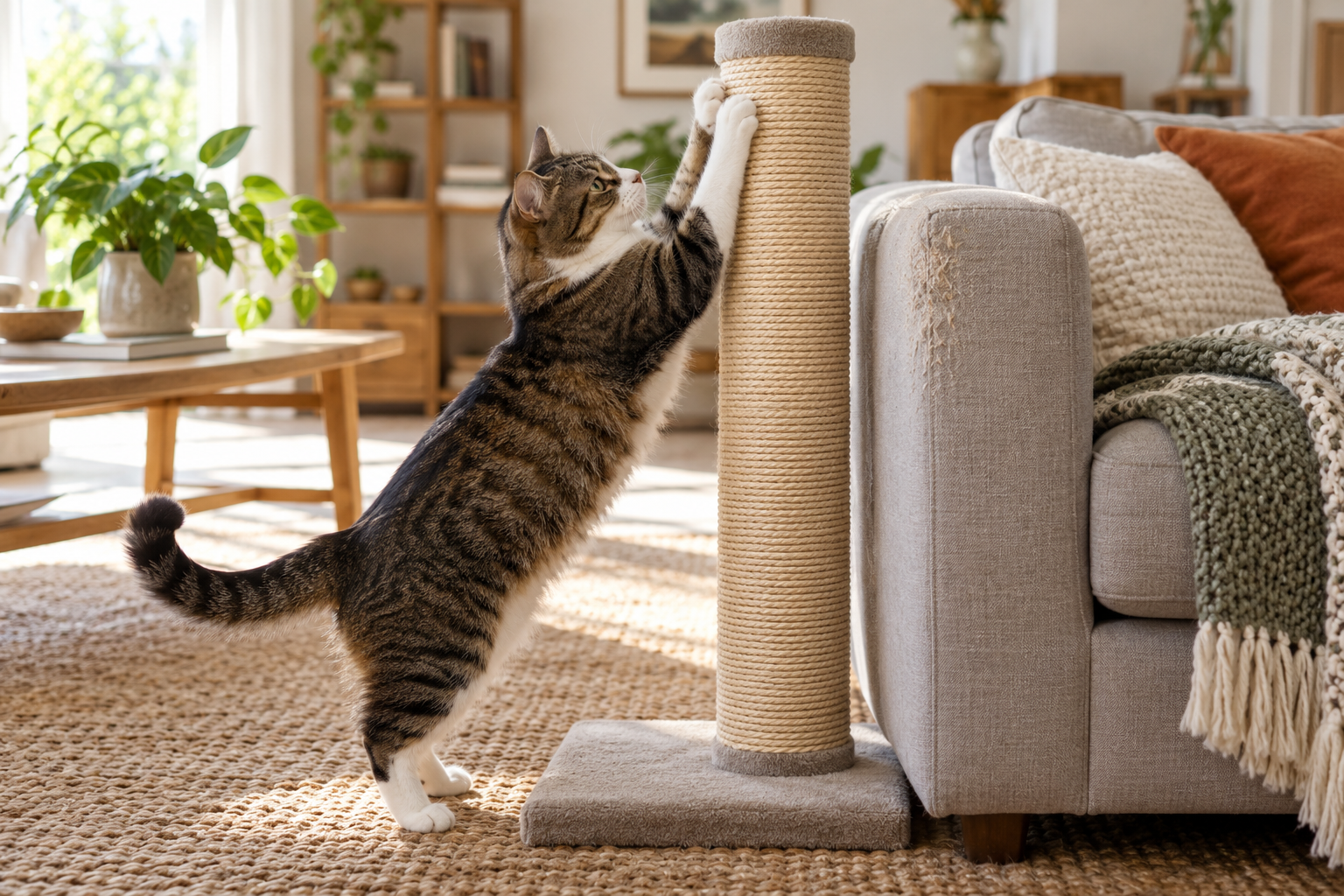
Placing the post right beside the chosen furniture target makes the preferred alternative easy to find at the moment your cat wants to scratch.
Useful starting locations include:
- Beside a sofa arm, chair, or doorframe your cat currently targets.
- Near a sleeping place, since cats often stretch and scratch after waking.
- In a shared living area where the cat spends time.
- Near a doorway, window, or route where the cat pauses and marks.
- In separate parts of the home when cats use different territories.
Keep the scratcher next to the problem spot while the cat learns to use it. If you later need to move it, shift it gradually and leave another acceptable scratcher near the original target until the new location is established. In a multi-cat home, place options so one cat cannot block every route to them; our guide to introducing two cats without fighting covers resource spacing during introductions.
How do I train my cat to use a scratching post?
Make the post easy to choose and reward voluntary scratching as soon as it happens. Cats learn through positive reinforcement; FelineVMA guidance recommends giving a reward immediately—within about three seconds—so it is clearly linked to the behavior 4.
- Match the post to the habit. Start with the angle and texture closest to the surface your cat already chooses.
- Place it by the target. Set the post beside the sofa, rug, or other current scratching spot.
- Invite, do not force. Let your cat explore. You can move a wand toy along the scratcher or place a treat nearby; use catnip only if your cat responds to it.
- Reward the choice. When the cat touches, stretches on, or scratches the surface, offer a favorite treat, play, or other reward right away.
- Keep the setup consistent. Leave the post in place while the new habit forms, and keep rewarding its use.
Do not grab your cat’s paws and scrape them against the post, yell, or spray water. Punishment can create fear and stress without showing the cat which surface is acceptable 4. If the post is ignored, change one variable at a time—location, angle, height, or texture—so you can tell what your cat prefers.
If your cat scratches during energetic play, try ending a short session with an approved scratcher nearby; our guide to interactive toys for indoor cats has ideas for structured play.
How many scratching surfaces does one cat need?
There is no single evidence-based number that fits every home. As a practical starting test, offer one scratcher near each recurring target area and at least two different orientations—usually one vertical post and one flat pad—then add or reposition options based on where the cat actually scratches 1.
In a multi-cat home, spread scratchers across separate rooms or routes rather than relying on one shared post. Make sure each cat can approach and leave without being cornered. If one location remains unused, try another position or surface before adding more identical posts.
How can I protect furniture while my cat learns?
Protect the furniture temporarily while making the approved scratcher more convenient. Put the new post directly beside the target and use a secure furniture cover or pet-safe barrier that does not create a chewing, snagging, or entrapment hazard. Reward the cat for choosing the scratcher, and remove the barrier gradually after use is consistent 5.
Avoid startling or punishing the cat when they scratch. If you need a broader room-by-room plan, see our guide to cat-proofing your home. Regular, calm nail care can also reduce snags; follow our steps for trimming cat nails safely.
When can a change in scratching signal a problem?
A new favorite surface is often a setup clue: the post may be unstable, too short, in the wrong place, or covered in a texture your cat avoids. A sudden increase in scratching or a change paired with signs of pain or broader behavior changes deserves more attention; AAFP guidance advises considering stress and having a veterinarian assess possible pain when scratching increases 1.
Contact your veterinarian if the change comes with limping, reluctance to stretch or jump, a painful-looking paw or claw, hiding, unusual irritability, or other sudden changes in appetite, sleep, or activity. Do not assume a behavior change is only a training issue when your cat may be uncomfortable.
Conclusion
Choose the scratcher by watching your cat: match its angle to their posture, start with a safe texture they already approach, and make sure an upright post supports a full stretch without wobbling. Put it beside the current target and reward voluntary use. If your cat keeps choosing the furniture, adjust the setup before buying several more of the same post.
Frequently Asked Questions
Are vertical or horizontal scratching posts better?
Neither is best for every cat. Choose a vertical post for cats that scratch upward and a flat pad for cats that scratch rugs or floors; offer both if you are not sure.
Is sisal rope or cardboard better for cats?
Both can work. Many cats use sisal rope, while others prefer cardboard, carpet, or wood. Start with the texture your cat already chooses and switch if they ignore it.
How tall should a cat scratching post be?
It should let your cat stretch fully while scratching. For a vertical post, choose one taller than the cat’s stretched body length and stable enough not to rock.
Why does my cat ignore a new scratching post?
It may be the wrong height, angle, texture, or location. Put it beside the current target and change one feature at a time; reward voluntary investigation or scratching.
Should I put catnip on a scratching post?
Only if your cat responds to catnip. A toy or a small treat can also invite exploration, and immediate rewards help reinforce scratching on the approved surface.
When should I replace a scratching post?
Replace or repair it when it wobbles, the surface no longer grips, or fibers and parts become loose enough to snag a paw or be chewed. A worn surface can remain useful if it is still stable and safe.
References
[1] American Association of Feline Practitioners. Claw Friendly Educational Toolkit. PDF.
[2] Wilson C, Bain M, DePorter T, et al. (2016). Owner observations regarding cat scratching behavior: an internet-based survey. Journal of Feline Medicine and Surgery. Full text.
[3] Moesta A, Keys D, Crowell-Davis S. (2018). Survey of cat owners on features of, and preventative measures for, feline scratching of inappropriate objects: a pilot study. Journal of Feline Medicine and Surgery. Full text.
[4] Feline Veterinary Medical Association (formerly AAFP). Positive Reinforcement of Cats. Guidance.
[5] ASPCA. Destructive Scratching. Guidance.