
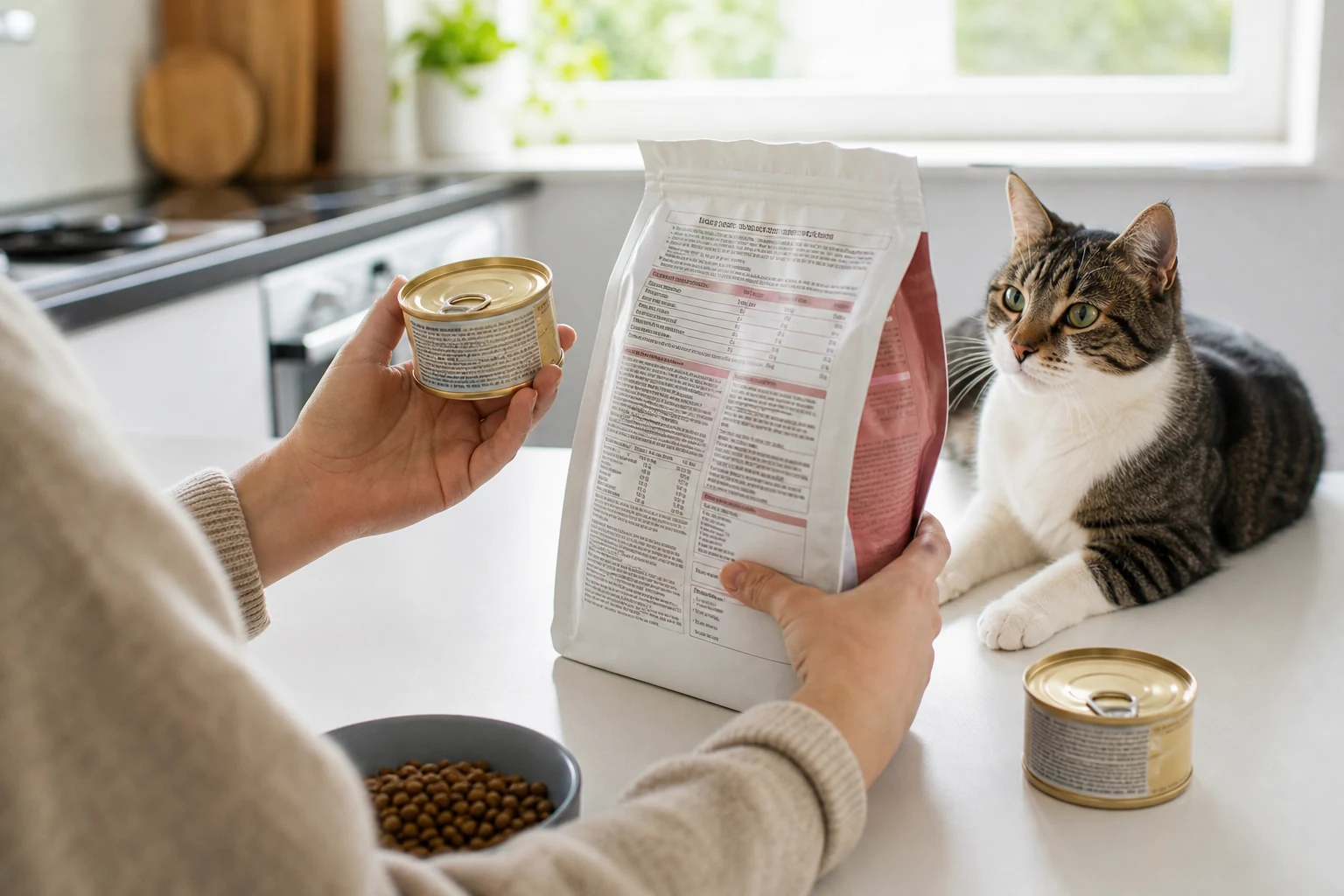
Low carb cat food can help some cats, especially diabetic cats, but it should fit calorie control, complete nutrition, and veterinary guidance.
That distinction matters because carbohydrate claims are easy to oversimplify. Cats are obligate carnivores, but commercial foods are not judged by one number alone. A cat food still needs to be complete and balanced for the right life stage, and labels can be tricky because wet food and dry food contain very different amounts of water 1.
This guide explains what low carb cat food means, how to estimate carbs from a label, when it may matter most, and when to call your veterinarian before changing your cat's diet.
Table of Contents
- What does low carb cat food actually mean?
- How do you check carbs on a cat food label?
- When does low carb cat food matter most?
- What should matter more than carbs?
- Is low carb cat food enough for weight loss?
- When should you ask your vet before switching foods?
- Conclusion: Is low carb cat food worth it?
- Frequently Asked Questions
- References
What does low carb cat food actually mean?
Low carb cat food usually means a food with less starch and sugar than typical kibble, often with more calories coming from animal protein and fat. There is no single legal definition of "low carb" on every cat food label, so the phrase is most useful when you can compare products on a dry matter basis.
Many wet foods are naturally lower in carbohydrate than many dry foods because canned textures do not need as much starch to hold their shape. Some dry foods are lower in carbohydrate than average, but kibble often needs plant starches for manufacturing. That is why the bigger question is not only "wet or dry?" but "what does the full nutrient profile look like after moisture is accounted for?"
If you are comparing this topic with high-protein cat food, think of them as related but not identical. A food can be high in protein and still contain moderate carbohydrate, especially if it is calorie-dense. A food can also be lower in carbohydrate but too high in calories for a sedentary indoor cat.
For most cat parents, a practical definition is this: low carb cat food is a complete and balanced cat food that keeps estimated carbohydrate lower than many mainstream options while still fitting your cat's age, health status, body condition, and daily calorie needs.
How do you check carbs on a cat food label?
You usually estimate carbs by reading the guaranteed analysis, adjusting for moisture, and comparing foods on a dry matter basis. The label's guaranteed analysis commonly lists minimum crude protein, minimum crude fat, maximum crude fiber, and maximum moisture, but it may not list carbohydrate directly 2.

The reason this matters is simple: canned food may be mostly water, while dry food contains much less moisture. FDA consumer guidance explains that pet food labels report nutrient percentages as fed, while many nutrient comparisons are more meaningful on a dry matter basis 1. If you compare the front of a can to the front of a bag without adjusting for water, the numbers can mislead you.
A rough label check looks like this:
| Label step | What to look for | Why it matters |
|---|---|---|
| Nutritional adequacy statement | Complete and balanced for your cat's life stage | A low-carb food still needs to meet overall nutrient needs |
| Guaranteed analysis | Protein, fat, fiber, moisture, and ash if listed | These values help estimate carbohydrate |
| Moisture level | Usually much higher in canned food | Moisture changes the apparent percentage of every nutrient |
| Calories | kcal per can, cup, pouch, or gram | A lower-carb food can still cause weight gain if portions are too large |
| Feeding directions | Starting point only | Your cat's body condition and vet advice should guide adjustments |
To estimate carbohydrate "by difference" on an as-fed basis, subtract protein, fat, fiber, moisture, and ash from 100. If ash is not listed, some cat parents use an estimate, but that makes the result less exact. To compare wet and dry foods more fairly, convert the nutrients to dry matter by removing the moisture percentage from the equation.
For a deeper format comparison, use this with the SnuggleSouls guide to wet vs dry cat food. Wet food often helps with moisture intake and may be lower in carbs, while dry food can be convenient and easier to portion for some households.
When does low carb cat food matter most?
Low carb cat food matters most when a veterinarian has identified a reason to manage your cat's carbohydrate intake. The most common example is feline diabetes, where Cornell Feline Health Center notes that low-carbohydrate diets can help improve blood sugar regulation as part of a veterinary treatment plan 3.
That does not mean every cat with diabetes should be switched overnight or that food replaces medical care. Diabetic cats often need insulin, monitoring, careful weight management, and close follow-up. If your cat is already receiving insulin, changing carbohydrate intake without veterinary guidance can affect blood glucose control.
Low-carb choices may also be discussed for overweight indoor cats, cats who struggle with satiety on high-starch diets, or cats whose vet recommends a specific therapeutic nutrition plan. In these cases, the food is one tool. The complete plan may also include calorie targets, scheduled meals, gradual transitions, activity, and body condition monitoring.
Low carb is less urgent for a healthy adult cat who is lean, energetic, eating a complete and balanced diet, and doing well at checkups. For that cat, the better goal may be choosing a high-quality food your cat digests well and feeding the right amount every day.
What should matter more than carbs?
Completeness, calories, protein quality, digestibility, moisture, and your cat's health status should matter more than a single carbohydrate number. A low-carb food that is not complete and balanced, is too high in calories, or causes vomiting or diarrhea is not a better choice just because the carb estimate looks appealing.
Start with the basics in how to choose healthy cat food: the food should be appropriate for your cat's life stage, clearly labeled, made by a company that can answer nutrition questions, and accepted by your cat without digestive upset. Cornell's feeding guidance also emphasizes that proper nutrition supports long-term health and should fit the individual cat 5.
For kittens, pregnant or nursing cats, seniors with health conditions, and cats with kidney disease, urinary disease, pancreatitis, food allergy, or chronic digestive symptoms, the "best" carbohydrate level is not something to solve from a label alone. Those cats need individualized advice because changing protein, fat, phosphorus, calories, fiber, or moisture may matter more than lowering starch.
A useful food decision order is:
- First, confirm the food is complete and balanced for your cat's life stage.
- Next, check calories and portion size.
- Then compare protein, fat, fiber, moisture, and estimated carbohydrate.
- Finally, watch your cat's stool, appetite, coat, energy, weight trend, and comfort.
This order keeps low carb in its proper place: important for some cats, useful for label literacy, but not the only measure of a good diet.
Is low carb cat food enough for weight loss?
Low carb cat food is not enough for weight loss if total calories are still too high. Weight change depends heavily on calorie intake, body condition, activity, age, neuter status, and medical factors, so a lower-carb food can still lead to weight gain when portions drift upward.
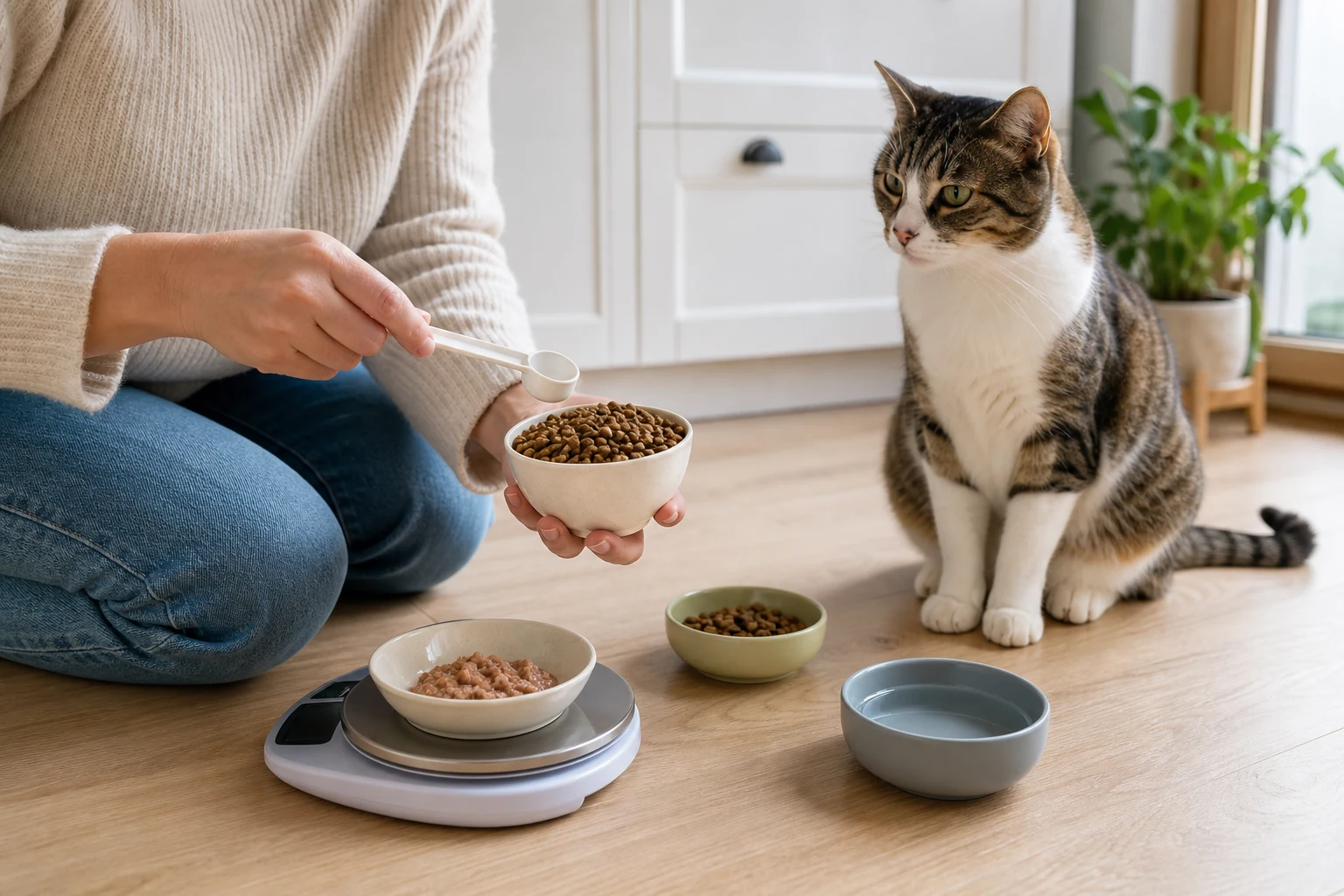
For an indoor cat who is gaining weight, start by measuring meals more accurately. Use the food's kcal information, check how much to feed your cat, and estimate a starting target with the cat calorie calculator. Then track body shape with a hands-on tool such as the cat body condition calculator.
WSAVA nutrition resources encourage body condition assessment as part of routine nutrition evaluation, because weight alone can miss whether a cat is under-muscled, lean, ideal, overweight, or obese 4. That is especially useful for cats with fluffy coats, large frames, or slow weight changes.
Do not crash diet a cat. Rapid calorie restriction can be dangerous, especially for overweight cats. If your cat needs to lose more than a small amount of weight, ask your veterinarian for a safe target rate, food plan, and recheck schedule.
When should you ask your vet before switching foods?
Ask your veterinarian before switching to low carb cat food if your cat has diabetes, is taking insulin, has kidney disease, has urinary issues, has pancreatitis, is underweight, is a kitten, is pregnant or nursing, has repeated vomiting or diarrhea, or has lost weight without explanation. In those situations, a diet change can affect more than appetite.
You should also call your vet promptly if your cat stops eating, eats much more than usual, drinks or urinates more, vomits repeatedly, has severe diarrhea, seems weak, hides suddenly, breathes abnormally, or declines quickly. If hunger is part of the reason you are researching food, compare your observations with why your cat is always hungry and treat sudden appetite changes as a medical clue.
For healthy cats, switch gradually over 7 to 10 days unless your veterinarian gives different instructions. Mix a small amount of the new food into the old food, increase slowly, and pause the transition if your cat develops digestive upset. Cats can be sensitive to abrupt texture, smell, and routine changes, even when the new food is nutritionally appropriate.
Bring useful details to your vet visit: the exact food name, flavor, calories, label photos, how much your cat eats, treats, weight history, body condition, stool quality, and any symptoms. That information is more actionable than saying you want "the lowest carb food."
Conclusion: Is low carb cat food worth it?
Low carb cat food can be a smart choice when it fits your cat's medical needs, calorie needs, and overall nutrition plan. It is especially worth discussing for diabetic cats or cats whose veterinarian wants a lower-starch diet, but it is not a magic label claim.
For most cat parents, the best next step is to compare labels on a dry matter basis, confirm the food is complete and balanced, measure calories, and watch your cat's body condition over time. If your cat has a medical condition or is already on medication, make the change with your veterinarian instead of experimenting alone.
Frequently Asked Questions
Is low carb cat food better for all cats?
No. Low carb cat food may be helpful for some cats, but a healthy cat also needs complete nutrition, appropriate calories, good digestibility, and a food they will reliably eat. A very low-carb choice is not automatically better if it does not fit your cat's life stage or health needs.
Is wet cat food always low carb?
Not always, but many wet foods are lower in carbohydrate than many dry foods. You still need to check the guaranteed analysis, calories, ingredients, and nutritional adequacy statement because formulas vary widely.
How can I tell if my cat food has too many carbs?
Start by estimating carbohydrate from the guaranteed analysis and comparing foods on a dry matter basis. If your cat has diabetes, obesity, or another health condition, ask your veterinarian what carbohydrate range makes sense rather than relying on a general internet target.
Can low carb cat food help a diabetic cat?
It can be part of the plan. Cornell Feline Health Center notes that low-carbohydrate diets can improve blood sugar regulation in diabetic cats, but diabetic cats need veterinary care, monitoring, and often insulin or other medical management 3.
Should I choose grain-free food to reduce carbs?
Not necessarily. Grain-free does not always mean low carb, because some formulas replace grains with potatoes, peas, lentils, tapioca, or other starches. Check the full nutrient profile instead of using "grain-free" as a shortcut.
How fast should I switch to a low carb cat food?
For a healthy cat, a gradual 7- to 10-day transition is usually easier on digestion and acceptance. For a diabetic cat, a cat on insulin, or a cat with a medical condition, ask your veterinarian first because a lower-carb diet may change medical management.
References
[1] FDA. (2019). Complete and Balanced Pet Food. https://www.fda.gov/animal-veterinary/animal-health-literacy/complete-and-balanced-pet-food
[2] AAFCO. (2023). Reading Labels. https://www.aafco.org/consumers/understanding-pet-food/reading-labels/
[3] Cornell Feline Health Center. (2026). Feline Diabetes. https://www.vet.cornell.edu/departments-centers-and-institutes/cornell-feline-health-center/health-information/feline-health-topics/feline-diabetes
[4] World Small Animal Veterinary Association. (2024). Global Nutrition Guidelines. https://wsava.org/global-guidelines/global-nutrition-guidelines/
[5] Cornell Feline Health Center. (2026). Feeding Your Cat. https://www.vet.cornell.edu/departments-centers-and-institutes/cornell-feline-health-center/health-information/feline-health-topics/feeding-your-cat





 Why Does My Cat Flinch When Touched While Sleeping? Startle, Trust, and Pain Clues">
 Cat Scratching Baseboards: Trim Guards and Route Fixes">
 EN
EN DE
DE ES
ES PT
PT