
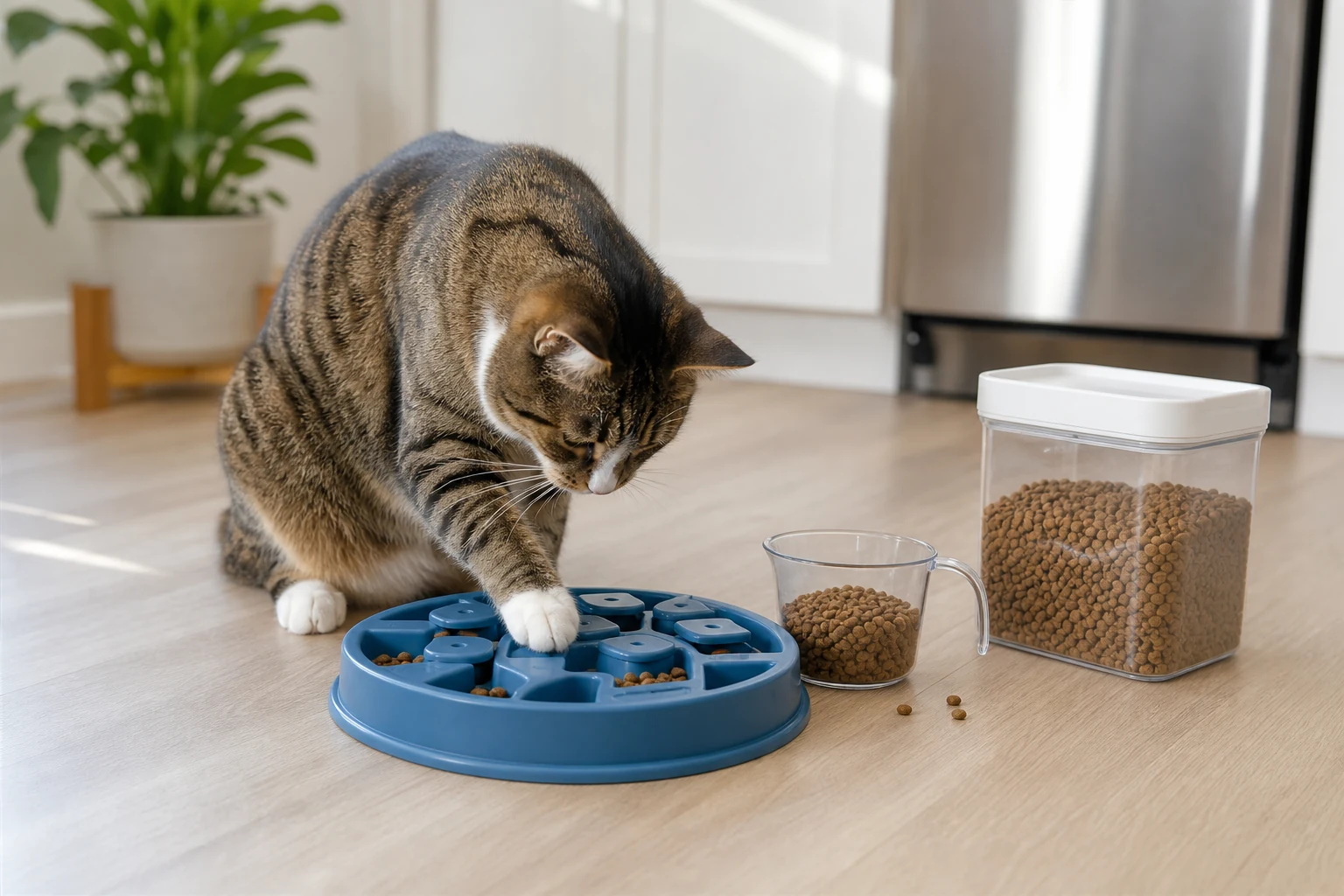
Puzzle feeders for cats can make meals slower, more active, and more mentally engaging, but they work best when the food amount is still measured. Think of the puzzle as the delivery method, not the diet plan.
Many indoor cats eat from bowls that ask very little of them. A puzzle feeder changes that by making the cat paw, nose, roll, lick, or search for food in small amounts. That can support natural hunting-style behavior, help some fast eaters slow down, and make a measured dry-food ration feel less like one quick snack.
The key is to introduce the puzzle gently. A cat who has always eaten from an open bowl may not understand a hard feeder on day one. Start easy, keep the daily calories the same, and use your cat's body language to decide when to raise the challenge.
Table of Contents
- Are puzzle feeders good for cats?
- Can puzzle feeders help with portion control?
- Which type of puzzle feeder should you choose?
- How do you introduce a puzzle feeder without frustrating your cat?
- What mistakes make puzzle feeders stressful or unsafe?
- What if your cat begs even with a puzzle feeder?
- How do puzzle feeders fit into indoor enrichment?
- When should you ask your veterinarian first?
- Conclusion: Make meals slower, not more complicated
- Frequently Asked Questions
- References
Are puzzle feeders good for cats?
Puzzle feeders are good for many cats because they add activity and choice to feeding. They can encourage a cat to work for small portions of food, which better resembles the search-and-capture pattern cats are built to use.
A review in the Journal of Feline Medicine and Surgery describes food puzzles as tools that can support feline physical health and emotional wellbeing when they are introduced appropriately 1. The AAFP/ISFM environmental needs guidelines also emphasize opportunities for play and predatory behavior, including feeding practices that require cats to actively acquire food 2.
That does not mean every cat should be forced into a difficult puzzle. A feeder is helpful only if your cat can succeed without fear, pain, guarding, or repeated frustration. For some cats, the best first step is a shallow tray, a snuffle-style mat, or a few pieces of kibble scattered in safe hiding spots. For others, a rolling ball or sliding compartment can be a fun daily challenge.
Puzzle feeders can pair well with timed feeders for cats if your goal is routine plus activity. The timer controls when food appears; the puzzle controls how quickly your cat accesses it.
Can puzzle feeders help with portion control?
Puzzle feeders can help with portion control when you load them with a measured amount of food. They do not reduce calories by themselves.
Cornell Feline Health Center notes that cats vary widely in how much food they need and that obesity is a common nutrition-related problem in cats 4. Cornell also describes body condition scoring as a practical way veterinarians assess whether a cat is at an ideal weight, overweight, or obese 5. A puzzle feeder can support that plan by slowing delivery, but the daily ration still needs to match your cat's age, body condition, activity level, food type, and veterinary guidance.
Use this simple setup:
| Step | What to do | Why it matters |
|---|---|---|
| Measure the day first | Weigh or measure the total daily food before filling any feeder. | Prevents "just a little extra" from becoming routine. |
| Split the amount | Put part of the ration in the puzzle and part in regular meals if needed. | Makes the transition easier for cautious cats. |
| Count treats | Include treats and training rewards in the daily food budget. | Treat calories can quietly undo portion control. |
| Track body condition | Check weight and body shape weekly or monthly. | Shows whether the plan is working safely. |
If you need a starting estimate, use the cat calorie calculator and our guide on how much should I feed my cat. If your indoor cat is gaining weight on mixed wet and dry feeding, this may also connect to calorie drift; see how to adjust mixed feeding for indoor cats who gain weight.
Which type of puzzle feeder should you choose?
Choose the easiest puzzle your cat can understand, then increase difficulty only after your cat is confident. The right feeder is not the most complicated one; it is the one your cat will use calmly.
Common options include:
- Stationary trays: shallow cups, ridges, pegs, or sliding pieces that hold dry food.
- Rolling feeders: balls or tubes that release kibble as the cat bats them around.
- Lick mats or slow-feeder plates: useful for some wet foods, depending on texture and cleaning needs.
- DIY beginner puzzles: egg cartons, low boxes, towel folds, or paper tubes used under supervision.
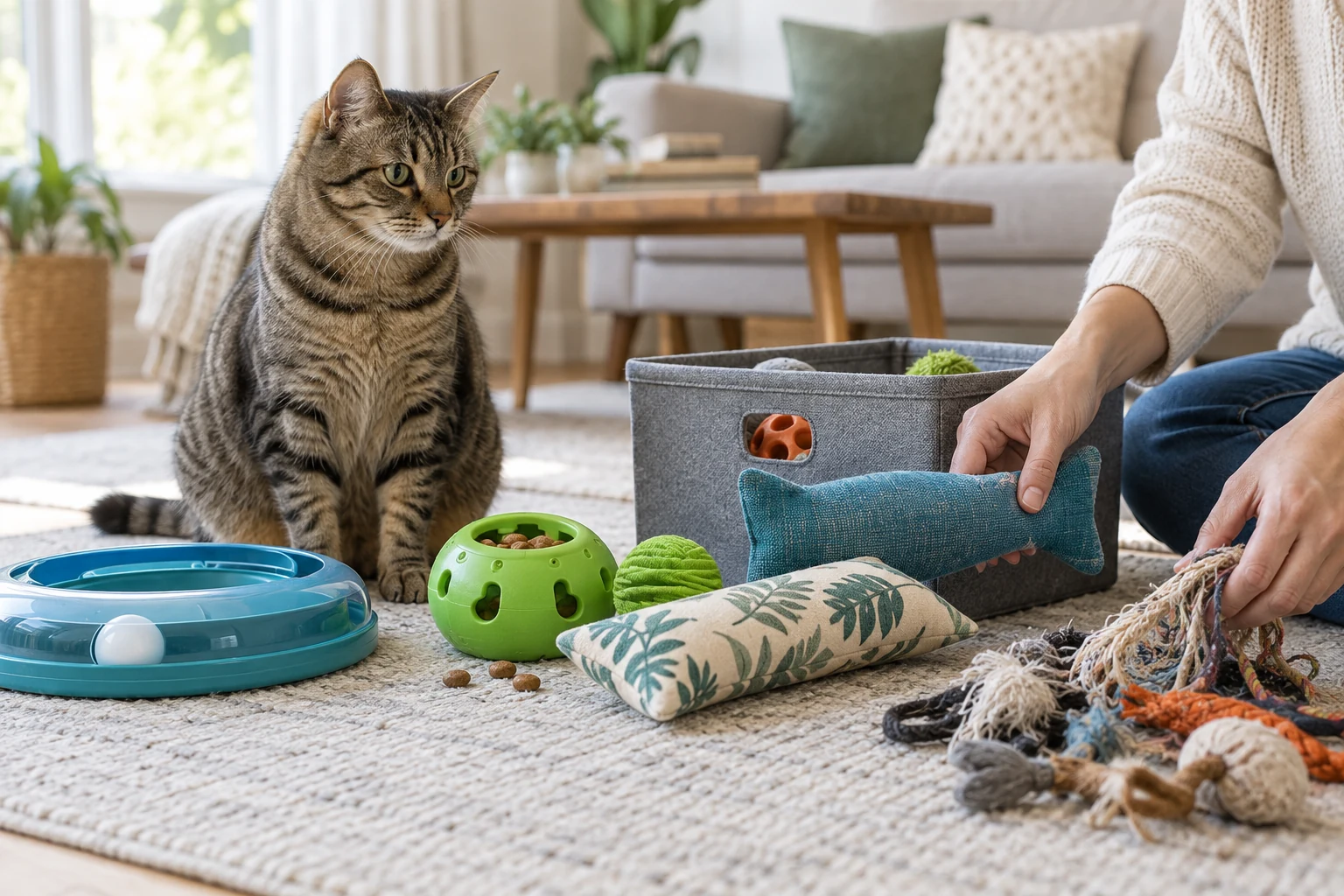
- Foraging stations: small measured portions placed around a safe room for the cat to find.
International Cat Care recommends starting with simple puzzles and making the task gradually harder as the cat learns 3. That progression matters. A cat who gives up, walks away tense, or paws frantically may need a simpler feeder, a more visible reward, or a return to a regular bowl for part of the meal.
Match the feeder to the food and schedule. Dry kibble usually works well in rolling or sliding puzzles. Wet food may work better on a lick mat, shallow slow feeder, or washable tray. If you are still building the meal routine, start with a cat feeding schedule by age and then decide where a puzzle feeder fits.
How do you introduce a puzzle feeder without frustrating your cat?
Introduce a puzzle feeder by making the first sessions almost too easy. Your cat should learn, "food appears when I interact with this," before you ask for harder problem-solving.
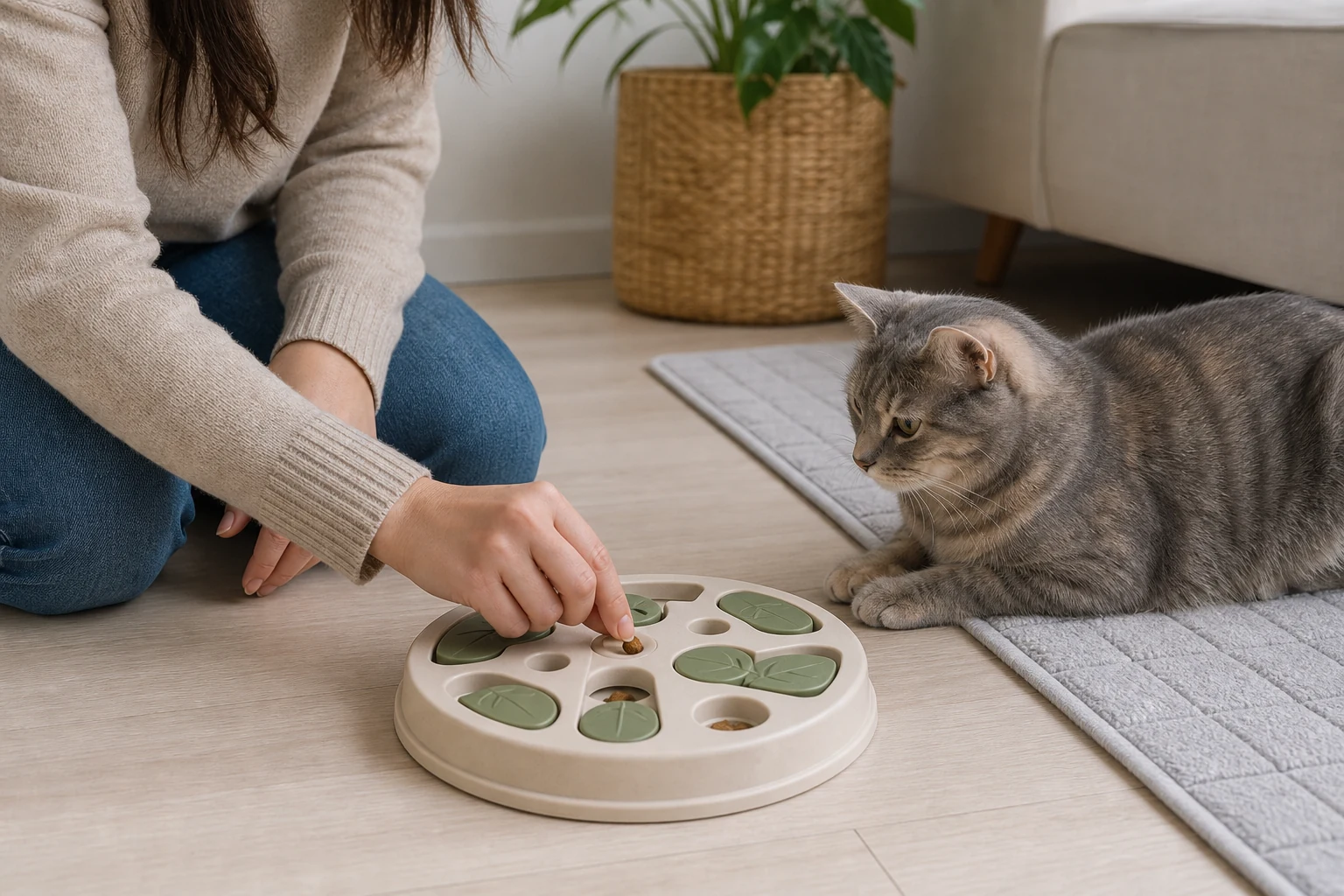
Start with these steps:
- Put the puzzle near your cat's normal feeding area.
- Leave a few pieces of food visible and easy to reach.
- Let your cat investigate without pushing, tapping, or holding the cat in place.
- Keep the first session short and successful.
- Offer part of the meal in a regular dish if your cat is unsure.
- Increase difficulty only after your cat returns willingly.
For a rolling feeder, begin with larger openings so kibble falls out easily. For a tray puzzle, leave some food uncovered before adding lids or sliders. For wet food, use a shallow texture your cat can lick without scraping whiskers or struggling to breathe comfortably.
Watch the body language. A relaxed cat may sniff, paw, pause, eat, and come back. A stressed cat may flatten the ears, freeze, swat hard, leave repeatedly without eating, guard the feeder, or vocalize in a strained way. If that happens, lower the difficulty or stop for that meal.
What mistakes make puzzle feeders stressful or unsafe?
Puzzle feeders become stressful when they are too hard, too competitive, poorly cleaned, or used as the only food source before the cat understands them. The goal is enrichment, not a test your cat can fail.
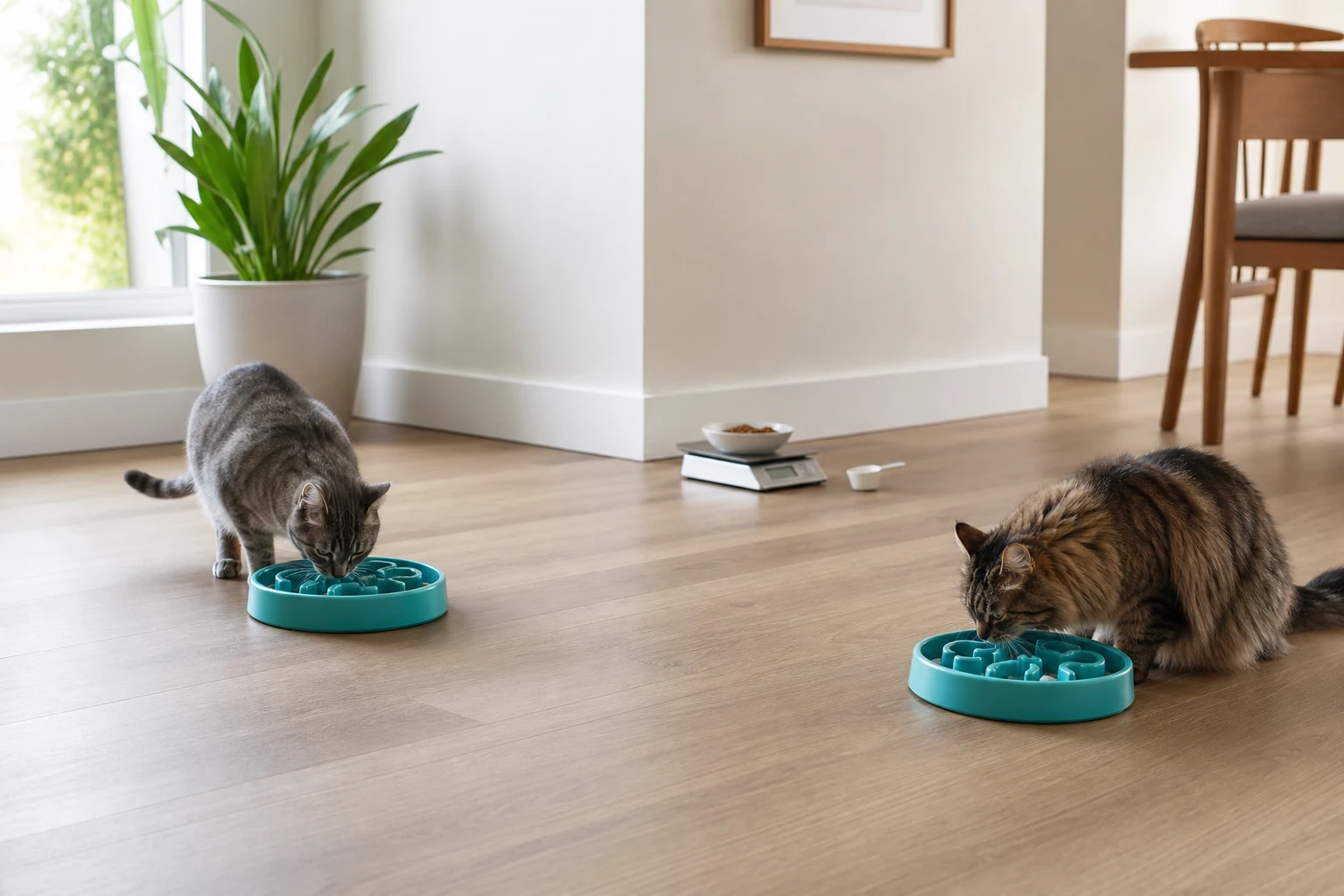
Avoid these common mistakes:
| Mistake | Why it causes trouble | Better setup |
|---|---|---|
| Starting too hard | The cat may quit or become frustrated. | Begin with visible food and easy movement. |
| Using one feeder for multiple cats | One cat may guard, steal, or block access. | Use separate stations with distance and supervision. |
| Filling it with extra food | The feeder slows eating but still adds calories. | Load only measured food from the daily ration. |
| Ignoring cleaning | Wet food residue and kibble dust can build up. | Wash according to material and food type. |
| Using damaged DIY parts | Torn cardboard, loose strings, or small pieces can be unsafe. | Supervise DIY puzzles and remove worn items. |
Multi-cat homes need special care. Cats are not always comfortable eating shoulder to shoulder, even when they live peacefully together. AAFP/ISFM guidelines recommend separated key resources in the home, and feeding stations are part of that idea 2. If one cat eats quickly and another eats slowly, separate rooms, microchip feeders, or supervised mealtimes may be safer than one shared puzzle.
What if your cat begs even with a puzzle feeder?
A puzzle feeder can reduce some begging by making meals last longer, but it will not solve every hunger signal. Begging can come from habit, boredom, calorie needs, food stealing, stress, or medical problems.
First, check the basics:
- Is the daily food amount measured accurately?
- Is another pet stealing part of the ration?
- Are treats, toppers, and table scraps counted?
- Is the puzzle too hard, causing your cat to eat less and ask for more later?
- Is your cat losing weight, vomiting, drinking more, or acting restless?
If your cat seems hungry all the time, read our guide to why your cat is always hungry. If the issue is asking for food right after a meal, the pattern may be different; see cat begging for food after eating.
For habit-based begging, keep the routine boring and predictable. Feed measured meals at consistent times, avoid giving snacks after loud meowing, and use play or foraging as a separate activity. If a feeder makes the meal last ten minutes instead of one minute, that can help some cats feel more occupied without increasing calories.
How do puzzle feeders fit into indoor enrichment?
Puzzle feeders are one piece of indoor enrichment. They work best alongside play, scratching, climbing, resting places, predictable routines, and safe social choice.
Cats are hunters by design. Even indoor cats who never need to catch prey may benefit from outlets for stalking, chasing, pouncing, pawing, and searching. A food puzzle adds a feeding-based outlet, while wand play, solo toys, climbing routes, and window watching add movement and variety.
Try a simple daily rhythm:
| Time | Enrichment idea | Feeding connection |
|---|---|---|
| Morning | Short wand-toy session | Small meal or easy puzzle afterward |
| Midday | Hidden kibble pieces or rolling feeder | Uses part of the dry-food ration |
| Evening | Interactive play | Wet meal or measured mixed meal |
| Before bed | Calm foraging station | A few pieces from the daily budget |
If your cat needs more movement, browse our guide to interactive cat toys for indoor cats. A puzzle feeder should not be the only enrichment tool, especially for cats who prefer chasing, climbing, or social play over food puzzles.
When should you ask your veterinarian first?
Ask your veterinarian before changing the feeding routine if your cat has a medical condition, a prescribed diet, sudden appetite change, weight loss, repeated vomiting, diarrhea, dental pain, diabetes, kidney disease, urinary disease, pregnancy, nursing, or a history of food guarding that causes conflict.
Also call a veterinarian promptly if your cat stops eating, seems weak, hides unusually, has breathing trouble, collapses, strains to urinate, vomits repeatedly, has severe diarrhea, or declines quickly. A puzzle feeder is not appropriate when the immediate issue is illness, pain, dehydration, or an urgent change in appetite.
For overweight cats, do not crash diet. Cats need safe, gradual weight plans because rapid or poorly planned weight loss can be dangerous. Use puzzle feeders as a support tool only after the calorie target and monitoring plan are clear.
Conclusion: Make meals slower, not more complicated
Puzzle feeders can be a practical way to slow meals, encourage natural foraging behavior, and make measured portions more satisfying. The safest approach is simple: measure the food first, choose an easy puzzle, watch your cat's comfort, and increase difficulty gradually.
If your cat enjoys the feeder, it can become a daily enrichment habit. If your cat dislikes it, simplify the design or use other forms of play and food scattering. The best feeding plan is one your cat can use calmly and one you can measure consistently.
Frequently Asked Questions
Can cats eat all their meals from puzzle feeders?
Some cats can, but it should happen gradually. Start with a small part of the daily ration in an easy puzzle, then increase only if your cat eats confidently, maintains weight, and shows no stress.
Are puzzle feeders good for wet cat food?
Some are, especially washable lick mats, shallow slow-feeder plates, and wet-food-safe trays. Clean them thoroughly after each use and avoid designs with deep crevices that trap food.
Do puzzle feeders stop cats from vomiting after eating too fast?
They may help some cats slow down, but vomiting can have many causes. If vomiting is repeated, severe, sudden, or paired with low appetite, weight loss, lethargy, diarrhea, or pain, contact your veterinarian.
What is the easiest puzzle feeder for a beginner cat?
The easiest option is usually a shallow tray, low egg carton, towel fold, or simple puzzle with visible food. Your cat should be able to get several pieces quickly before you make the puzzle harder.
Should I use a puzzle feeder for multiple cats?
Yes, but usually not one shared feeder. Use separate feeding stations, distance, and supervision so one cat does not guard the food or steal another cat's portion.
References
[1] Dantas, L. M. S., Delgado, M. M., Johnson, I., & Buffington, C. T. (2016). Food Puzzles for Cats: Feeding for Physical and Emotional Wellbeing. Journal of Feline Medicine and Surgery
[2] Ellis, S. L. H., et al. (2013). AAFP and ISFM Feline Environmental Needs Guidelines. Journal of Feline Medicine and Surgery via PMC
[3] International Cat Care. (2025). Puzzle Feeders for Your Cat. International Cat Care
[4] Cornell Feline Health Center. (2026). Feeding Your Cat. Cornell University College of Veterinary Medicine
[5] Cornell Feline Health Center. (2026). Obesity. Cornell University College of Veterinary Medicine
 Why Does My Cat Flinch When Touched While Sleeping? Startle, Trust, and Pain Clues">
 Cat Scratching Baseboards: Trim Guards and Route Fixes">
 EN
EN DE
DE ES
ES PT
PT