
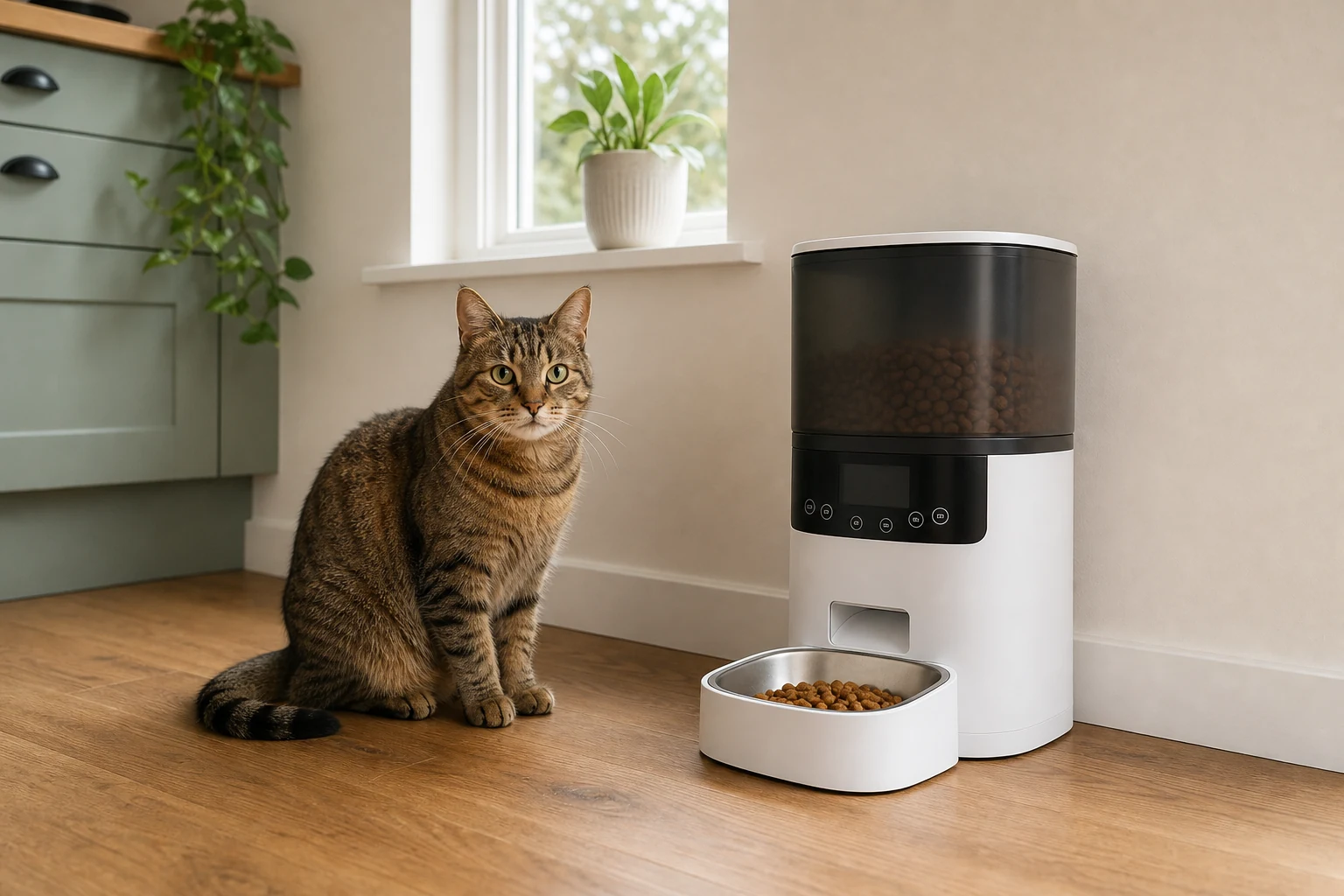
Timed feeders for cats can help with predictable meals, early-morning begging, and portion control, but they are not a shortcut around measuring food. The safest setup starts with your cat's daily calorie target, divides that amount into meals, and uses the feeder to deliver the plan consistently.
Many cat parents buy a timed feeder after weeks of 5 a.m. wake-up calls or after realizing a free-fed bowl is never as "self-regulating" as it looked. That can be a smart move. VCA notes that automatic feeders can dispense food at planned times and may help with controlled portions when used correctly 1. The mistake is assuming the machine decides how much a cat should eat.
Use this guide to choose the right cats, set realistic portions, avoid multi-cat stealing, and know when a timed feeder should wait for veterinary advice.
Table of Contents
- Do timed feeders for cats actually help?
- Which cats are good candidates for a timed feeder?
- How do you set portions in a timed cat feeder?
- What meal timing works best with an automatic feeder?
- Can timed feeders stop early-morning begging?
- What setup mistakes make timed feeders less safe?
- How should you monitor weight after switching?
- Conclusion: Use automation to support the plan, not replace it
- Frequently Asked Questions
- References
Do timed feeders for cats actually help?
Timed feeders help when the problem is inconsistent meal timing, unmeasured dry food, or a cat who has learned to pressure the nearest human for snacks. They work best as part of a feeding plan, not as a replacement for one.
A feeder can be useful if you need to:
- Split dry food into smaller meals while you are asleep or away.
- Keep breakfast from depending on when you wake up.
- Reduce human-triggered begging by making the feeder the source of routine meals.
- Prevent one large bowl from turning into all-day nibbling.
- Support a planned weight-loss or weight-maintenance routine under veterinary guidance.
That routine should still connect to your cat's age, health, food type, and daily amount. If you are still deciding how often meals should happen, start with our cat feeding schedule by age guide, then decide whether automation would make that schedule easier to keep.
Timed feeders have limits. They are usually easiest with dry food. Some models handle wet food with cold packs, but freshness and cleaning become more important. They also cannot tell you whether one cat stole another cat's meal, whether a battery died, or whether a cat skipped food because of nausea, dental pain, stress, or illness.
Which cats are good candidates for a timed feeder?
The best candidates are healthy cats who eat dry food or mixed meals, need a more predictable routine, and can safely access the feeder without bullying or guarding. A timed feeder is especially helpful for indoor cats who beg early, eat too fast from one large bowl, or need smaller dry-food portions spread through the day.
Good candidates often include:
| Cat situation | Why a timed feeder may help | What to check first |
|---|---|---|
| Early-morning food begging | Feeder delivers breakfast before the cat wakes you | Daily calories are still measured |
| Dry-food grazer who gains weight | Meals replace the always-full bowl | Cat can tolerate scheduled meals |
| Fast eater | Smaller releases reduce one huge meal | Slow bowl or puzzle feeder may also help |
| Busy household | Meals happen on time even when people are delayed | Feeder is cleaned and tested |
| Single-cat home | Lower risk of food stealing | Weight and appetite are monitored |
Use more caution if your cat eats mostly wet food, is a kitten, is underweight, is a senior with appetite changes, or has a medical condition. Cats with diabetes, kidney disease, prescription diets, vomiting, diarrhea, dental pain, or appetite medication need an individualized feeding plan from a veterinarian. WSAVA's nutrition guidance emphasizes that feeding plans should account for the animal, diet, feeding management, and environment 5.
If your cat eats both canned and dry food, a feeder can manage only one part of the day. Our guide on how to mix wet and dry cat food can help you avoid counting the wet meal and dry feeder portion as two separate "full" diets.
How do you set portions in a timed cat feeder?
Set portions by calculating the total daily food first, then dividing that food across the feeder's meals. Do not start with the feeder's default serving size.
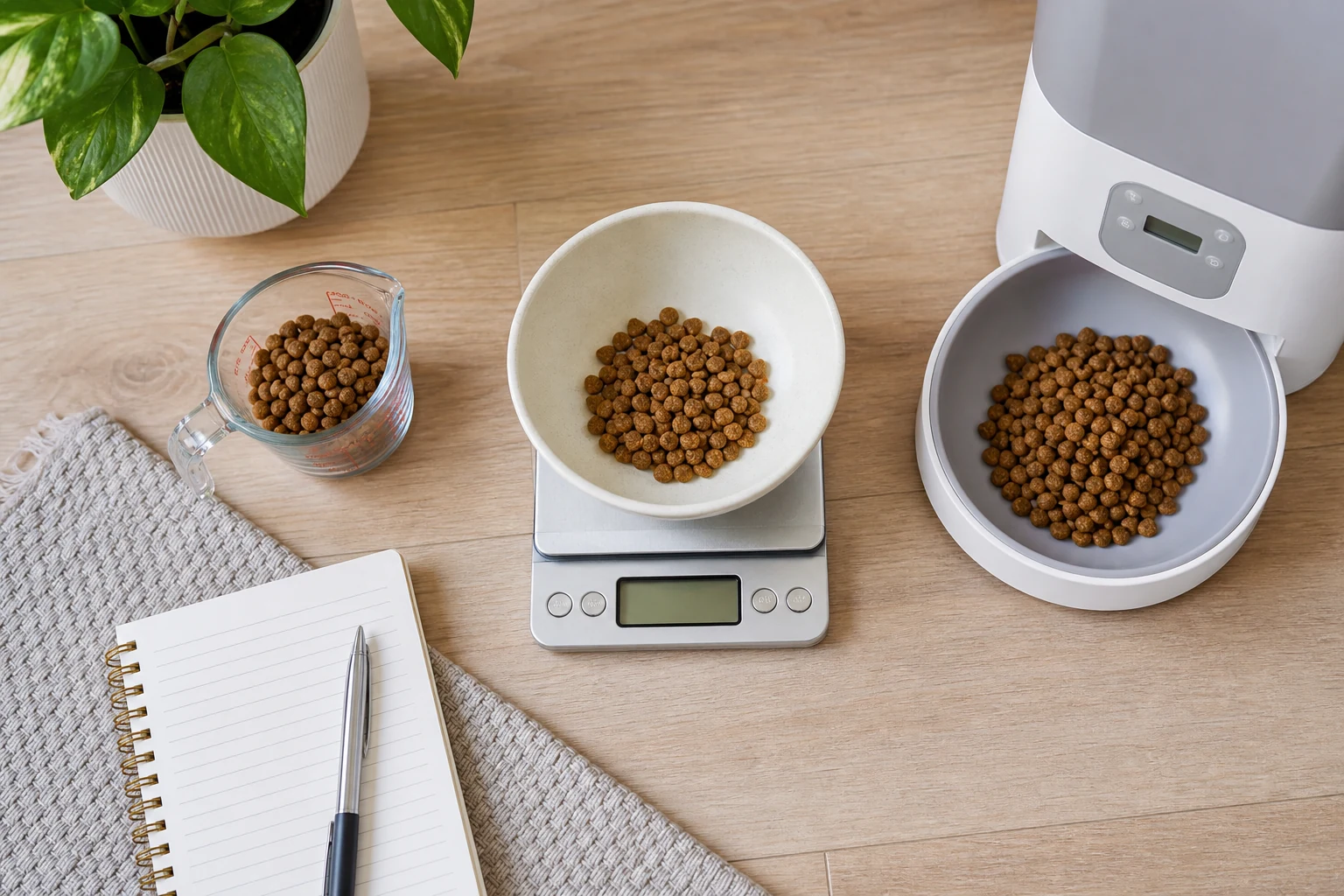
Begin with the calorie information on the food label. If you need an estimate, use the cat calorie calculator or our guide on how much should I feed my cat as a starting point, then adjust with your veterinarian if your cat is growing, overweight, underweight, pregnant, nursing, senior, or ill.
Next, test the feeder. Many feeders dispense by volume, not calories, and kibble size can change how much comes out per "portion." Run several test releases into a bowl, weigh or measure the result, and write down the real amount. Repeat when you change foods.
A practical setup looks like this:
| Step | What to do | Why it matters |
|---|---|---|
| 1 | Confirm the daily calories or daily grams/cups | Prevents guessing from the feeder setting |
| 2 | Subtract wet food, treats, and training rewards | Stops hidden calories from stacking up |
| 3 | Divide the remaining dry food into feeder meals | Keeps the total daily ration consistent |
| 4 | Test three to five releases | Checks whether the feeder dispenses accurately |
| 5 | Recheck weekly for the first month | Catches weight gain, missed meals, or stealing |
Cornell Feline Health Center explains that weight loss for cats should be gradual and calorie-controlled, not improvised by simply feeding less from a random bowl 3. That same principle applies when you use an automatic feeder: precision matters more than the gadget.
What meal timing works best with an automatic feeder?
Most healthy adult cats do well when the feeder supports two to four measured meals across the day. The right number depends on your cat's appetite pattern, food type, and health.
VCA notes that feeding at least two meals daily is a common recommendation and that cats benefit from predictable routines 2. For a feeder, that might look like:
| Goal | Sample timed feeder schedule | Notes |
|---|---|---|
| Stop dawn wake-ups | 5:30 a.m. small dry meal, 6 p.m. main meal | Keep the early meal small enough to fit daily calories |
| Reduce fast eating | 7 a.m., noon, 6 p.m., 10 p.m. | Smaller portions can be easier on some cats |
| Support mixed feeding | Dry feeder at 5 a.m. and 2 p.m.; wet meals morning and evening | Count every format in the daily total |
| Manage evening begging | 7 a.m., 5 p.m., 9 p.m. | A planned late snack may beat random treats |
Avoid dramatic schedule changes overnight. If your cat has been free-fed for years, start by measuring the current daily amount, then gradually shift part of the food into timed meals. Cats who become frantic, vomit bile, lose weight, or stop eating need a slower plan and possibly veterinary help.
Kittens are a special case. They often need frequent meals and steady growth monitoring, so do not use a timed feeder to restrict a kitten unless your veterinarian has given a clear plan.
Can timed feeders stop early-morning begging?
Timed feeders can reduce early-morning begging if the cat is asking for a predictable breakfast and the feeder becomes the consistent food source. They are less likely to help if the cat is bored, anxious, underfed, ill, or rewarded with extra attention every time they wake you.
To make the switch work, set the feeder for a small breakfast before the usual wake-up time, then avoid giving a second "real" breakfast because the cat complained. If you feed again after the alarm, the cat may learn that the feeder is only the opening round.
Begging can also mean something else. A cat who suddenly seems ravenous, loses weight, vomits, drinks more, has diarrhea, or steals food aggressively should not be managed only with a machine. Read why your cat is always hungry or cat begging for food after eating for behavior and health clues, then call your veterinarian if the change is new, intense, or paired with other symptoms.
For cats who beg from boredom, pair the timed feeder with play and foraging. International Cat Care describes puzzle feeders as a way to encourage mental and physical stimulation during feeding and support natural hunting behavior 4. A timed feeder gives the meal on schedule; a puzzle feeder can make part of that meal last longer.
What setup mistakes make timed feeders less safe?
The biggest mistakes are overfilling the hopper, trusting default portions, using one feeder for multiple cats without supervision, and failing to notice appetite changes. A timed feeder should make feeding clearer, not hide what is happening.
Watch for these common problems:
| Mistake | Why it causes trouble | Better setup |
|---|---|---|
| Filling the hopper and guessing portions | Kibble can dispense more than expected | Test and measure each release |
| One open feeder for two cats | One cat may steal while the other eats less | Use separate rooms, supervision, or microchip feeders |
| Ignoring wet-food freshness | Wet food can spoil if left too long | Use wet-food-safe models and clean promptly |
| No backup plan | Power or battery failure can delay meals | Check batteries and keep a manual meal plan |
| Placing feeder near litter or conflict zones | Stress can reduce eating or trigger guarding | Put food in quiet, separate, easy-access areas |
| Using the feeder for a sick cat without advice | Missed meals may go unnoticed | Follow a veterinary feeding plan |
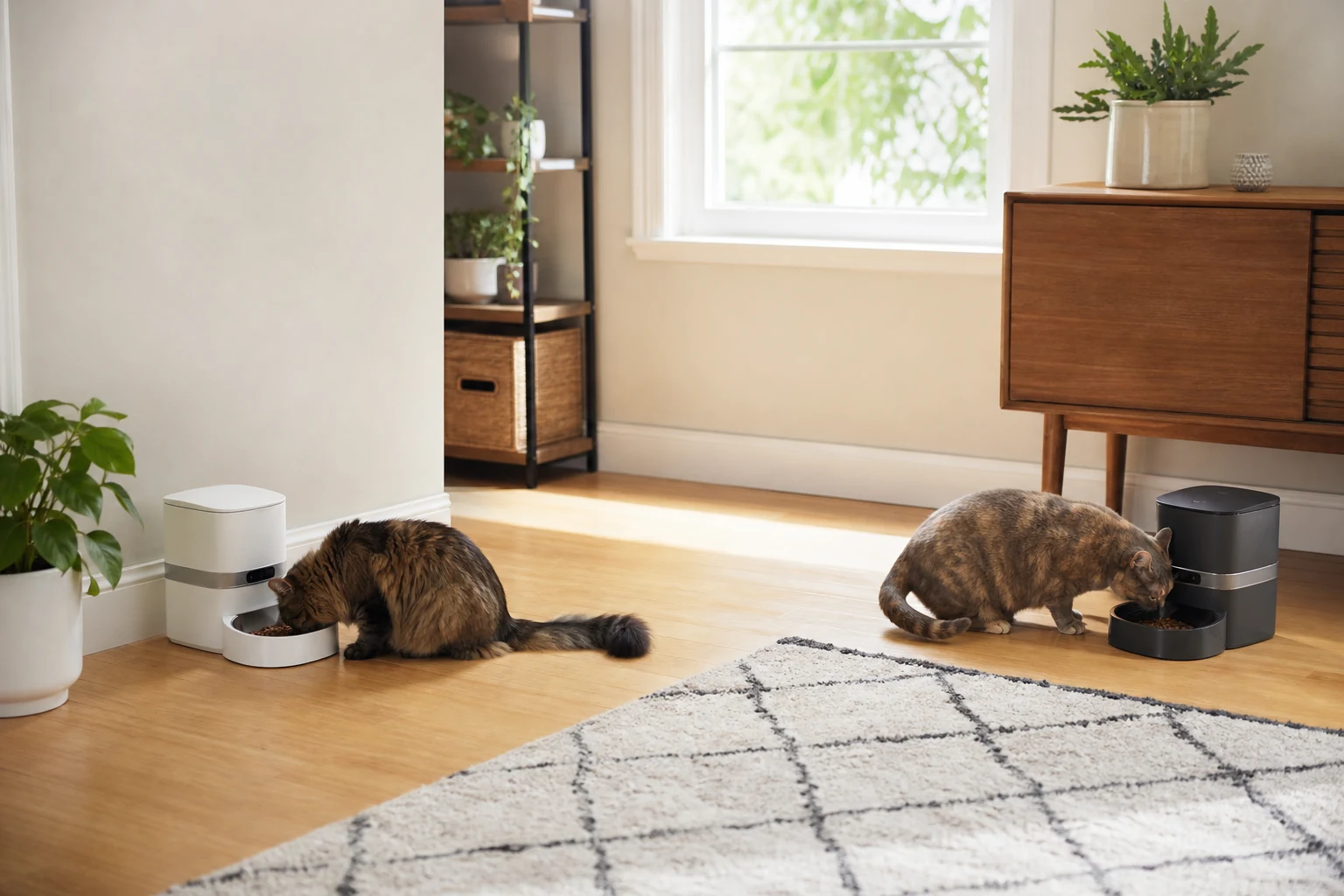
Multi-cat homes deserve extra attention. If one cat is gaining weight and another is slim, a shared feeder may be making the problem worse. Feed cats apart, close doors during meals, or use microchip-controlled access when stealing is likely. If weight gain is already happening with mixed feeding, see how to adjust mixed feeding for indoor cats who gain weight.
Clean the feeder regularly, too. Food dust, oils, and moisture can build up in the bowl and chute. Wash removable parts according to the manufacturer's instructions and fully dry them before adding food.
How should you monitor weight after switching?
Monitor appetite daily and weight weekly for the first month, then at least monthly once the routine is stable. The feeder may be automatic, but the health check is still yours.
Track these details:
- Did the feeder open at the right times?
- Did your cat eat each meal normally?
- Is any food left behind?
- Is another cat stealing meals?
- Has your cat's weight changed?
- Are stool, vomiting, thirst, and energy normal?
- Is your cat more settled, or more stressed?
Use the cat body condition calculator as a simple at-home check, but do not rely on weight alone. A cat can lose muscle, gain fat, or hide illness behind a normal-looking number.
Call your veterinarian if your cat refuses food for 24 hours, has repeated vomiting, severe diarrhea, rapid weight loss, sudden weakness, breathing trouble, collapse, suspected poisoning, or blocked urination signs. Cats with diabetes, known kidney disease, liver disease risk, kittens, and frail seniors should be checked sooner when appetite changes.
Conclusion: Use automation to support the plan, not replace it
A timed feeder can be a useful cat-care tool when it supports a measured plan: right daily amount, predictable meal times, clean equipment, and regular monitoring. It can help with early breakfasts, smaller dry-food meals, and weight-management routines, but it cannot decide calories or diagnose why a cat is begging.
Start with the food amount, test the feeder's real portion size, watch each cat's access, and adjust slowly. If your cat's appetite, weight, thirst, vomiting, stool, or energy changes, pause the automation mindset and get veterinary guidance.
Frequently Asked Questions
Are timed feeders good for cats?
Timed feeders can be good for healthy cats when they deliver measured meals and fit the cat's routine. They are less appropriate for cats with medical conditions, poor appetite, or multi-cat food stealing unless a veterinarian or careful setup addresses those risks.
Can I put wet food in a timed cat feeder?
Only use wet food in a feeder designed for it, usually with a sealed tray and cold pack. Wet food should not sit out for long periods, and the tray needs prompt cleaning after use.
How many times a day should a timed feeder feed my cat?
Many adult cats do well with two to four measured meals per day. The number should fit your cat's total calories, appetite pattern, food type, and health needs rather than the feeder's default settings.
Will a timed feeder stop my cat waking me up?
It may help if your cat is waking you for a predictable breakfast. It will not fully solve begging caused by boredom, anxiety, underfeeding, illness, or a routine where the cat still gets extra food from you after the feeder opens.
Are automatic feeders safe for multiple cats?
They can be safe, but shared feeders often allow stealing. Use separate feeding stations, close doors during meals, supervise at first, or consider microchip feeders if cats need different diets or portions.
References
[1] VCA Animal Hospitals. (2026). The Pros and Cons of Automatic Feeders. URL
[2] VCA Animal Hospitals. (2026). Feeding Times and Frequency for Your Cat. URL
[3] Cornell Feline Health Center. (2026). Ask Elizabeth: Care of Obese Cats. URL
[4] International Cat Care. (2025). Puzzle Feeders for Your Cat. URL
[5] World Small Animal Veterinary Association. (2024). Global Nutrition Guidelines. URL
 Why Does My Cat Flinch When Touched While Sleeping? Startle, Trust, and Pain Clues">
 Cat Scratching Baseboards: Trim Guards and Route Fixes">
 EN
EN DE
DE ES
ES PT
PT