
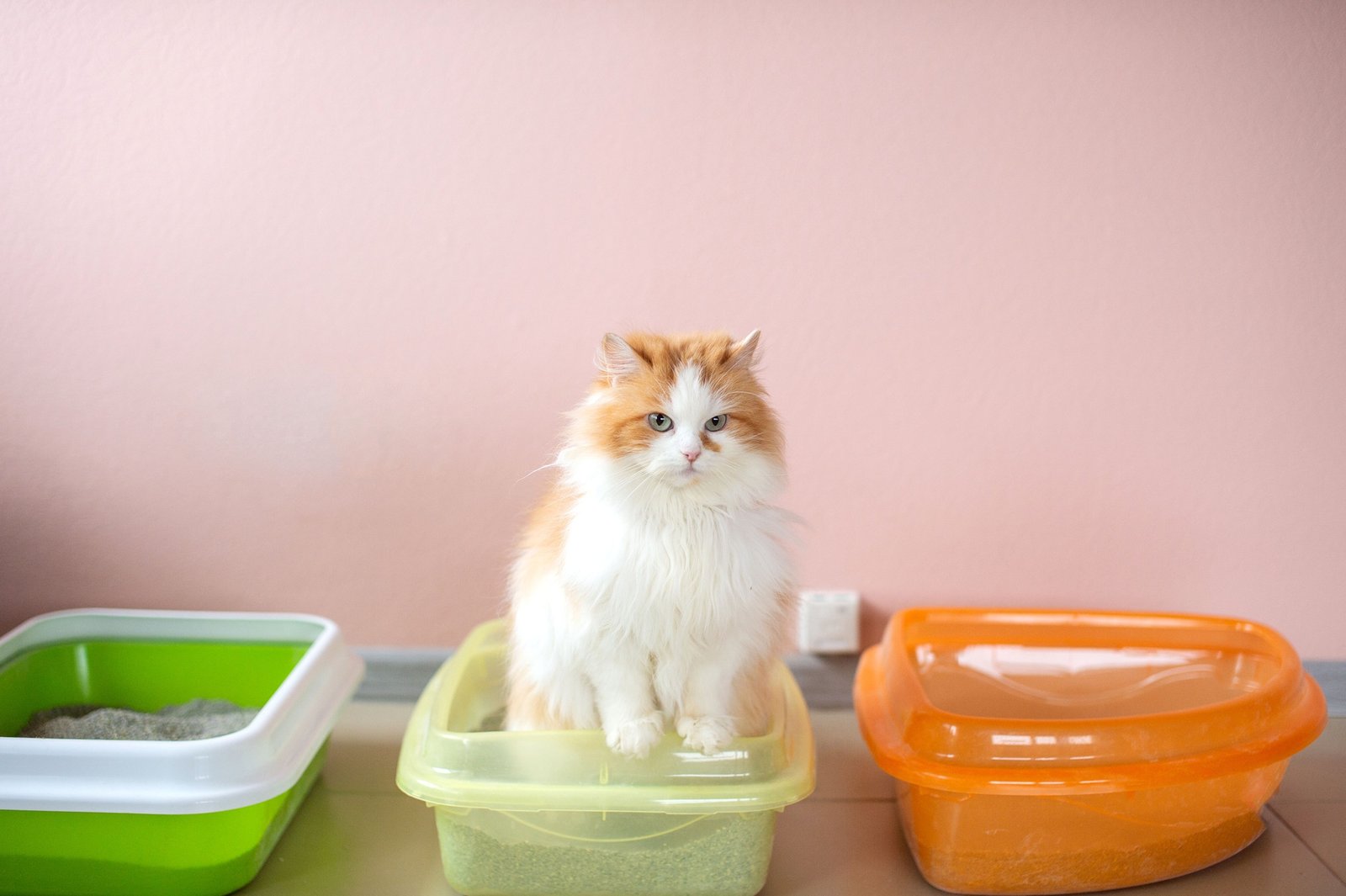
How big should a cat litter box be?
A tray is large enough when the cat can stand in it, turn around, and squat without touching the sides. International Cat Care puts a number on that: the ideal tray length is one and a half times the cat's body length, measured from the nose to the base of the tail. The RSPCA gives the same rule with a worked example — an average cat measuring about 50 cm nose to tail needs a tray at least 75 cm long.
That measurement is why many standard trays fail. A tray sold as "large" is often 55–60 cm long, which suits a small cat and is too short for an average one. Measure the cat first, then compare the tray's internal length — not the outer rim, and not the packaging claim.
| Body length, nose to tail base | Minimum tray length | Typical cat |
|---|---|---|
| 40 cm | 60 cm | Small adult, some females |
| 46 cm | 69 cm | Average adult |
| 50 cm | 75 cm | RSPCA's worked example |
| 55 cm | 83 cm | Large adult |
| 60 cm | 90 cm | Large breeds |
| 65 cm | 98 cm | Maine Coon and similar |
How many litter boxes do you need?
The working rule is one tray per cat, plus one extra. Two cats means three trays. The extra tray is not a spare: it matters when one cat guards a tray, when a tray is being cleaned, and when an older cat cannot travel to a tray on another floor.
Placement carries as much weight as the count. RSPCA recommends separate locations; boxes pushed together can be blocked as one resource. Put at least one box on each floor your cat regularly uses, then place any extra boxes in separate, quiet and easy-to-reach spots away from food and water.
How deep should cat litter be?
Use about 3 cm as a starting estimate, not a rule every cat will prefer. International Cat Care's kitten guide describes 3 cm as ideal, while RSPCA's general litter-tray guidance suggests about 3–4 cm. Cats vary by litter type and digging style, so watch whether your cat can dig comfortably without sinking or reaching the tray floor.
This calculator estimates volume at 3 cm. To estimate a different depth, multiply the tray's internal length × width × depth in centimetres, then divide by 1,000 for litres. A 60 × 40 cm tray at 3 cm takes about 7.2 L.
Kittens, senior cats, and large cats
Kittens need a tray they can climb into and out of, so a lower side matters more than a generous length. Use a smaller tray while they grow, then re-measure — a tray that fits a three-month-old kitten is too small by six months.
Senior cats and cats with arthritis benefit from low entry sides and a tray on every floor they use. A high-sided tray that worked for years can become the reason a cat stops using it. Keep the route clear and lit at night.
Large cats are where covered trays fail most often. A hood reduces the usable internal length, and a large cat cannot position itself to dig. If the calculated minimum exceeds the internal length of a covered tray you are considering, choose an open one.
Frequently asked questions
What size litter box does a large cat need?
Measure the cat from nose to the base of the tail, then multiply by 1.5. A cat measuring 55 cm needs at least 83 cm of internal tray length. Most covered trays are shorter than that once the hood is fitted, so an open tray is usually the practical answer.
How many litter boxes for two cats?
Three. The rule is one per cat plus one extra. Two trays for two cats works only if both cats get along and both trays stay clean, and it leaves nothing in reserve when one tray is being washed.
How many litter boxes does one cat need?
Plan for at least two in separate locations. If your cat regularly uses multiple floors, make sure a box is easy to reach on every floor; you may need more than the basic count to keep access convenient.
Is 2 inches of litter enough?
Two inches is about 5 cm, a little deeper than the 3–4 cm general starting range RSPCA cites. It is not automatically too deep: use a depth your cat can dig in comfortably, watch whether it is scattered or avoided, and follow any care guidance for the litter type.
Should the litter box be covered or open?
Open trays are easier to keep clean and give the cat room to turn. Covered trays contain odour for people but concentrate it for the cat, and the hood reduces usable space. If you use a covered tray, remove the flap and check that the internal length still meets the minimum.
How often should the litter be fully replaced?
Scoop at least twice a day. Replace clumping litter completely every two to four weeks, and non-clumping litter weekly. Top up between changes only when the remaining litter is dry and clean.
Does tray height matter?
Yes, for two different reasons. High sides keep litter in for a vigorous digger. Low sides let a kitten, senior, or arthritic cat walk in without a jump. Choose the lowest side the cat can manage comfortably, then use a mat to catch tracking.
Where these figures come from
- International Cat Care — Choosing a litter tray for your cat: the 1.5× body length rule, the ~3 cm depth, and one tray per cat plus one extra.
- RSPCA Knowledgebase — Why is my cat urinating inappropriately?: the same 1.5× rule with a 50 cm to 75 cm worked example.
- RSPCA Knowledgebase — How do I encourage my cat to use a litter tray?: quiet, separate locations; at least two trays for one cat; 3–4 cm as a starting fill depth.
- International Cat Care — Home modifications for cats with pain or mobility problems: easy access across home levels and low-entry tray considerations.