
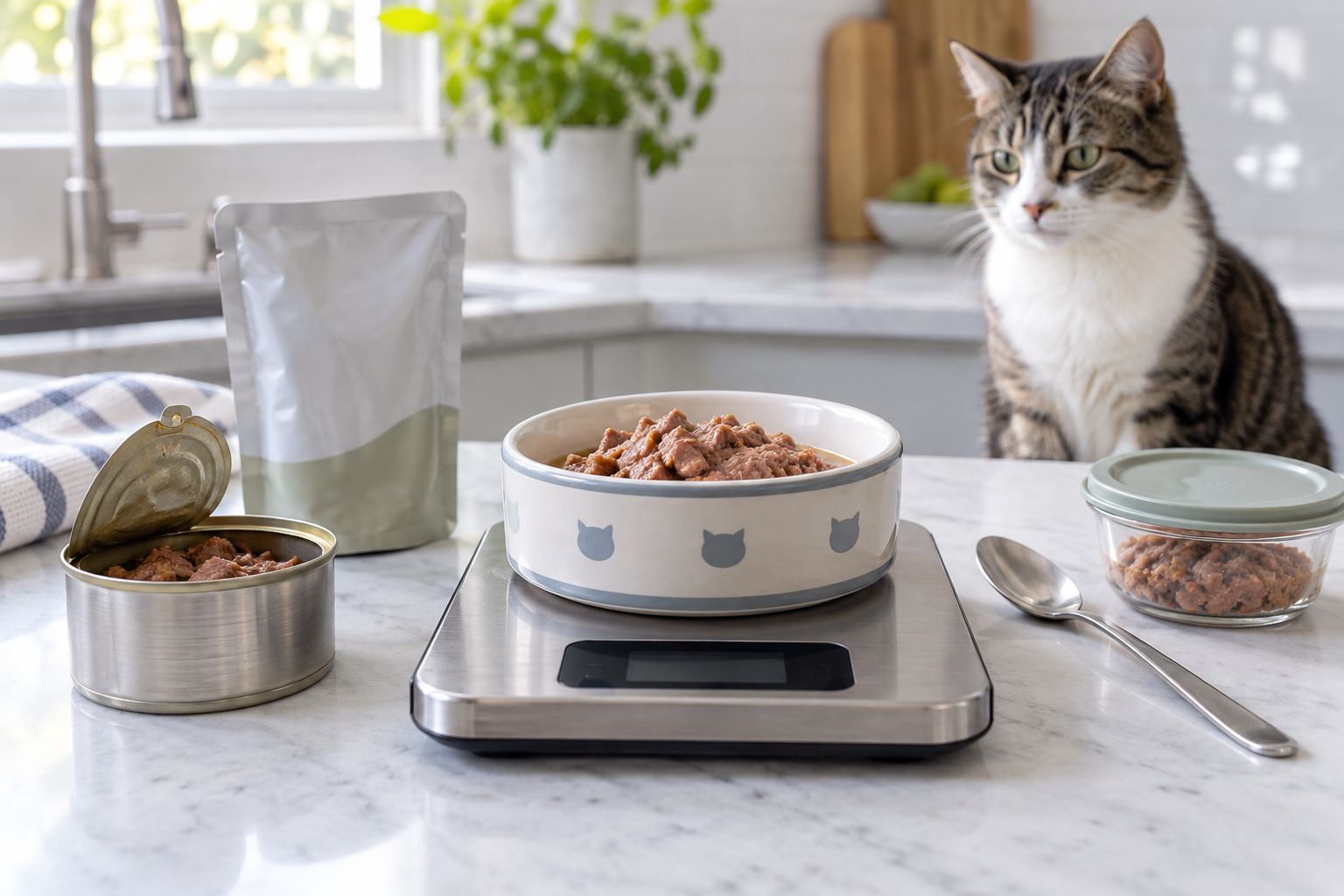
Weighing wet cat food portions turns a can, pouch, or tray into repeatable gram amounts, so meals and leftovers stay consistent.
It is most useful when your cat eats partial containers, mixed wet and dry meals, prescription food, or a weight plan that needs more consistency than "about half a can." Once you know the food's calories and the amount your cat should eat, a kitchen scale can help you split meals, store leftovers safely, and notice when a cat's appetite changes.
Table of Contents
- Why weigh wet cat food instead of half a can?
- What label numbers do you need before you portion wet food?
- How do you turn cans and pouches into grams?
- How do you weigh wet cat food step by step?
- How do you split a can or pouch across meals?
- How should you store leftover wet food after weighing?
- What mistakes can throw off wet food portions?
- When should a veterinarian set the portion?
- Conclusion: Measure Wet Food Once, Then Make It Easy
- Frequently Asked Questions
- References
Why weigh wet cat food instead of half a can?
Weigh wet cat food because cans, trays, and pouches rarely split as neatly as they sound. "Half a can" may be close enough for a healthy cat with stable weight, but it can drift when the food is packed unevenly, some gravy stays in the container, or different family members serve different spoonfuls.
Wet food is also less visually intuitive than dry food. Cornell Feline Health Center notes that canned cat food has high moisture content and can be very palatable, but unused opened canned food should be refrigerated to maintain quality and prevent spoilage 2. That makes portioning and storage part of the same routine: serve what your cat needs now, then cover and chill the rest.
A scale is especially helpful when:
- your cat eats part of a can or pouch at each meal
- your cat eats wet food plus dry food or treats
- you are trying to stop slow weight gain
- one cat in a multi-cat home needs a different portion
- a veterinarian gave a calorie or gram target
- you need to track appetite after illness, dental pain, or a food switch
If your main question is the daily calorie target rather than wet-food handling, start with the SnuggleSouls cat calorie calculator and your veterinarian's advice. The scale does not decide the right diet; it helps you serve the chosen amount accurately.
What label numbers do you need before you portion wet food?
You need three label details: calories, container weight, and nutritional adequacy. The calorie statement tells you how much energy the food provides. The container weight tells you how much food is in the can, pouch, or tray. The adequacy statement tells you whether the food is intended as a complete diet or only a treat, topper, or supplemental food.
AAFCO explains that pet food calorie statements are listed under "Calorie Content" and should be expressed both as kilocalories per kilogram as fed and as kilocalories per familiar unit, such as per can, per cup, or per biscuit 1. That familiar unit is what makes wet food easier: many labels say something like "85 kcal per 3 oz can" or "72 kcal per pouch."
Check this before you do math:
| Label item | What to find | How it helps |
|---|---|---|
| Calories per container | kcal per can, tray, pouch, or tub | Lets you split the container by calories |
| Net weight | grams or ounces in the container | Lets you split the container by weight |
| Calories per kg | kcal/kg as fed | Useful when the label lacks a clear per-container number |
| Life stage statement | adult maintenance, growth, all life stages, or other wording | Helps match food to the cat's needs |
| Feeding directions | suggested amount by body weight or life stage | A starting range, not a personal prescription |
If the label feels hard to interpret, read SnuggleSouls' cat food feeding directions before changing portions. For wet-food-specific daily amounts, use our guide on how much wet food to feed a cat.
How do you turn cans and pouches into grams?
Turn cans and pouches into grams by dividing the container's total grams by the number of servings you want, or by dividing your calorie target by the food's calories per gram. The calorie method is better when your cat has a specific daily calorie target.
Here are the two most useful formulas:
“`text calories per gram = calories per container / grams per container
grams to feed = meal calorie target / calories per gram “`
Example:
| Step | Example | Math |
|---|---|---|
| Label calories | 96 kcal per can | Given on label |
| Net weight | 85 g per can | Given on label |
| Calories per gram | 1.13 kcal/g | 96 / 85 |
| Meal target | 48 kcal | Half of the can's calories |
| Wet food amount | about 42 g | 48 / 1.13 |
If your cat should eat the whole 85 g can per day across two meals, the easy household version is 42 to 43 g per meal. If the food is chunky and gravy-heavy, stir the can first so one meal does not get mostly meat and the other mostly liquid.
For mixed feeding, calculate wet food first, then subtract those calories from the daily budget before measuring dry food. The SnuggleSouls guide on how to mix wet and dry cat food walks through that daily-calorie split.
How do you weigh wet cat food step by step?
Put the empty bowl on the scale, press tare or zero, add wet food until you reach the gram amount, and serve it promptly. Taring matters because the bowl may weigh much more than the food.
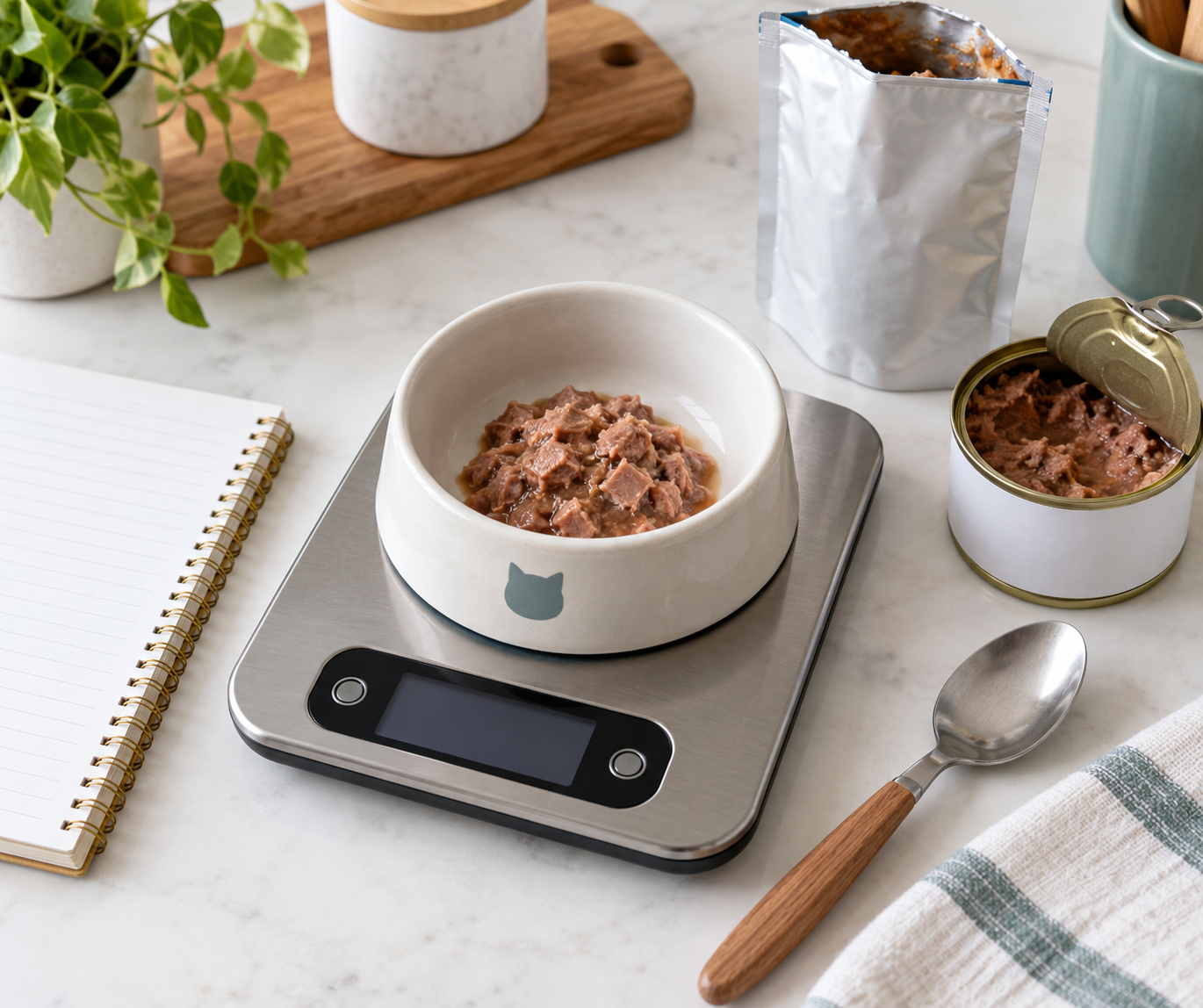
Tare the bowl first, then add wet food until the scale reaches the gram amount for that meal.
Use this simple routine:
- Wash your hands before handling food.
- Place the scale on a flat, dry surface.
- Set the scale to grams.
- Put the clean empty bowl on the scale.
- Press tare or zero.
- Stir the can or pouch if the texture has separated.
- Spoon food into the bowl until the display reaches the target grams.
- Cover and refrigerate the remaining food promptly.
- Wash the bowl, spoon, and measuring tools after the meal.
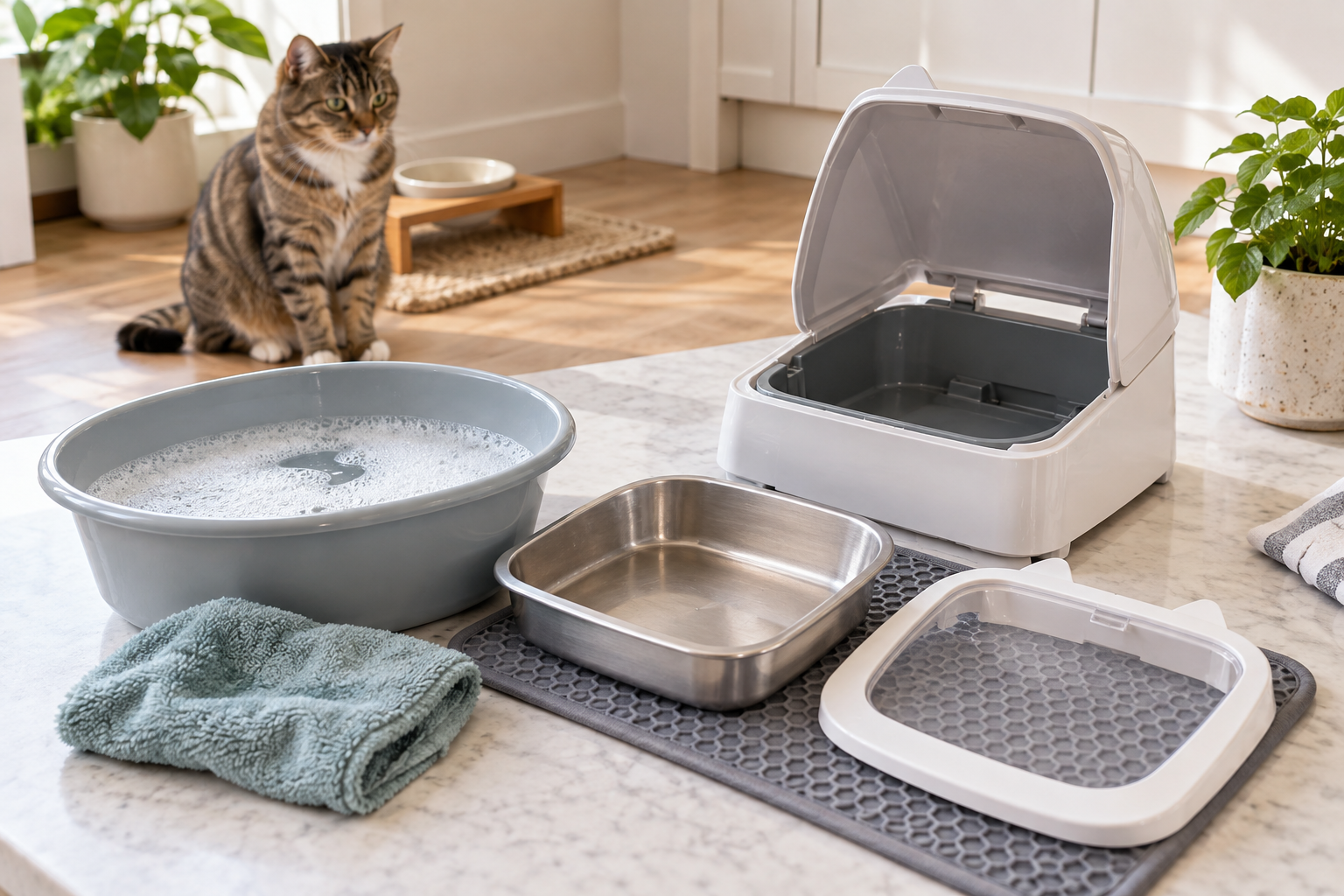
FDA pet-food handling advice says to wash pet food bowls and scooping or measuring utensils with soap and hot water after each use, and not to use the pet's bowl as the scooping utensil 3. For a broader scale-feeding routine that also covers dry food, see SnuggleSouls' guide to use a kitchen scale for cat food portions.
How do you split a can or pouch across meals?
Split a can or pouch by grams when you want equal meals, and by calories when the wet food is part of a larger daily plan. If your cat eats the same wet food at breakfast and dinner, grams are usually easiest. If treats, dry food, or toppers are involved, calories matter more.
Here are practical wet-food splits:
| Container | Goal | What to weigh |
|---|---|---|
| 85 g can | Two equal meals | 42 to 43 g per meal |
| 70 g pouch | One morning meal plus small evening topper | 50 g meal and 20 g topper |
| 156 g can | Three meals for one cat | 52 g per meal |
| 85 g can for two cats | Equal split if both have the same plan | 42 to 43 g per cat |
| 85 g can plus dry food | Wet food covers 60 kcal of the day | Calculate grams from kcal/g |
For multi-cat homes, do not assume an equal split is fair. Cats may have different weights, ages, activity levels, body condition scores, and medical needs. If one cat steals food, feed in separate rooms, use supervised meals, or consider a feeder setup that keeps each cat's portion separate.
Treats also count. If your cat gets lickable treats, pill pockets, or food toppers, subtract those calories from the same daily budget rather than adding them on top of the wet-food plan.
How should you store leftover wet food after weighing?
Cover leftover wet cat food and refrigerate it promptly. Keep the refrigerator at 40 F or below, use clean utensils, and discard food that sat out too long, looks changed, smells unusual, or has an uncertain timeline.
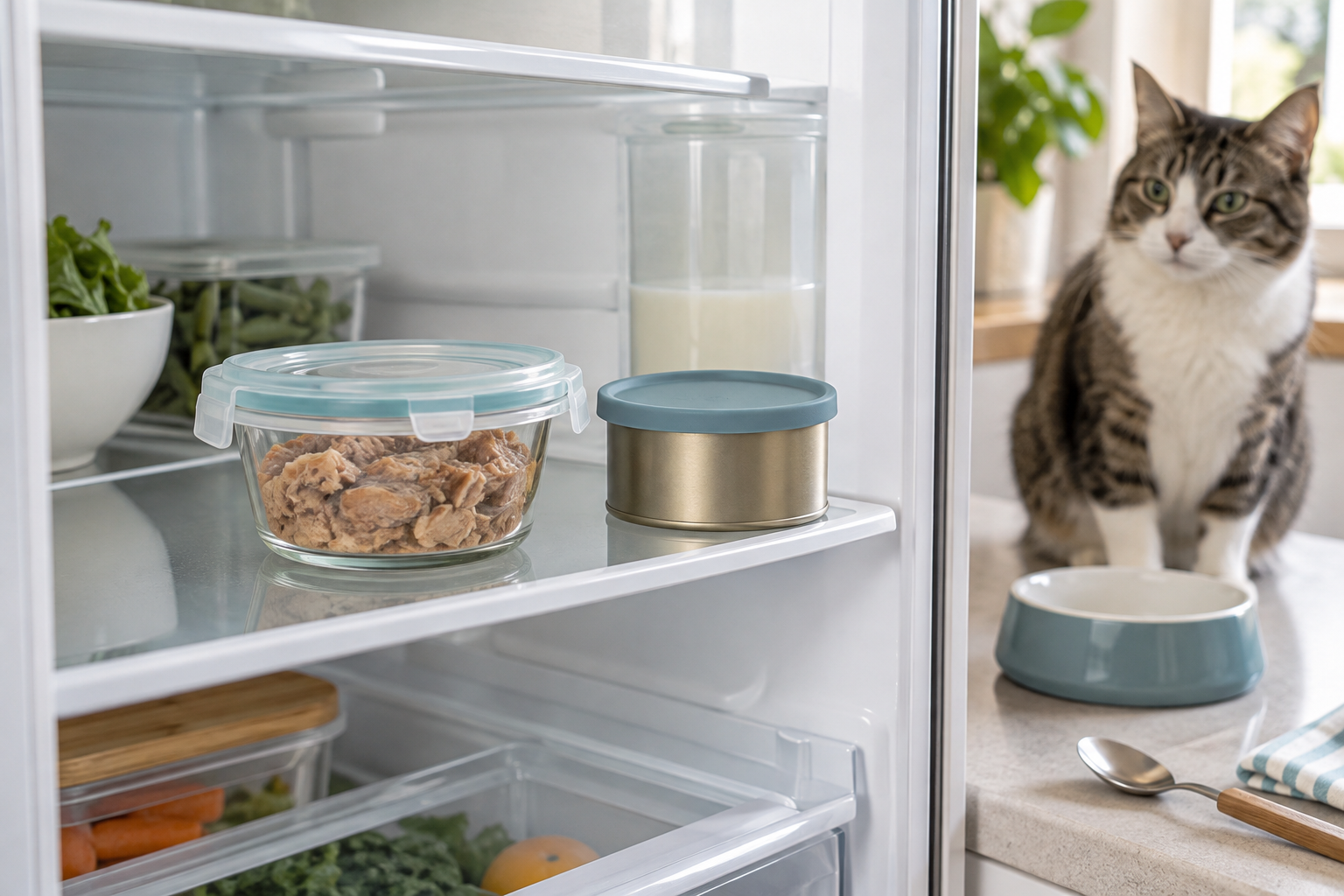
Opened wet food should be covered, refrigerated promptly, and served from clean utensils and bowls.
FDA specifically advises pet owners to promptly refrigerate or throw out unused or leftover canned and pouched pet food, tightly cover refrigerated pet food, and keep the refrigerator at 40 F or below 3. FoodSafety.gov gives the general perishable-food rule: refrigerate within 2 hours, or within 1 hour when food has been exposed to temperatures above 90 F 4.
Use this storage checklist:
| Situation | Safer action |
|---|---|
| Opened can or pouch with unused food | Cover tightly and refrigerate promptly |
| Food served in the bowl | Pick up leftovers when the meal window ends |
| Food was out during hot weather | Shorten the time window and discard sooner |
| Food smells sour, looks dry or changed, or has mold | Throw it away |
| You cannot remember when it was opened | Throw it away |
| Prescription or therapeutic wet food | Follow your veterinarian's and label instructions |
For more detail on timing, covers, fridge storage, and when to toss questionable food, use the SnuggleSouls wet cat food storage guide.
What mistakes can throw off wet food portions?
The most common mistake is weighing carefully but using the wrong target. A scale can make a portion consistent, but it cannot tell whether that portion fits your cat's age, weight, body condition, health, and total diet.
Watch for these wet-food portion mistakes:
- Counting a full can but leaving gravy stuck in the container.
- Splitting by eye instead of weighing the first few times.
- Forgetting that different flavors from the same brand may have different calories.
- Switching from a pouch to a can without recalculating.
- Adding dry food, treats, toppers, or lickable snacks without subtracting calories.
- Letting one cat finish another cat's leftovers.
- Leaving wet food out for grazing all day.
- Reducing food sharply because the cat looks overweight.
- Continuing the same portion after weight loss, illness, neutering, or a major activity change.
AAFCO notes that calorie content should be one factor among many and that a veterinarian or animal professional can help fine-tune feeding amounts for an individual animal based on age, weight, activity, and other factors 1. WSAVA's nutrition resources also emphasize individualized nutrition assessment, body condition tools, diet history, and calorie recommendations rather than one generic rule for every pet 5.
When should a veterinarian set the portion?
A veterinarian should set or approve the portion when your cat has a medical condition, needs weight loss, is underweight, is a kitten, is pregnant or nursing, eats a prescription diet, or has a sudden appetite change. In those cases, wet-food grams are part of a health plan, not just household math.
Ask for veterinary guidance if your cat:
- has diabetes, kidney disease, urinary disease, gastrointestinal disease, pancreatitis, food allergy, dental pain, or obesity
- is losing weight without a plan
- refuses food or eats much less than usual
- vomits repeatedly or has severe or persistent diarrhea
- drinks or urinates much more than usual
- strains to urinate, cries in the litter box, or produces little urine
- is a kitten, senior with muscle loss, pregnant, nursing, or medically fragile
- needs a prescription food split across meals
Do not crash-diet a cat. Sudden or severe restriction can be dangerous, and a cat who stops eating needs veterinary advice. At home, track weight and shape with tools such as the SnuggleSouls cat body condition score calculator, then confirm concerns with your veterinarian.
Conclusion: Measure Wet Food Once, Then Make It Easy
Weighing wet cat food works best when it becomes a small repeatable habit. Find the calories and grams on the label, calculate the meal amount, tare the bowl, weigh the portion, and refrigerate leftovers safely.
The real goal is not perfect kitchen math. It is a feeding routine where your cat gets the right amount more consistently, leftovers are handled safely, and appetite or weight changes are easier to notice.
Frequently Asked Questions
Should I weigh wet cat food before or after adding water?
Weigh the wet food first, then add water only if your veterinarian says it is appropriate or your cat already tolerates that routine. Added water changes texture and bowl weight, but it does not add calories.
How many grams are in a 3 oz can of cat food?
A 3 oz can is about 85 grams. If you split it into two equal meals, each meal is about 42 to 43 grams before accounting for any food left in the can.
Is half a can of wet food always half the calories?
It is close only if the food is evenly mixed and the halves truly weigh the same. Chunky foods and gravy can separate, so weighing is more accurate than eyeballing the container.
Can I pre-portion wet cat food for the next day?
Yes, if you portion it into clean covered containers and refrigerate it promptly. Follow the label directions and discard food if the timing, smell, or appearance is questionable.
Do I need to weigh every wet food meal forever?
Not always. Many cat parents weigh carefully for a week or two, learn what the usual portion looks like, then recheck periodically. Keep weighing if your cat is on a medical, weight, or multi-cat feeding plan.
What if my cat leaves part of the measured wet food?
Note how much is left and whether it happens once or repeatedly. A skipped portion may be preference or timing, but reduced appetite, vomiting, diarrhea, weight loss, hiding, drooling, or pain while eating should prompt a veterinary call.
References
[1] Association of American Feed Control Officials. (2026). Calories. Calories
[2] Cornell Feline Health Center. (2026). Feeding Your Cat. Feeding Your Cat
[3] U.S. Food and Drug Administration. (2026). Tips for Safe Handling of Pet Food and Treats. Tips for Safe Handling of Pet Food and Treats
[4] FoodSafety.gov. (2023). 4 Steps to Food Safety. 4 Steps to Food Safety
[5] World Small Animal Veterinary Association. (2026). Global Nutrition Guidelines. Global Nutrition Guidelines

 EN
EN DE
DE ES
ES PT
PT