
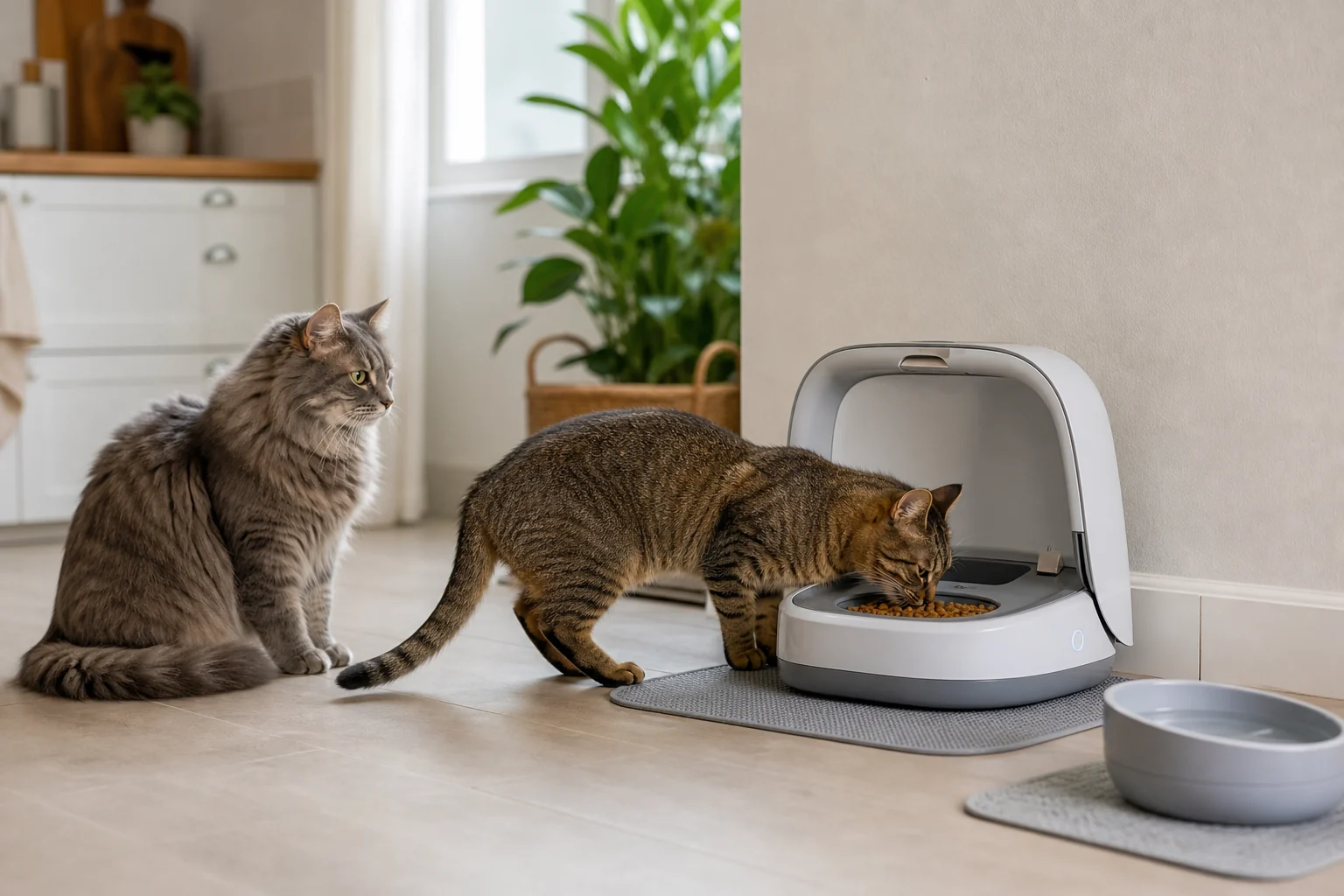
Microchip feeders for cats are most useful when one cat steals food, one cat needs a different diet, or you need better control over individual portions in a multi-cat home. They are not a cure-all, but they can turn a chaotic shared bowl into a calmer system where each cat gets access to the food intended for them.
The key is to treat the feeder as one part of a feeding plan. Your cat still needs the right daily calories, a comfortable eating location, and time to learn that the lid or door is safe. In homes with tension around food, feeder placement can matter as much as the technology.
Table of Contents
- Are microchip feeders good for cats?
- Which cats benefit most from a microchip feeder?
- How do you set portions in a microchip feeder?
- What is the best multi-cat setup for microchip feeders?
- Should you use scheduled meals or leave food inside?
- How do you train a cat to use a microchip feeder?
- What problems can happen with microchip feeders?
- How do you know whether the feeder is working?
- Conclusion
- Frequently Asked Questions
- References
Are microchip feeders good for cats?
Microchip feeders can be good for cats when they solve a specific problem: food stealing, different diets, measured portions, or a slow eater being pushed away. They work by opening only for the cat whose microchip or approved tag is registered to that feeder.
They are especially helpful when a shared bowl makes it impossible to know who ate what. Cornell Feline Health Center notes that cats vary widely in how much food they need, and healthy weight depends on matching intake to the individual cat rather than guessing from a bowl that everyone shares 1.
A microchip feeder is different from timed feeders for cats. A timed feeder controls when food appears; a microchip feeder controls who can reach it. Some households need one or the other. Some need both access control and scheduled meals.
It is also different from puzzle feeders for cats, which are mainly enrichment and slow-feeding tools. A puzzle feeder can make a meal more mentally engaging, while a microchip feeder protects a specific cat's food from another animal.
Which cats benefit most from a microchip feeder?
The best candidates are cats who need individual feeding without constant human supervision. That may mean an overweight cat who steals food, a thin or elderly cat who grazes slowly, a kitten eating a different formula, or a cat on a veterinary diet that must not be shared.
Microchip feeders are often most useful in these situations:
- One cat finishes quickly and moves to another cat's bowl.
- One cat needs a prescription or therapeutic diet under veterinary guidance.
- One cat is gaining weight while another cat is losing or maintaining.
- A shy cat eats only when the pushier cat is not nearby.
- A dog, toddler, or other pet keeps getting into the cat food.
- You need to track whether a particular cat is eating less than usual.
They are less useful if every cat eats peacefully, all cats eat the same amount, and you can already supervise meals without stress. They may also be a poor first choice for a very noise-sensitive cat unless you can introduce the lid gradually.
For health-related feeding changes, use the feeder to support your veterinarian's plan rather than replacing that plan. A cat who suddenly stops eating, vomits repeatedly, rapidly loses weight, seems painful, or cannot keep food down needs veterinary advice instead of a gadget-based fix.
How do you set portions in a microchip feeder?
Set portions by deciding the cat's total daily amount first, then dividing that amount into the meals or refills you actually place in the feeder. The feeder controls access; it does not automatically make the portion correct.
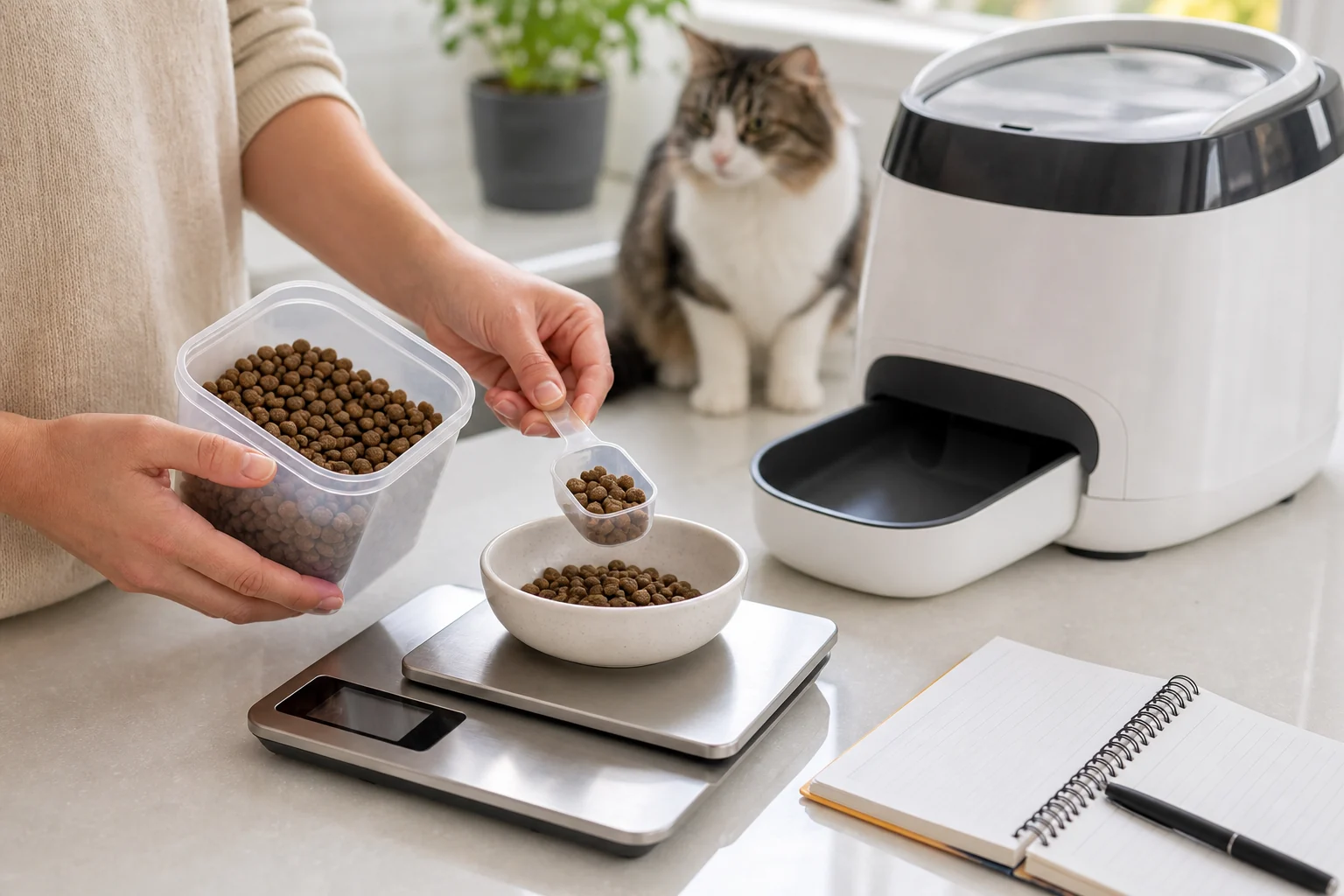
Start with the calories recommended by your veterinarian or the food label, then adjust based on body condition, weight trend, age, activity, neuter status, and whether your cat eats wet food, dry food, or both. If you need a planning estimate, the SnuggleSouls cat calorie calculator and guide to how much should I feed my cat can help you think through the numbers before you confirm them with your vet.
For a cat who gains weight easily, measure by weight with a kitchen scale when possible. Cups and scoops can vary, especially with dense kibble. If you feed mixed meals, keep the wet-food and dry-food calories in the same daily budget; our guide to adjust mixed feeding for indoor cats who gain weight walks through that logic.
Use this simple setup check:
| Step | Why it matters | Practical example |
|---|---|---|
| Assign one feeder to one cat | Prevents the old shared-bowl problem from returning | Register only the intended cat's microchip or tag |
| Measure the daily ration | Keeps access control from becoming free feeding | Pre-portion the day's dry food in a container |
| Split meals if needed | Reduces hunger spikes and begging | Morning wet meal, evening dry portion in feeder |
| Recheck weight | Confirms the plan is working | Weigh every 2-4 weeks unless your vet advises otherwise |
Avoid putting a full bag's worth of dry food into the feeder and assuming the lid will solve overeating. If the registered cat is the one who overeats, the feeder may simply protect too much food for the wrong cat.
What is the best multi-cat setup for microchip feeders?
The best setup gives each cat a private, low-pressure eating spot with enough distance that another cat cannot hover over the feeder opening. Cats may share a home peacefully and still feel stress when resources are crowded.
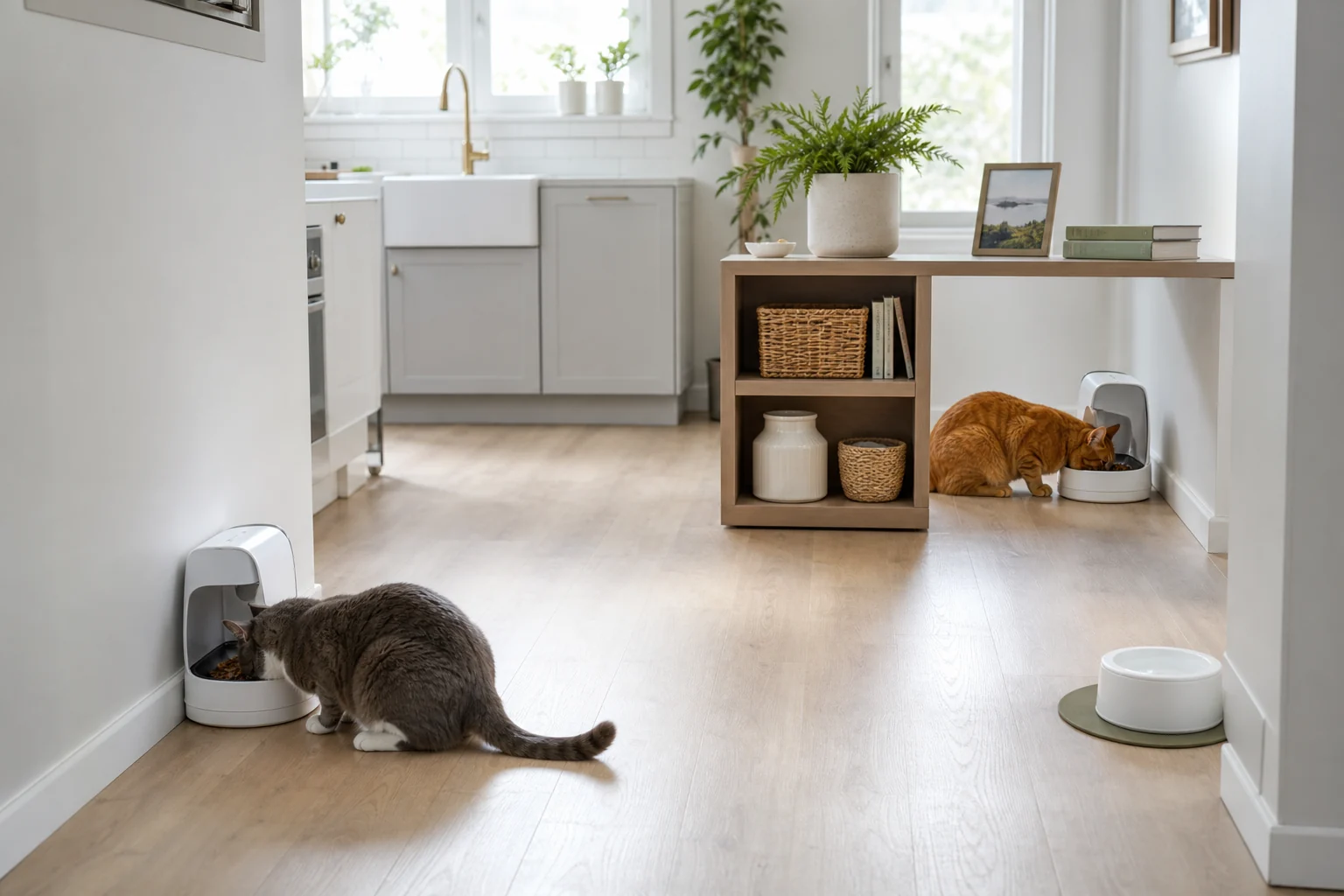
The AAFP and ISFM environmental guidelines emphasize that food, water, litter boxes, resting places, and other key resources should be available in ways that reduce competition and allow cats to avoid each other 2. International Cat Care also recommends feeding cats separately rather than making them eat side by side, especially in multi-cat homes 3.
For most homes, that means:
- Place feeders in different parts of the room, or in separate rooms if tension is high.
- Keep water bowls away from food bowls.
- Do not put the feeder next to the litter box.
- Give each cat an escape route so they do not feel trapped while eating.
- Use a wall, shelf, doorway, or furniture angle as a partial visual barrier.
- Watch for silent blocking, such as one cat sitting near the other cat's station.
If a food-stealing cat learns to push in while the authorized cat is still present, move the feeder into a narrower but comfortable station where only one cat can stand at the opening. Do not create a tight corner that traps the eating cat. The goal is privacy, not confinement.
Should you use scheduled meals or leave food inside?
Scheduled meals are usually easier to monitor, but leaving a measured portion inside can work for a grazer if the amount is controlled. Choose the method based on the cat's needs, not just the feeder's capacity.
If a cat eats too fast or begs intensely between meals, a microchip feeder may need to be paired with smaller scheduled meals. You can use the same meal rhythm from your cat feeding schedule by age and reserve the feeder for one protected meal or snack.
If a cat is a slow eater, a protected measured portion may be helpful because the cat can return without losing the meal to a faster housemate. This is common with older cats, timid cats, or cats who prefer to eat small amounts throughout the day.
For cats who need a therapeutic diet, ask your veterinarian whether the food can sit out, how long wet food can safely remain available, and whether all other pets must be blocked from it. The Animal Medical Center notes that multi-cat diet management often requires separate feeding strategies, including options such as microchip-activated feeders when cats need different foods 4.
How do you train a cat to use a microchip feeder?
Train slowly enough that the feeder predicts food, not fear. Many cats accept the feeder quickly, but some need several days or weeks before the moving lid feels normal.
Start with the feeder powered off or with the lid fixed open if the model allows it. Put a familiar bowl or a small amount of favorite food in the feeder area. Let the cat approach, sniff, and leave without being forced. When the cat eats comfortably, add the next training stage.
A gentle progression looks like this:
- Put the feeder in the final feeding location before expecting daily use.
- Let the cat eat from the open feeder without lid movement.
- Activate the training mode or slowest lid movement.
- Stay nearby but do not crowd the cat.
- Reward calm approaches with the normal meal, not extra treats that distort portions.
- Increase closure only when the cat is eating comfortably.
If another cat is watching too closely during training, train the target cat behind a closed door. A nervous cat may blame the feeder when the real problem is being stared at by a housemate.
What problems can happen with microchip feeders?
The most common problems are food theft at the open door, a nervous cat avoiding the lid, incorrect portion sizes, and a false sense that the feeder replaces supervision. Most issues can be improved with placement, training, and better portion tracking.
Watch for these signs:
| Problem | What you may see | What to try |
|---|---|---|
| Tailgating | Food thief pushes in while the right cat is eating | Move feeders apart, add a visual barrier, supervise early meals |
| Fear of the lid | Cat stretches, backs away, or refuses the meal | Return to open-lid training for several days |
| Overeating continues | Registered cat empties the feeder too quickly | Reduce to measured refills or scheduled meals |
| Guarding | One cat sits near another cat's station | Add distance, separate rooms, or different feeding times |
| Missed appetite change | Food disappears but you do not know when | Check leftovers daily and track weight |
If your cat is acting hungry after meals, first check the portion math, stealing, and feeding rhythm. Then consider whether there may be a medical or behavioral reason; our guide to cat begging for food after eating explains common causes and when to ask a veterinarian.
Some cats also need enrichment around feeding. Food puzzles can support natural foraging behavior and may help some indoor cats eat more slowly, but they should be introduced gradually and matched to the cat's ability 5. A microchip feeder can protect the ration, while a puzzle feeder can make part of that ration more engaging.
How do you know whether the feeder is working?
The feeder is working if the intended cat eats calmly, the food thief loses access, weight trends move in the right direction, and mealtime tension drops. Do not judge success only by whether the lid opens.
Track four things for the first month:
- Body weight or body condition every 2-4 weeks.
- Whether each cat finishes, leaves, or avoids meals.
- Whether one cat waits near another cat's feeder.
- Whether vomiting, begging, conflict, or night waking changes.
The SnuggleSouls cat body condition calculator can help you organize what you see, but it cannot replace a hands-on veterinary exam. If the plan involves weight loss, weight gain, kidney disease, diabetes, food allergy, gastrointestinal disease, dental pain, or any prescription diet, keep your veterinarian involved.
Stop and call your vet promptly if your cat stops eating for 24 hours, seems weak, hides more than usual, breathes abnormally, vomits repeatedly, has severe diarrhea, or shows rapid weight loss. Feeding tools are useful only when the cat is medically stable enough to eat normally.
Conclusion:
Microchip feeders for cats are most helpful when the problem is individual access: one cat steals, one cat eats slowly, or one cat needs a different diet. They work best with measured portions, separate feeding zones, gradual training, and regular weight checks.
Think of the feeder as a door, not a diet plan. It can protect the right food for the right cat, but you still decide how much food goes in, where the feeder sits, and whether each cat feels safe enough to eat.
Frequently Asked Questions
Do microchip feeders work with all cat microchips?
Many microchip feeders work with common implanted microchip formats, but compatibility varies by model and country. Check the feeder's specifications before buying, and use the included collar tag only if your cat can safely wear a breakaway collar.
Can two cats share one microchip feeder?
Some feeders allow more than one registered pet, but sharing usually defeats the purpose if the cats need different portions or diets. In a food-stealing household, one feeder per cat is usually cleaner and easier to monitor.
Are microchip feeders worth it for wet food?
They can be worth it if one cat needs protected wet food, but wet food should not sit out indefinitely. Ask your veterinarian or follow food-safety guidance from the food maker, and clean the bowl and lid area often.
What if my cat is scared of the microchip feeder?
Go back to the easiest training stage: lid open, familiar food, no pressure, and no other cats nearby. If fear continues, the feeder may need a different location or may not suit that cat's temperament.
Can a microchip feeder help an overweight cat lose weight?
It can help if the overweight cat is stealing from other bowls or if you need controlled access to a measured ration. Weight loss still requires a safe calorie plan, gradual monitoring, and veterinary guidance so the cat loses weight without nutritional risk.
References
[1] Cornell Feline Health Center. (2026). Feeding Your Cat. Cornell University College of Veterinary Medicine
[2] AAFP and ISFM. (2013). Feline Environmental Needs Guidelines. PMC
[3] International Cat Care. (2024). Making Your Home Cat Friendly. International Cat Care
[4] The Animal Medical Center. (2026). How to Feed Multiple Cats Different Diets. The Animal Medical Center
[5] Journal of Feline Medicine and Surgery. (2016). Food Puzzles for Cats: Feeding for Physical and Emotional Wellbeing. SAGE Journals
 Why Does My Cat Jerk Awake Suddenly? Startle Reflexes, Sleep Starts, and Vet Clues">
 Cat Scratching Door Frame: How to Protect Trim">
 EN
EN DE
DE ES
ES PT
PT