
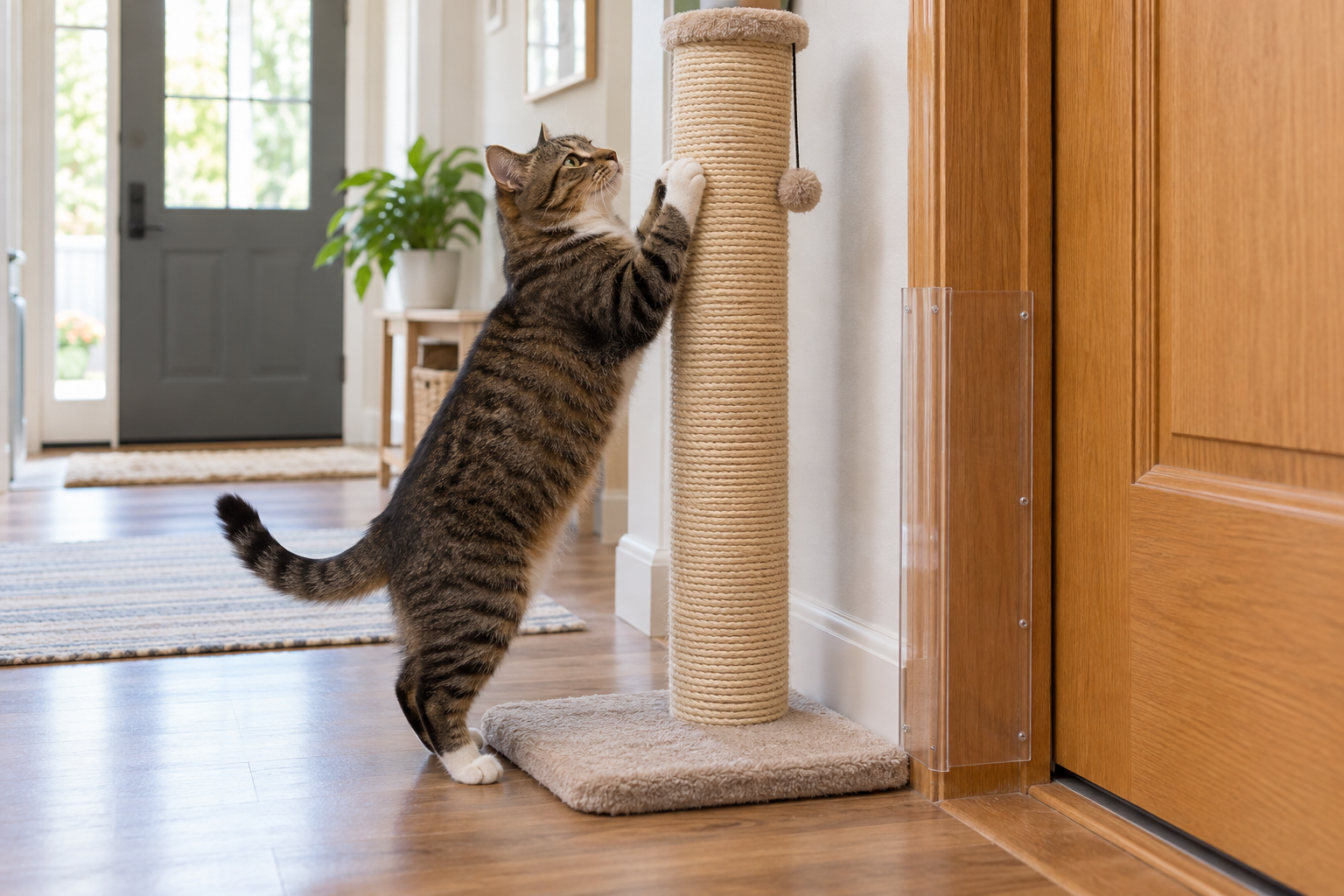
To protect a door frame from cat scratching, cover the damaged trim with a safe removable barrier and place a sturdy scratching surface beside that doorway.
The goal is not to stop a normal cat behavior. It is to protect the frame while giving your cat a legal place to stretch, mark, and move through the route comfortably.
Door frames are tempting because they are tall, firm, visible, and placed exactly where cats pass many times a day. A cat may scratch the bedroom jamb after waking, hook claws into painted trim while turning a corner, or mark the hallway frame when another cat uses the same doorway. Scratching helps cats maintain claws, stretch, and leave both scent and visual marks 1.
This guide focuses on door frames and interior trim: safe covers, scratcher placement, route checks, training steps, and when a sudden change may point to stress, conflict, or discomfort.
Table of Contents
- Why do cats scratch door frames and trim?
- How can you tell whether the trim or the route is the real target?
- What door-frame protection is safe for cats and homes?
- Where should you place scratchers around door frames?
- How do you train your cat away from the door frame?
- What should you avoid on door frames and hallways?
- When is door-frame scratching a stress or health clue?
- Conclusion:
- Frequently Asked Questions
- References
Why do cats scratch door frames and trim?
Cats scratch door frames because they combine three things cats value: a vertical stretch, a firm object, and a meaningful location. Doorways connect rooms, sleeping spots, litter box routes, food areas, and human traffic. That makes them useful places for a cat to leave a visible mark and paw scent.
The ASPCA explains that cats need appealing scratching surfaces, and many prefer tall, sturdy posts that do not shift when used 2. A door frame already meets the sturdy part. If the nearest legal scratcher is short, wobbly, hidden, or across the room, the trim may feel like the better option.
Door-frame scratching can also overlap with stair, carpet, or wall scratching. If the damage is on a stair rail or newel post, SnuggleSouls' guide to protect stair banisters from cat scratching is a closer match. If the scratches run along carpet edges near the doorway, review how to stop cats scratching carpet so you can separate texture preference from doorway marking.
| Scratched area | What it may mean | Best first fix |
|---|---|---|
| Bedroom door jamb | Stretching after sleep or marking a favorite route | Add a tall post beside the jamb |
| Hallway corner trim | Turning-point marking where cats pass often | Protect the trim and add a vertical board nearby |
| Door casing near food or litter routes | Route importance or resource pressure | Keep the route open and add legal scratchers at both ends |
| Lower baseboard beside a door | Low horizontal or edge scratching preference | Add an angled or horizontal scratcher off the walking path |
| Sudden deep damage | Stress, conflict, boredom, pain, or claw trouble may be involved | Check household changes and health signs |
How can you tell whether the trim or the route is the real target?
Start by mapping the marks before buying covers. The exact location usually tells you whether your cat wants the door frame itself, the carpet edge, the route, or a social marking point.
Use this quick check:
- Are the deepest marks on vertical wood, painted casing, baseboard, carpet, or drywall?
- Does scratching happen after sleep, meals, door activity, play, or another cat passing through?
- Is the current scratching post tall enough for a full stretch?
- Can the post stay still when your cat pulls down hard?
- Does one cat block another in the doorway or hallway?
- Are gates, furniture, shoes, storage bins, or rugs narrowing the route?
International Cat Care notes that scratching posts should be placed where cats already scratch or spend time, not tucked away where humans prefer them 3. That matters around doorways because the location is often the whole point. A scratcher in the laundry room may not compete with a bedroom frame your cat marks every morning.
If the door frame is beside a tense route, fixing the trim alone may fail. The cat may need more than one path, a second scratcher, or separated resources in a multi-cat home. In that case, look for blocking, chasing, staring, or one cat waiting in the doorway before the scratching happens.
What door-frame protection is safe for cats and homes?
Safe door-frame protection is smooth, secure, removable when needed, and limited to the scratched area. It should protect the trim without trapping paws, damaging the finish, creating sharp edges, or making the doorway harder to use.
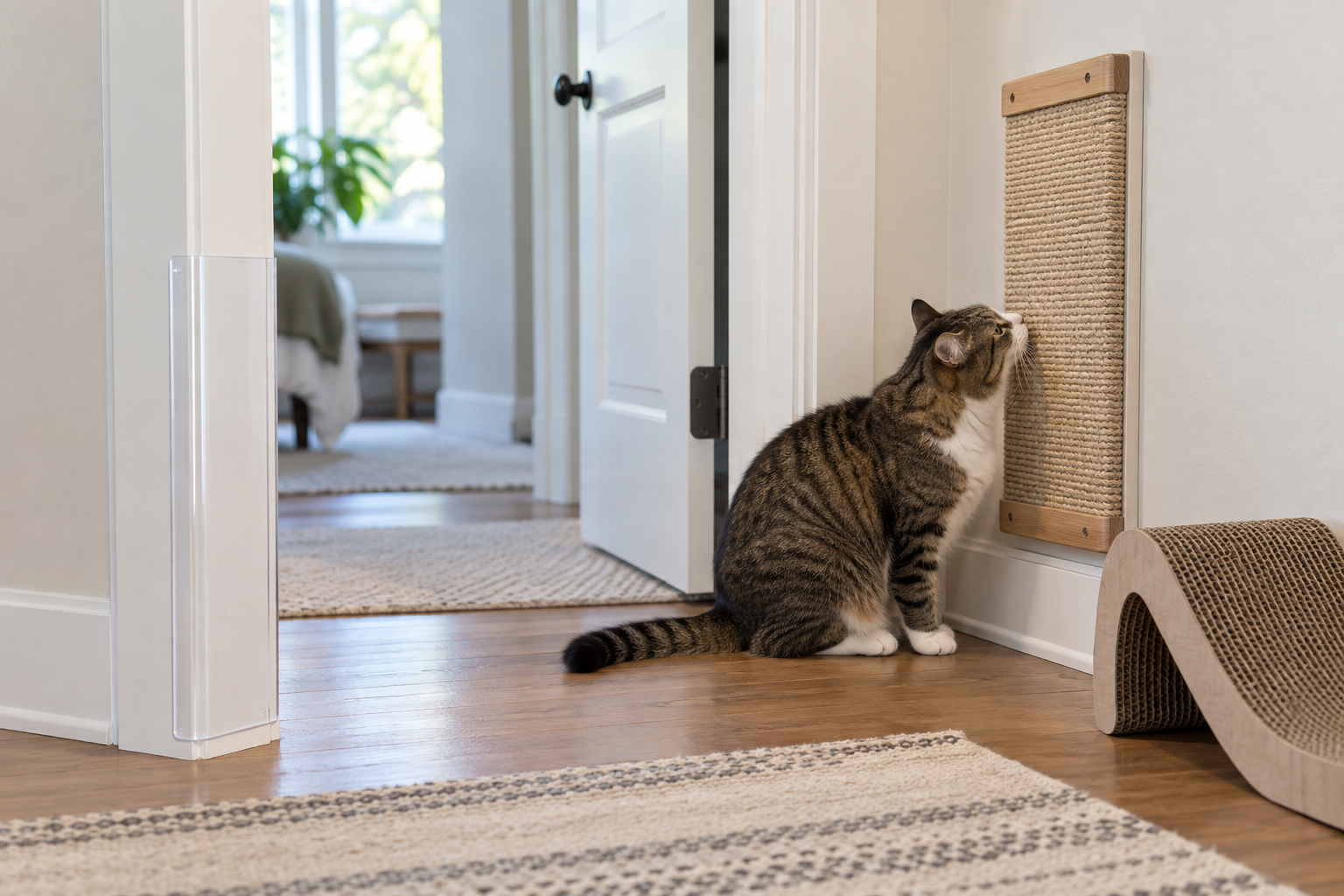
A safe trim setup protects the old target while offering a sturdy nearby surface that matches the same vertical scratching preference.
Useful options often include:
- Clear removable trim guards on the lower door jamb or casing.
- Smooth temporary panels attached according to the product directions.
- A wall-mounted sisal board beside the frame, if it can be secured well.
- A tall freestanding post placed next to the marked trim.
- A cardboard or angled scratcher near the doorway if your cat also scratches low surfaces.
Think of this as part of cat-proofing your home, not just covering damage. Doorways are shared movement zones. A product that saves paint but catches paws, curls into the hall, or blocks a person carrying laundry is not a good fix.
| Protection choice | Useful when | Watch-outs |
|---|---|---|
| Clear trim guard | The cat scratches one lower jamb or casing | Check finish compatibility and smooth edges |
| Smooth temporary panel | Painted trim needs a boring protected surface | Avoid loose corners that invite chewing or pawing |
| Wall-mounted scratch board | The cat wants a vertical grip near the doorway | Install securely and outside the door swing |
| Tall freestanding post | The cat wants a full-body stretch | Use a heavy base and keep the doorway open |
| Angled cardboard scratcher | The cat scratches low trim or carpet edge | Keep it off the walking path |
Avoid using strong scents, harsh sprays, or sticky barriers where your cat must pass. A deterrent can make the old spot less rewarding, but your cat still needs an obvious legal target nearby.
Where should you place scratchers around door frames?
Place the first replacement scratcher beside the marked door frame, not across the room. It should be close enough to compete with the old target and far enough from the door swing, hallway route, and foot traffic to stay safe.
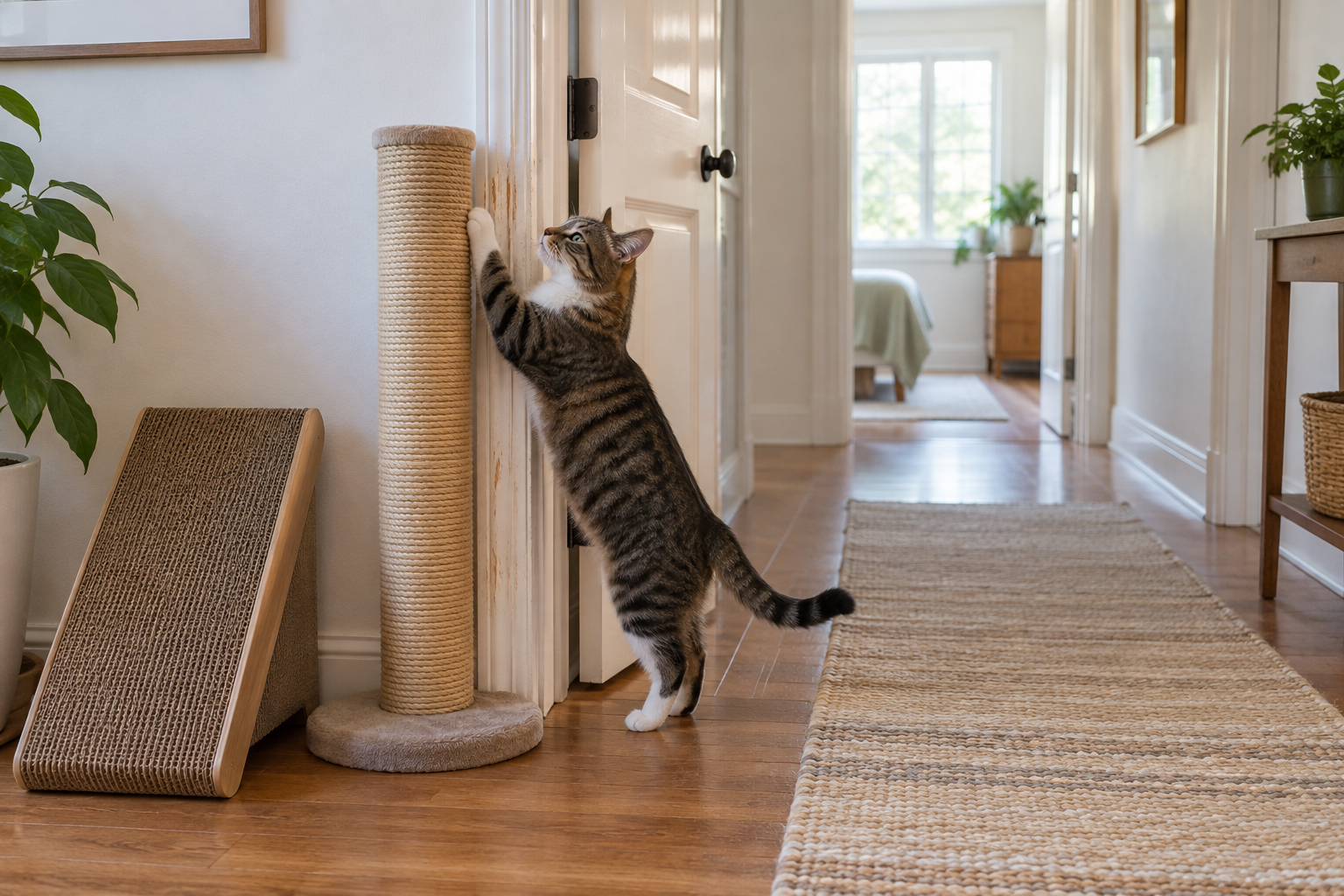
Keep the replacement scratcher close to the marked frame, but leave the doorway and hallway route open for people and cats.
For most homes, start with one of these placements:
- A tall sisal post on the hinge-side wall if it does not block the door.
- A wall-mounted scratch board beside the casing, outside the door swing.
- An angled scratcher on the hallway side if the marks are low.
- A horizontal scratcher just beyond the doorway if your cat scratches carpet edges.
- A second scratcher on the other side of the door if two cats share the route.
FelineVMA includes scratching areas among environmental resources that help cats feel secure in their territory 4. In practical terms, that means one hidden post rarely solves a doorway problem. Cats often scratch where the household action is.
If you need help choosing height, weight, and texture, use SnuggleSouls' guide to the best scratching posts for cats. Around doors, stability is the first test. If the post tips, slides, or rattles when your cat pulls on it, the frame still wins.
How do you train your cat away from the door frame?
Training should make the legal surface easy and rewarding while the protected frame becomes boring. Do not punish your cat for scratching the frame. Punishment can increase stress and may only teach your cat to scratch when you are not watching.
Use this two to four week plan:
- Put the legal scratcher beside the marked frame before covering the old damage.
- Add the trim guard or smooth cover to make the frame less satisfying.
- Use a wand toy so your cat lands paws near the new scratcher.
- Reward sniffing, stretching, or scratching with praise, play, or a small treat.
- Keep the setup consistent until your cat uses the scratcher daily.
- Move the scratcher only a few inches at a time if you need a tidier final spot.
Cat Friendly Homes recommends looking at the cat's body position and preferred texture when choosing a new scratching post, then placing it next to the furniture or area being scratched 5. That same idea works for trim. Match vertical scratching with a vertical surface. Match low edge scratching with an angled or horizontal option.
Nail care can reduce damage while the habit changes, but it does not replace scratching. If claws snag in paint grooves, carpet loops, or old wood splinters, learn how to trim your cat's nails safely or ask your veterinary team or groomer for help. Keep sessions short and stop before your cat struggles.
If scratching spikes after evening running or hallway games, end a daily play routine beside the legal scratcher. Many cats scratch after excitement, waking, or stretching, so timing the reward matters.
What should you avoid on door frames and hallways?
Avoid any fix that turns the doorway into an obstacle. A doorway is not just furniture. People carry things through it, doors swing through it, and cats use it as part of their daily route.
Skip these common mistakes:
- Sticky tape or mats where paws or feet can stick.
- Loose plastic that curls into the hallway.
- Scratchers placed where the door hits them.
- Hanging toys from door knobs or trim where they can tangle.
- Strong essential oils or citrus oils on surfaces your cat must pass.
- Wobbly posts that can fall into the doorway.
- Blocking one route in a multi-cat home without opening another.
Doorway fixes should reduce conflict, not create it. If one cat already guards a hall, blocking the frame with a large object may give that cat more control over the route. In multi-cat homes, keep doorways open, add multiple legal scratchers, and make sure each cat can reach food, water, litter boxes, and resting places without being trapped.
When is door-frame scratching a stress or health clue?
Most door-frame scratching is normal behavior in the wrong place. Still, a sudden change deserves attention, especially when it appears with other behavior or health signs.
Look deeper if you notice:
- A cat who never used the doorway starts scratching it intensely.
- Scratching increases after moving, renovations, visitors, or a new pet.
- One cat waits in the doorway and blocks another cat's route.
- Your cat scratches while hiding more, eating less, or avoiding normal rooms.
- Your cat hesitates to jump, limps, or seems painful when stretching.
- Claws are broken, overgrown, bleeding, or curling toward the paw pad.
- Scratching appears with litter box changes, aggression, or unusual vocal distress.
Contact your veterinarian if scratching comes with pain signs, damaged claws, appetite change, mobility change, or a rapid behavior shift. For urgent symptoms such as breathing trouble, collapse, seizures, suspected poisoning, blocked urination, severe trauma, repeated vomiting, or rapid decline, seek emergency veterinary care.
A trim guard can protect wood, but it cannot solve pain, illness, serious fear, or resource conflict by itself. If the behavior keeps escalating despite good covers and better scratchers, ask your veterinarian or a qualified feline behavior professional for help.
Conclusion:
The best way to protect door frames from cat scratching is to redirect the behavior at the exact route where it happens. Cover the damaged trim safely, place a stable legal scratcher beside the doorway, reward the new choice, and keep the route easy for people and cats to use.
Once your cat is choosing the new surface reliably, leave the setup in place long enough for the habit to feel normal. Scratching, nail care, play, safe routes, and household stress all connect, and SnuggleSouls' Daily Care guides can help you keep improving the home without turning doorways into barriers.
Frequently Asked Questions
Can I put double-sided tape on a door frame to stop scratching?
You can use a pet-safe sticky deterrent on some vertical trim surfaces, but test a hidden area first and avoid anything that could trap paws, pull paint, or collect dirt. Do not use sticky products on floors or thresholds where people or cats walk.
Why does my cat scratch the door frame instead of the scratching post?
The door frame may be taller, sturdier, closer to a favorite route, or more socially important than the post. Move a taller, heavier scratcher beside the frame and reward your cat for using it before trying to move it elsewhere.
Should I block the doorway until my cat stops scratching?
Temporary access control can help during repair, but permanent blocking may increase stress or route conflict. A better long-term plan is to protect the trim, add a legal scratcher at the same route, and keep the doorway open.
Are nail caps a good way to protect door frames?
Nail caps can reduce surface damage for some cats, but they need correct sizing, regular replacement, and a cat who tolerates paw handling. They do not remove the need for satisfying scratching surfaces.
What kind of scratcher works best beside a door frame?
Most door-frame scratchers should be tall, stable, and textured enough for a full stretch. Sisal posts, wall-mounted sisal boards, and angled scratchers can all work if they match how and where your cat scratches.
When should I call a vet about door-frame scratching?
Call your vet if the scratching is sudden, intense, paired with limping or stair hesitation, or connected to damaged claws, appetite change, hiding, litter box issues, or rapid behavior change. The scratching may be a visible clue that your cat is uncomfortable or stressed.
References
[1] University of California, Davis School of Veterinary Medicine. (2019). Inappropriate Scratching in Cats. URL
[2] ASPCA. (n.d.). Destructive Scratching. URL
[3] International Cat Care. (2025). Scratching on furniture and carpets. URL
[4] FelineVMA. (2026). Setting Up the Environment for Success. URL
[5] Cat Friendly Homes. (2022). All You Need to Know About Scratching Posts. URL





 EN
EN DE
DE ES
ES PT
PT