
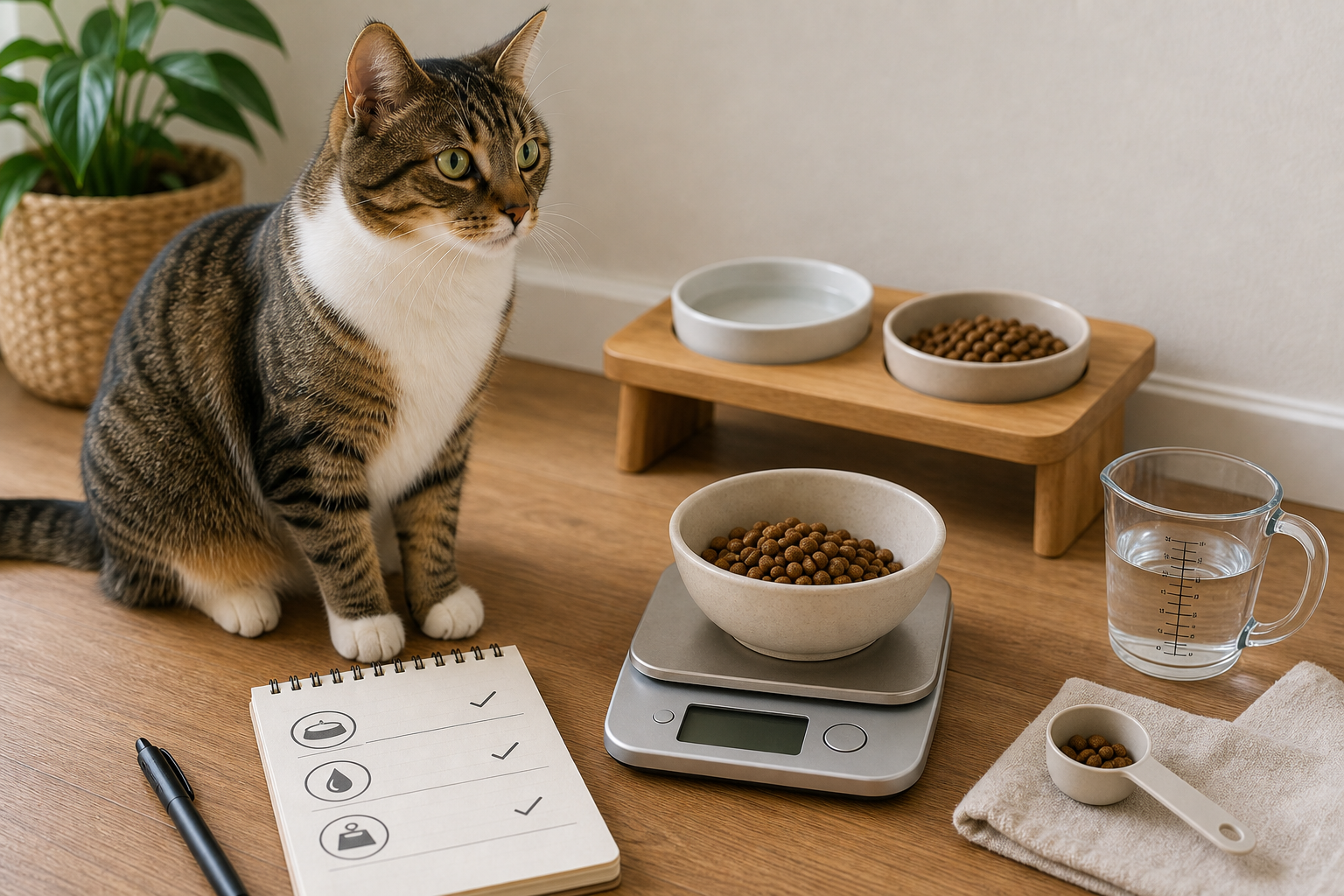
Most adult cats need a measured daily food amount based on calories, body condition, age, activity, and whether they eat dry kibble, wet food, or both. The feeding chart on the bag or can is only a starting point; your cat's body condition tells you whether that amount is actually working.
If you are asking "how much should I feed my cat?" or "how much dry food to feed a cat?", the safest answer is: calculate a starting daily calorie target, measure the food in grams or cups, watch your cat's weight and shape for a few weeks, then adjust gradually. Cats vary a lot, and guessing by bowl size is one of the easiest ways to accidentally overfeed.
Table of Contents
- How much should I feed my cat each day?
- What information do you need before choosing a portion?
- How do age, weight, and body condition change feeding amounts?
- How do wet food, dry food, and mixed feeding change portions?
- How many meals should cats eat per day?
- How much should kittens eat?
- How do you adjust portions without overfeeding or underfeeding?
- When should a veterinarian help with feeding amounts?
- Conclusion: Measure, track, and adjust gently
- Frequently Asked Questions
- References
How much should I feed my cat each day?
Start with a daily calorie estimate, then convert that number into the exact amount of your cat's food. A healthy adult indoor cat often needs fewer calories than the feeding chart suggests, while a growing kitten, active young cat, pregnant cat, or underweight cat may need more.
Use the SnuggleSouls cat calorie calculator as a practical starting point. Then check the calorie information on your cat's food label. Many labels list calories as kcal per cup, kcal per can, kcal per pouch, or kcal per kilogram.
Here is the basic method:
- Estimate your cat's daily calories.
- Find the calories per cup, can, pouch, or gram on the food label.
- Divide daily calories by food calories to get the daily portion.
- Split that portion into meals.
- Recheck body condition and weight every 2-4 weeks.
For example, if a cat's starting target is 220 kcal per day and the dry food contains 440 kcal per cup, that cat would receive about 1/2 cup per day, split into meals. If the cat also eats wet food, the wet food calories must be subtracted from the dry food portion.
What information do you need before choosing a portion?
You need more than body weight. Weight matters, but two cats at the same weight may need different portions if one is lean and active while the other is carrying extra body fat.
Before you choose a feeding amount, gather:
| Detail | Why it matters |
|---|---|
| Current weight | Helps estimate starting calories. |
| Body condition | Shows whether the cat is underweight, ideal, or overweight. |
| Age and life stage | Kittens, adults, and seniors often need different plans. |
| Spay/neuter status | Neutered cats may need fewer calories than intact cats. |
| Activity level | Active cats usually need more energy than sedentary cats. |
| Food calories | Converts calorie targets into real portions. |
| Health history | Medical conditions can change diet and feeding goals. |
The SnuggleSouls cat feeding guide can help you organize these basics before you change portions. Cornell Feline Health Center also emphasizes that feeding decisions should consider life stage, health, and maintaining a healthy body condition 1.
How do age, weight, and body condition change feeding amounts?
Age tells you the life stage, weight gives you a starting number, and body condition tells you whether the current plan is too much, too little, or about right. Body condition is especially important because the scale alone can be misleading.
An ideal adult cat usually has a visible waist from above, a slight abdominal tuck from the side, and ribs that are easy to feel under a thin layer of fat. If the ribs are hard to feel, the waist is gone, or the belly pad is increasing, the current portion may be too high. If ribs, spine, or hips are sharp or your cat is losing weight unexpectedly, the current portion may be too low or there may be a health problem.
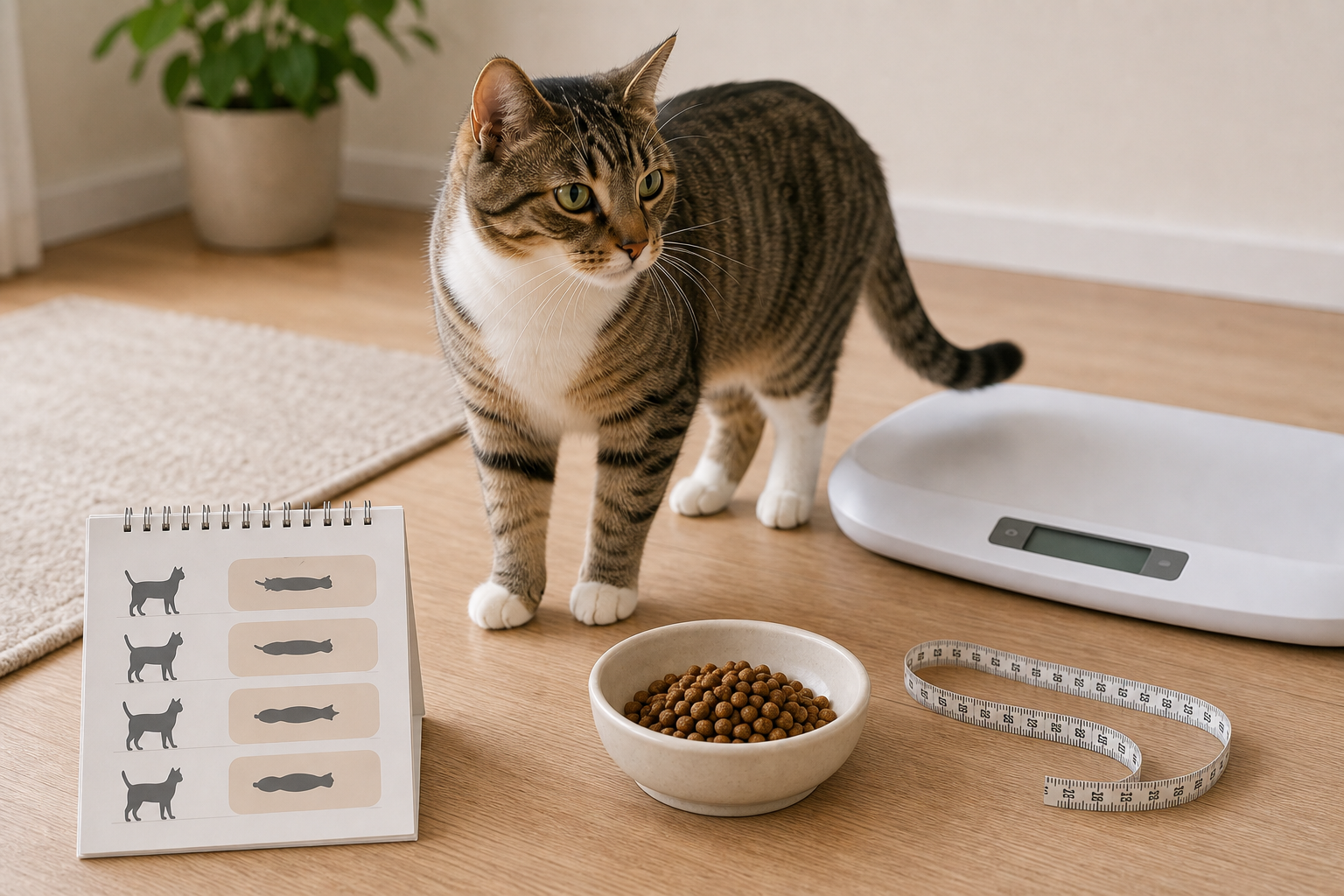
Use the SnuggleSouls cat body condition and weight calculator alongside regular weigh-ins. WSAVA's nutrition guidance treats body condition scoring and nutrition assessment as routine parts of good veterinary care 2.
| Cat profile | Feeding implication |
|---|---|
| Growing kitten | Needs growth-appropriate food and more frequent meals. |
| Lean active adult | May need a higher calorie target than a sedentary cat. |
| Indoor sedentary adult | Often needs careful measuring and fewer free-fed calories. |
| Overweight cat | Needs a gradual, veterinarian-safe reduction plan. |
| Senior cat | Needs monitoring for weight loss, appetite change, dental issues, and disease. |
Do not put a cat on a sudden crash diet. Rapid weight loss or not eating can be dangerous for cats, so weight-loss plans should be gradual and veterinary-guided when the cat is significantly overweight or has medical concerns.
How do wet food, dry food, and mixed feeding change portions?
The format changes the portion size because wet food contains more water and dry food is calorie-dense. A large-looking wet meal may contain fewer calories than a small bowl of kibble, so compare calories instead of volume.
If your cat eats only wet food, add the calories from all cans or pouches fed during the day. If your cat eats only dry food, use a measuring cup or kitchen scale (see our kitchen scale portion guide) and avoid topping off the bowl casually. If your cat eats both, calculate the wet food first and then use dry food to fill the remaining calorie allowance with our wet and dry cat food calculator.
Sample daily cat food chart by weight (dry kibble vs. wet cans)
The chart below shows starting daily estimates for a neutered, indoor adult cat at ideal body condition, assuming typical dry kibble at 400 kcal per cup (about 110 g per cup) and typical wet food at 90 kcal per 3-oz (85 g) can. Always check your exact label.
| Adult Cat Weight | Estimated Daily Calories | Dry Kibble Only (400 kcal/cup) | Wet Food Only (90 kcal / 3-oz can) | Mixed Split (1 Wet Can + Dry) |
|---|---|---|---|---|
| 6 lb (2.7 kg) | ~150\u2013170 kcal | 3/8 to 7/16 cup (41\u201347 g) | 1.7 to 1.9 cans (5.1\u20135.7 oz) | 1 can + 1/6 to 1/5 cup dry |
| 8 lb (3.6 kg) | ~180\u2013210 kcal | 7/16 to 1/2 cup (50\u201358 g) | 2.0 to 2.3 cans (6.0\u20136.9 oz) | 1 can + 1/4 to 5/16 cup dry |
| 10 lb (4.5 kg) | ~210\u2013250 kcal | 1/2 to 5/8 cup (58\u201369 g) | 2.3 to 2.8 cans (6.9\u20138.4 oz) | 1 can + 5/16 to 3/8 cup dry |
| 12 lb (5.4 kg) | ~240\u2013280 kcal | 5/8 to 11/16 cup (66\u201377 g) | 2.7 to 3.1 cans (8.1\u20139.3 oz) | 1 can + 3/8 to 1/2 cup dry |
| 14 lb (6.4 kg) | ~270\u2013310 kcal | 2/3 to 3/4 cup (74\u201385 g) | 3.0 to 3.4 cans (9.0\u201310.2 oz) | 1 can + 7/16 to 9/16 cup dry |
If you are comparing formats, read wet vs dry cat food. For wet-food-specific container math, use SnuggleSouls' guide on how much wet food to feed a cat.
How many meals should cats eat per day?
Many adult cats do well with two or more measured meals per day, while kittens usually need more frequent meals. Meal feeding makes it easier to know who ate, how much they ate, and whether appetite changed.
Free-feeding dry food can work for some cats, but it often makes weight control harder, especially in multi-cat homes. If one cat grazes and another steals food, consider timed meals, separate rooms, microchip feeders, or puzzle feeders with measured portions. For age-based meal timing, see our cat feeding schedule by age.
For wet food, smaller fresh meals are often more practical than leaving a large portion out. SnuggleSouls' guide on how often to feed cat wet food can help you build a daily schedule.
How much should kittens eat?
Kittens need growth-formulated food and more frequent feeding than adult cats. They are building bone, muscle, organs, and immune function, so adult maintenance portions are not appropriate for young kittens.
The exact amount depends on age, weight, growth rate, and the calorie density of the kitten food. Follow the kitten-food label as a starting point, then adjust with your veterinarian during vaccine and wellness visits. FDA explains that complete and balanced foods are formulated for specific nutritional needs when fed according to directions, so the life-stage statement matters 5.
As kittens approach adulthood around 10 to 12 months, their calorie needs usually change. If you are unsure when to move from kitten food to adult food, read when to switch from kitten to cat food.
How do you adjust portions without overfeeding or underfeeding?
Adjust slowly, measure accurately, and track results. A small change repeated every day is powerful, so do not make large cuts unless your veterinarian gives a specific plan.
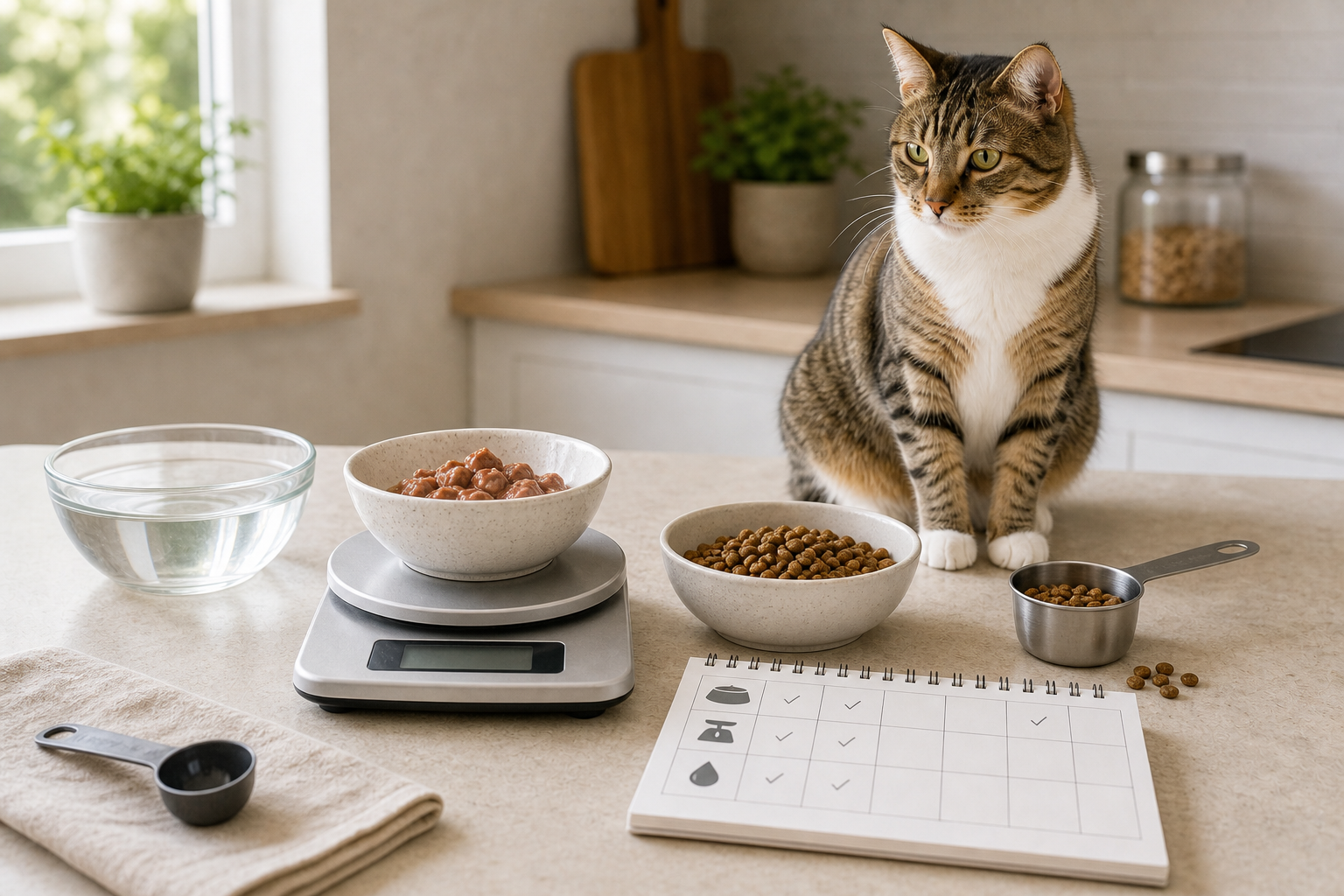
Use this simple adjustment plan:
| Situation | Safer next step |
|---|---|
| Cat is gaining weight | Reduce total daily calories slightly and recheck in 2-4 weeks. |
| Cat is losing weight unexpectedly | Call your veterinarian, especially if appetite changed. |
| Cat begs constantly | Check calories, meal timing, enrichment, and whether the food is satisfying. |
| Cat leaves food | Confirm freshness, dental comfort, stress level, and illness signs. |
| Multi-cat home | Feed separately so each cat's intake is visible. |
Treats count. If treats, toppers, dental chews, or human foods are added, they should make up only a small part of the total diet and should be included in the daily calorie count. AAFCO's label guidance can help you read feeding directions and calorie information more carefully 4.
Weigh portions instead of estimating
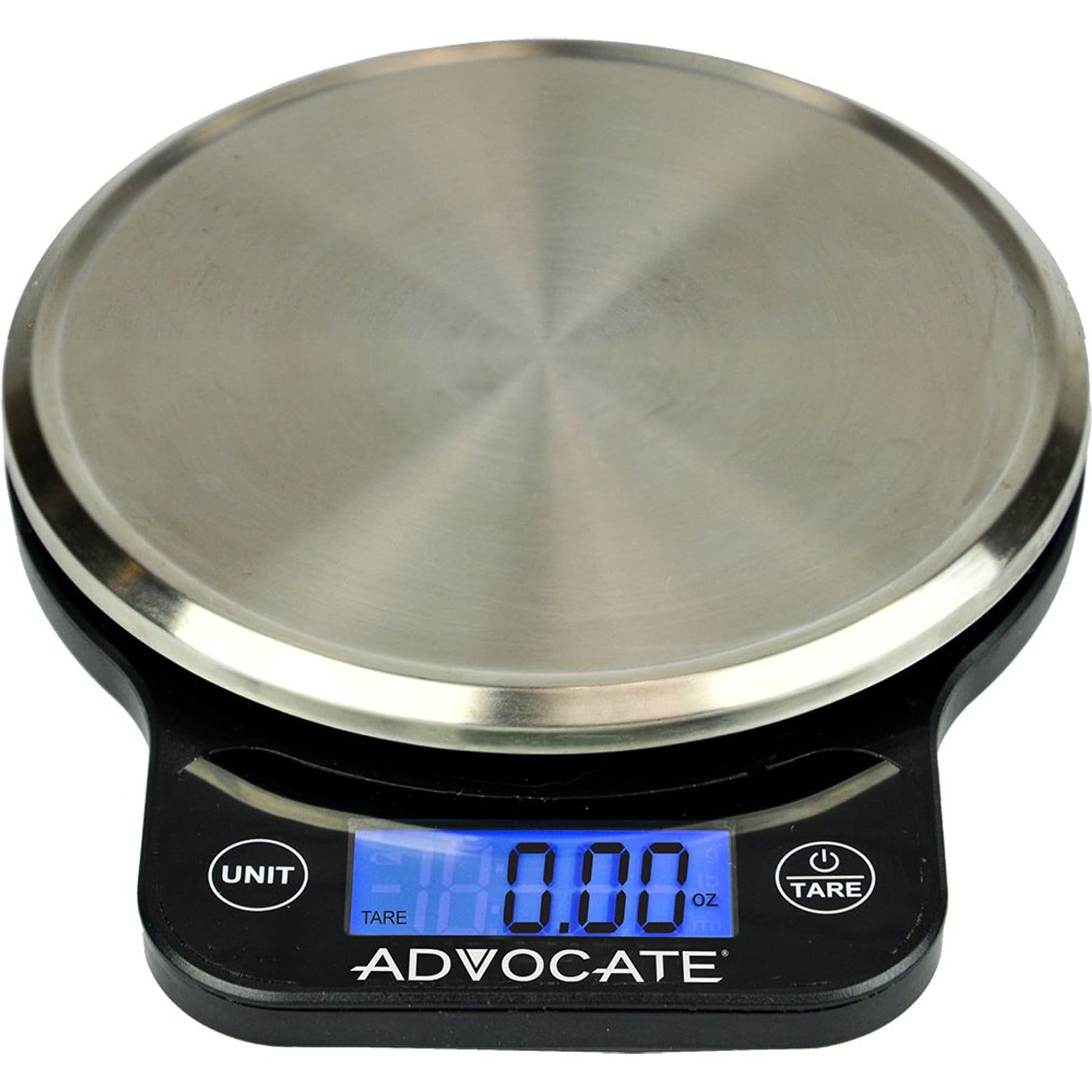
Measure food in grams instead of estimating partial cups, then compare calories with the label. Use the scale to make a consistent plan, not to replace an individualized veterinary calorie target.
Advocate
Advocate Universal Digital Household Scale
Advocate Universal Digital Household Scale; For precise everyday measurements, try the Advocate Universal Digital Household Scale. This portable scale is great for measuring your…
$32.95
Shop ChewyWe may earn a commission if you buy through this Chewy link, at no extra cost to you. Product details and prices can change.
When should a veterinarian help with feeding amounts?
Ask a veterinarian for help if your cat is underweight, obese, pregnant, nursing, diabetic, diagnosed with kidney disease, dealing with urinary problems, vomiting often, having chronic diarrhea, losing weight, or refusing food. Nutrition can be part of care, but it should not replace diagnosis or treatment.
Also seek urgent veterinary advice if your cat does not eat for 24-48 hours, seems weak, cannot urinate, vomits repeatedly, has severe diarrhea, collapses, has breathing trouble, or declines rapidly. Cats can become seriously ill when they stop eating, especially if they are overweight.
Merck Veterinary Manual notes that nutrition-related problems can be connected with both deficiency and excess, and that appropriate feeding depends on the animal's needs and health status 3. When the situation is medical, the best feeding amount is the one your veterinarian tailors to your cat.
Conclusion: Measure, track, and adjust gently
The right amount to feed your cat is not just a number from a bag. It is a measured routine built from calories, food format, life stage, body condition, activity, and real-world results.
Start with a calorie estimate, measure every meal, track weight and body condition, and adjust slowly. If your cat is gaining, losing, refusing food, or living with a medical condition, bring your veterinarian into the decision instead of guessing.
Frequently Asked Questions
How much food should an indoor cat eat per day?
An indoor cat should eat the amount that maintains a healthy body condition, which depends on weight, age, activity, and food calories. Most healthy 8-to-12-pound indoor adults need roughly 180 to 280 kcal per day, converted into cups, cans, pouches, or grams from the product label.
How much food should a 10-pound cat eat?
A typical neutered 10-pound indoor cat needs roughly 210 to 250 kcal per day, which equals about 1/2 to 5/8 cup of 400-kcal/cup dry kibble or about 2.3 to 2.8 three-ounce cans of 90-kcal wet food. Adjust based on your cat's body condition and the exact calories on your food label.
Is one cup of cat food a day too much?
It depends on the food's calories and the cat's needs. One cup of some dry foods contains 400 to 500 kcal\u2014far more than a sedentary indoor cat needs\u2014so check kcal per cup and measure carefully.
Should I feed my cat by weight or by calories?
Use weight to estimate calories, then feed by calories and adjust based on body condition. Weight alone does not show whether a cat is lean, muscular, overweight, or losing condition.
How do I know if I am overfeeding my cat?
Common signs include weight gain, a disappearing waist, ribs that are hard to feel, and leftover food being topped off anyway. A body condition check is more useful than bowl appearance.
Are cat appetite suppressants safe for begging or weight loss?
No\u2014there is no safe over-the-counter appetite suppressant for cats, and human weight-loss drugs are toxic to pets. Instead of appetite suppressants, manage begging with measured calories, smaller scheduled meals, puzzle feeders, and a veterinarian-supervised weight plan.
Why is my cat hungry after the right amount of food?
Some cats beg because of habit, boredom, meal timing, low-satiety food, or food competition. Hunger with weight loss, vomiting, diarrhea, or behavior change should be checked by a veterinarian; see why your cat is always hungry for next steps.
References
[1] Cornell Feline Health Center. (2026). Feeding Your Cat. Cornell Feline Health Center
[2] World Small Animal Veterinary Association. (2024). Global Nutrition Guidelines. WSAVA
[3] Merck Veterinary Manual. (2025). Nutritional Requirements and Related Diseases of Small Animals. Merck Veterinary Manual
[4] Association of American Feed Control Officials. (2026). Reading Labels. AAFCO
[5] U.S. Food and Drug Administration. (2024). "Complete and Balanced" Pet Food. FDA